Bidspirit auction | MONET CLAUDE: (1840-1926) Monet donates
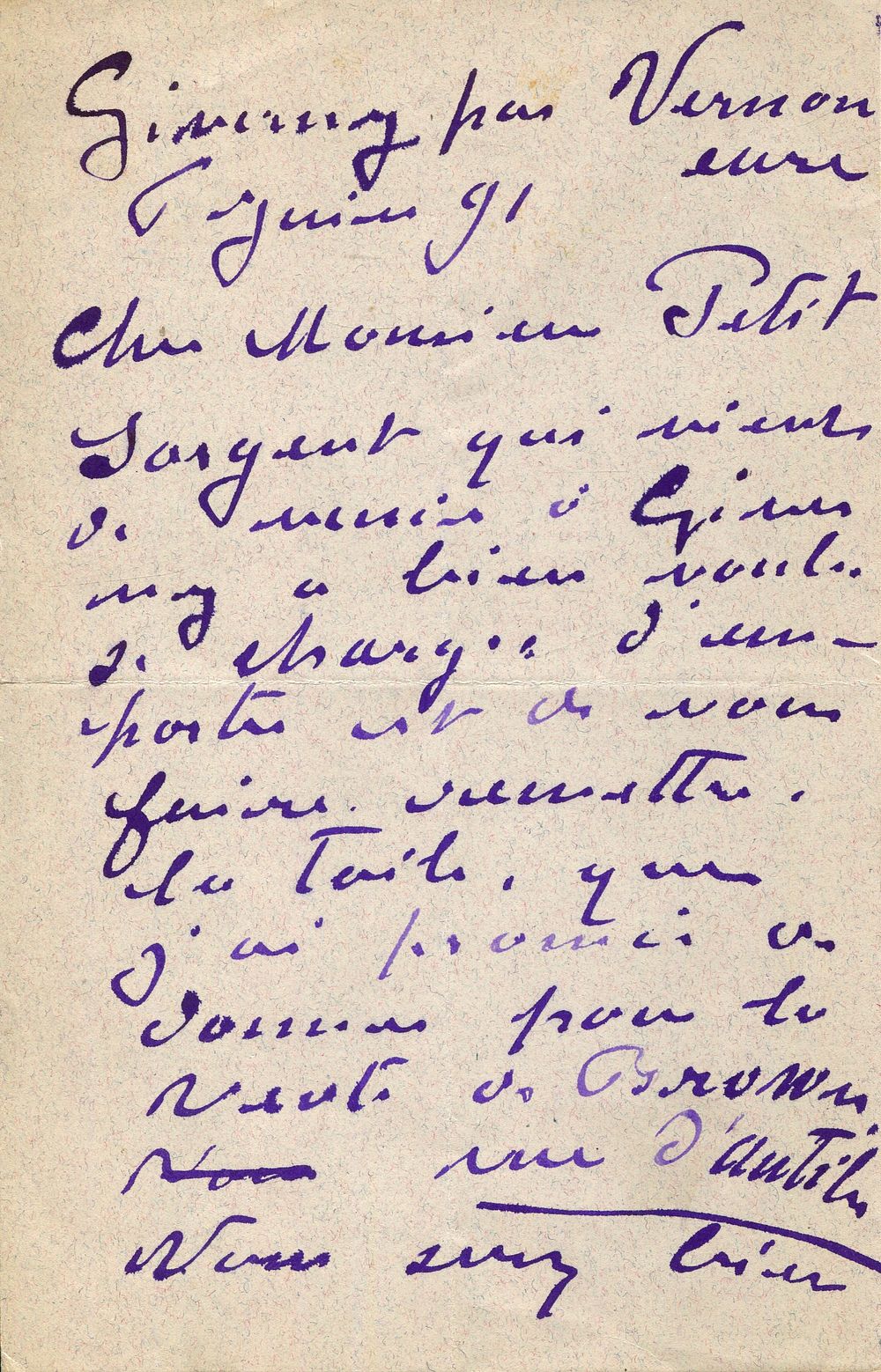
MONET CLAUDE: (1840-1926) Monet donates a painting of Antibes - MONET CLAUDE: (1840-1926) French Impressionist painter. A good A.L.S., Claude Monet , two pages (written to the first and final sides of the bifolium), 8vo, Giverny par Vernon, Eure, 6th June 1891, to [Georges] Petit, in French. Monet writes in bold purple ink and informs his correspondent that ´Sargent qui vient de venir à Giverny a bien voulu se charger d´emporter et de vous faire remettre la toile que j´ai promis de donner pour la vente de Brown. Vue d´Antibes .´ (Translation: ´Sargent, who has just arrived in Giverny, has kindly agreed to take the painting I promised to donate for Brown’s sale – View of Antibes – and ensure it is delivered to you´ ), further adding ´Vous serez bien aimable de me faire savoir qu´elle vous est bien parvenue´ (Translation: ´I would be grateful if you could let me know that you have received it´ ). A letter of interesting content and association. VG Georges Petit (1856-1920) French art dealer, a key figure in the Paris art world and an important promoter of Impressionist artists. John Singer Sargent (1856-1925) American artist, considered the leading portrait painter of his generation. Sargent´s famous painting Claude Monet Painting by the Edge of a Wood (1885) marked the artist´s brief, but intense, Impressionist phase, inspired by Monet. John Lewis Brown (1829-1890) French battle, animal and genre painter. In 1891 Petit organised and hosted a posthumous sale for the benefit of Brown´s widow and daughter, which took place at the Galerie Georges Petit in Paris on 11th & 12th June. At the time the event was described as an auction of Brown’s paintings, studies, and drawings, together with works donated by other artists. Monet’s stay in Antibes in 1888 marked one of the most unusual and important episodes of his career. Accustomed to the muted skies and soft atmospheric effects of northern France, Monet found himself confronted by the dazzling clarity of the Mediterranean. The Riviera’s fierce sunlight, brilliant blue sea, and sunlit stone architecture presented him with an entirely new set of artistic challenges. He later described himself as “fencing and wrestling with the sun, ” overwhelmed by the intensity and purity of the southern light. Working along the coast between January and spring 1888, Monet produced nearly forty canvases depicting Antibes, Cap d’Antibes, the old fortifications, pine trees, and the shimmering Mediterranean beyond. These paintings are distinguished by their luminous palette of pinks, violets, turquoise blues, and golden haze — colours rarely seen in his earlier Normandy works. The series also foreshadowed the methodical serial painting campaigns that would define his later career, including the Haystacks and Rouen Cathedral series. Although Monet often complained about the mistral winds and the exhausting difficulty of painting in such intense light, the Antibes works became some of the most radiant and atmospheric paintings of his middle period. More than simple coastal landscapes, they represent Monet’s growing fascination with light itself — not merely as illumination, but as a force capable of dissolving form into colour and sensation.