Bidspirit auction | MONET CLAUDE: (1840-1926) ´ ...I
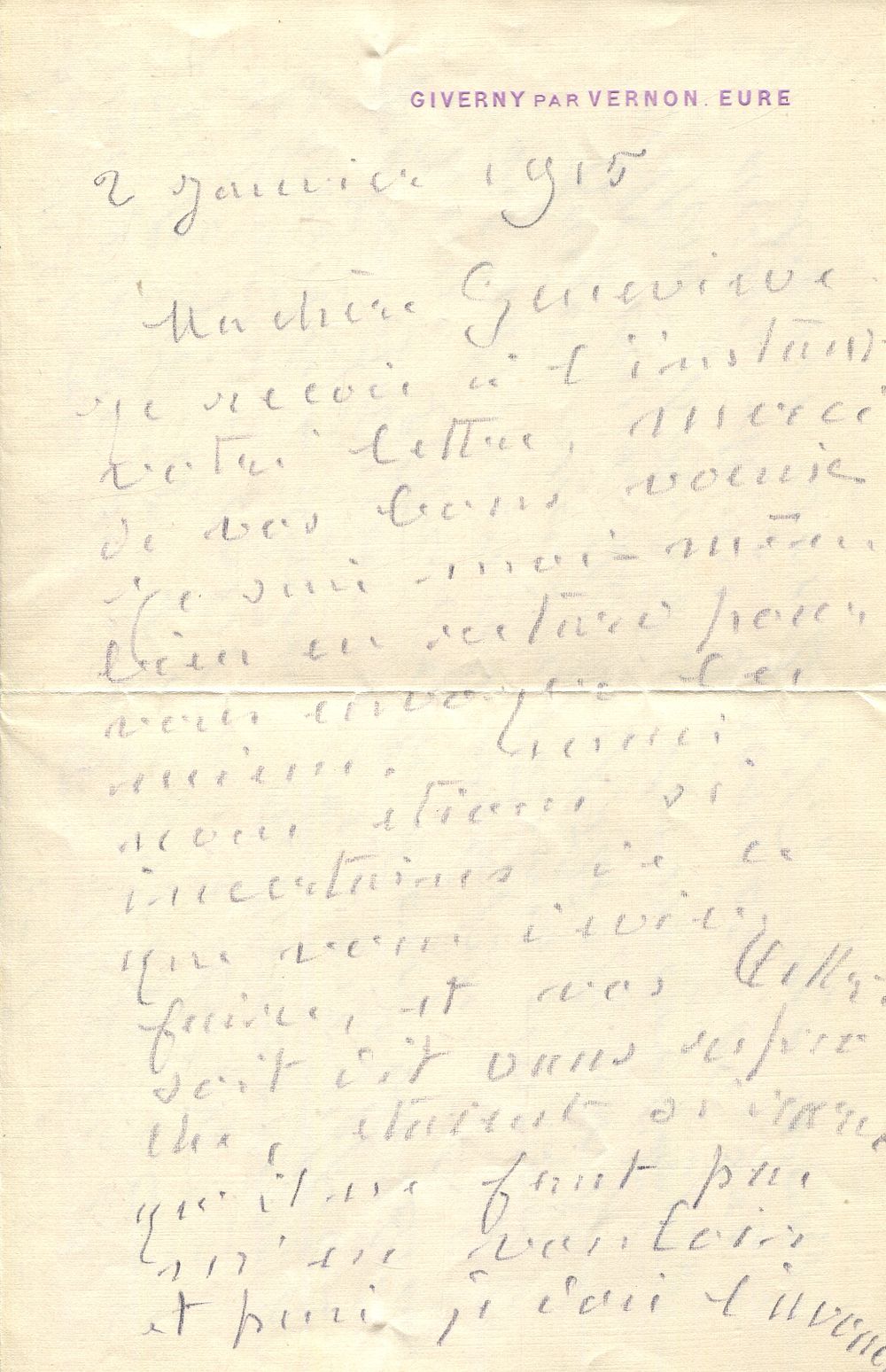
MONET CLAUDE: (1840-1926) ´ ...I feel completely at a loss...´ - MONET CLAUDE: (1840-1926) French Impressionist painter. A.L.S., Claude Monet , four pages, 8vo, Giverny par Vernon, Eure, 2nd January 1915, to Geneviève Hoschedé, in French. Monet writes in pencil and composes an emotional letter to his step-daughter-in-law, thanking her for her letter and good wishes, apologising for being late in sending his own, and reflecting ´ Eh bien! je dois l'avouer, je me sens tout désemparé et bien triste de cette triste fin d'année et si inquiet de l'avenir. Enfin, il faut se soumettre´ (Translation: ´ Well! I must admit, I feel completely at a loss and very sad about this gloomy end to the year, and so anxious about the future. At any rate, one must resign oneself to it´ ). The artist further refers to family members, including Geneviève´s husband, Jean-Pierre Hoschedé, ´ Je suis bien heureux de savoir J.-P. si bien partagé, mais j'ai grand peur qu'il n'en soit pas de même pour Michel´ (Translation: ´ I am very happy to hear that J.-P. is so well provided for, but I very much fear that the same cannot be said for Michel´ ) and concludes his letter in a somewhat dispirited tone, ´J e vous envoie tous mes souhaits et vous envoie cette petite somme, ne pouvant faire mieux cette année où l'argent devient si rare. J'avais, du reste, fait un envoi à J.-P., mais je doute qu'il l'ait reçu, ce qui me contrarie bien. Voulez-vous remercier votre maman de son affectueuse lettre ? Elle voudra bien m'excuser de ne pas le faire moi-même, mais je vous le répète, je suis tout chaviré´ (Translation: ´ I send you my best wishes and this small sum, as I cannot do better this year when money is so scarce. I had, moreover, sent a parcel to J.-P., but I doubt he has received it, which upsets me greatly. Would you please thank your mother for her affectionate letter? She will kindly excuse me for not doing so myself, but I repeat, I am quite overwhelmed´ ). Autograph letters of Monet to Geneviève Hoschedé are rare, and only three others (in addition to the present example) are recorded in Daniel Wildenstein´s catalogue raisonné. VG In 1903 Geneviève Costadau (1874-1957) married Jean-Pierre Hoschedé (1877-1961), the youngest son of Monet´s second wife, Alice Hoschedé (1844-1911). Jean-Pierre Hoschedé and his stepbrother Michel Monet (1878-1966), also mentioned in the present letter, were both called up to serve on the Western Front during World War I. Their military mobilisation deeply affected Monet, who refused to abandon his home and gardens in Giverny despite being close enough to the front lines to hear the rumblings of heavy artillery. Of this particular period in Monet´s life, his biographer Jackie Wullschlager writes ´One of the saddest vignettes of Monet´s life is that of the old man returning from a failed journey to bid farewell to his only surviving son about to leave for the front in 1915, departing from Versailles. Monet set off from Giverny ´to kiss my Michel...useless trip: he had gone a day earlier, so I couldn´t kiss him and came back contrite and sad, it´s hard at my age, ´ he told Geffroy. ´What does the future hold for me? Many, many families are suffering, ´ he wrote, and ´I am always trembling for my Michel.´.....Geffroy believed that Monet ´survived the most terrible griefs which broke his heart and ravaged his spirit by his inner strength´. ´I haven´t painted the war...But there´s no doubt about the war existing in the pictures I did at the time, ´ Picasso said of 1939-45. The same holds true for Monet´s Grandes Décorations in relation to the 1914-18 conflict. They were begun in personal sorrow, the ephemeral. drifting lilies and dark, downward-coursing willows images of mourning, memorializing Alice and Jean. The war, bringing constant anxiety about Michel, intensified the emotional charge, and gave the context of national grief. The counterbalance is comfort and renewal: a garden growing, nature´s enduring rhythms, acceptance of diurnal, seasonal cycles, distilled on tp canvases painted a few hours from the killing fields. The paintings are rapturously melancholic, exuberant in the joy and challenge of returning to painting and the refuge it offered......Work ´is the only means not to think too much about current sorrows´, he told Raymond Koechlin in January 1915. ´So I am pursuing my idea of a Grande Décoration. It´s a very big thing that I´ve begun, especially at my age, but I don´t despair of getting somewhere if I keep my health.´ (from Monet: The Restless Vision , 2023, pp.403-405).