Bidspirit auction | MONET CLAUDE: (1840-1926) Monet to
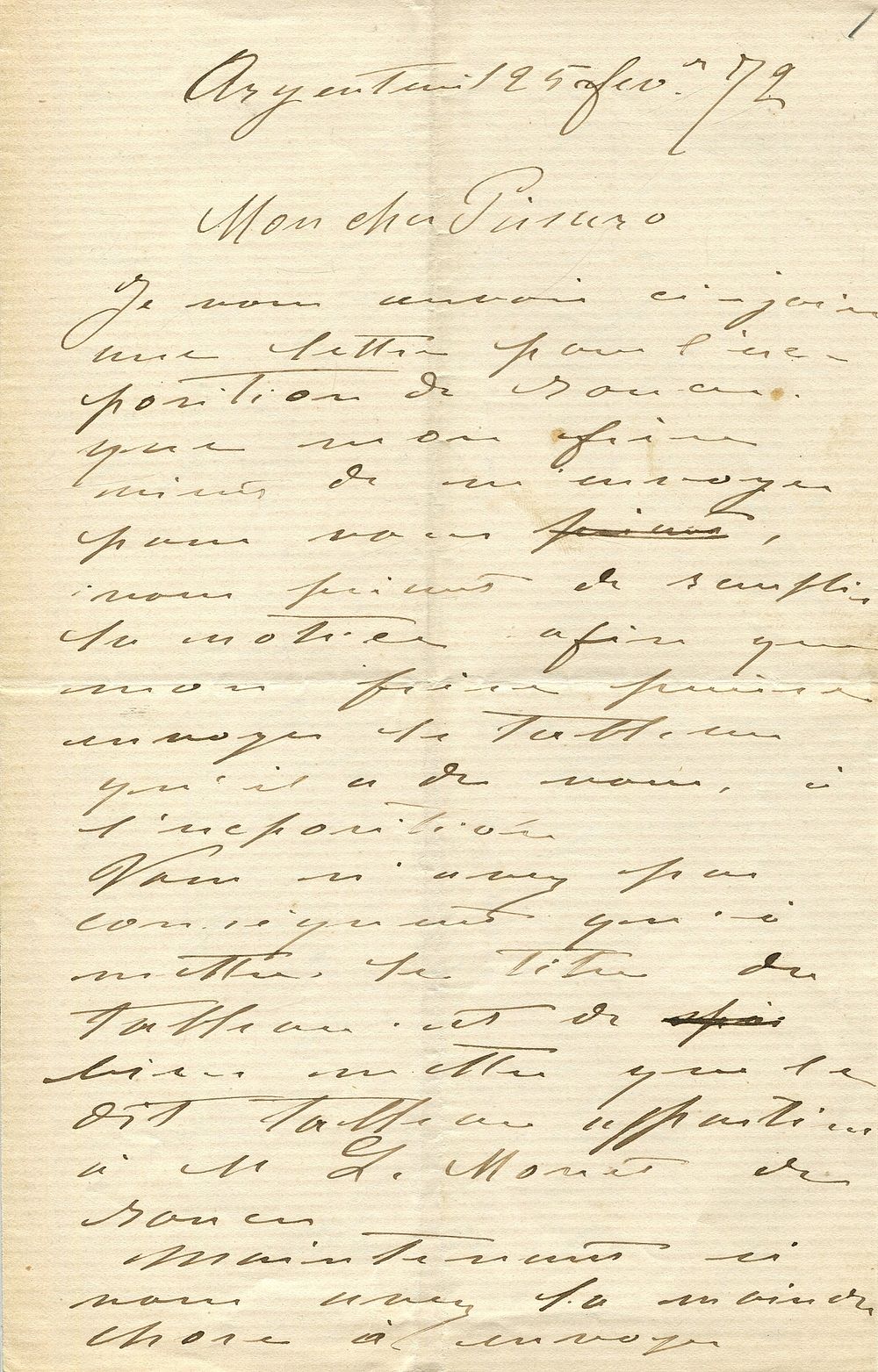
MONET CLAUDE: (1840-1926) Monet to Pissarro on exhibiting their works in Rouen - MONET CLAUDE: (1840-1926) French Impressionist painter. An interesting A.L.S., Claude Monet , two pages (written to the first and third sides of the bifolium), 8vo, Argenteuil, 25th February 1872, to Camille Pissarro ( ´Mon cher Pissarro´ ), in French. Monet states that he is enclosing a letter (no longer present) which his brother had sent, ´vous priant de remplir la notice afin que mon frère puisse envoyer le tableau qu´il a de vous, à l´exposition´ (Translation: ´asking you to complete the entry form so that my brother can send the painting he has of yours to the exhibition´ ), and provides instructions to his friend, ´Vous n´avez par conséquent qu´à mettre le titre du tableau, et de bien mettre que le dit tableau appartient à M. L. Monet de Rouen´ (Translation: ´You therefore need only enter the title of the painting, and clearly state that the said painting belongs to Mr L. Monet of Rouen´ ). Monet further writes ´Maintenant si vous avez la moindre chose à envoyer personnellement indiquez-le par la même notice avec le prix mon frère pourrait peut-être vous faire vendre. Je fais un envoi à mon frère Mardi ou Mercredi, vous pourriez profiter de l´occasion´ (Translation: ´Now, if you have anything at all to send personally, please indicate this on the same form, along with the price at which my brother might perhaps be able to sell it for you. I am sending a consignment to my brother on Tuesday or Wednesday; you could take advantage of this opportunity´ ) and in concluding remarks ´En tous cas renvoyez-moi la notice en question, signée de vous et en règle, il faut que je l´envoie de suite à mon frère´ (Translation: ´In any case, please return the form in question to me, signed by you and in order; I must send it to my brother immediately´ ). In a postscript Monet enquires if Pissarro had received the 100 francs. A letter of wonderful content and fine association. A few small, minor stains, not affecting the text or signature, otherwise VG Camille Pissarro (1830-1903) French Impressionist painter. Léon Monet (1836-1917). French chemist and industrialist with a factory in Rouen. Léon, Claude´s elder brother, was one of the first patrons of the Impressionist movement who not only supported his brother when he was poor and struggling to make his name, but also assisted other painters including Pierre-Auguste Renoir, Camille Pissarro, and Alfred Sisley. Léon Monet built a remarkable collection of art and had his portrait painted by Claude Monet in 1874. The exhibition which Monet writes of in the present letter was the 23rd Exposition municipale des Beaux-Arts de Rouen, held in March 1872. The official French art establishment in Paris heavily rejected Impressionism at the time, and Léon Monet used his local influence as a prominent Rouen industrialist and founder of the Société Industrielle de Rouen to give his brother, Pissarro and their fellow artists crucial regional exposure. Léon entered four Impressionist paintings from his private collection into the municipal showcase, including his brother´s Méditation. Madame Monet au canapé (1870-71), and Pissarro´s Paris, l'Institut au Quai Malaquais (1872), the work referred to in the present letter. Of this particular period in Monet´s and Pissarro´s careers, the biographer of the former, Jackie Wullschlager, writes: ´The years 1872-4 were a glory moment in French art, when people, place, time, thought, were propitiously aligned. The generation born between 1830 and 1840 were reaching maturity; a spirit of shared ideas. close friendships and rivalry spurred them on, and the experiments of the previous decade were a bedrock on which to build. In the 1860s Manet had dominated the avant-garde with heavyweight socio-political themes (Olympia, The Execution of Maximilian), and mythological or Christian subjects had still appeared in his work and that of Cézanne and Renoir. In the early 1870s that vanished and it was Monet who pointed the way - as the painter of light, and also in his secular, apolitical world view. Durand-Ruel noted that in 1872-3 Manet began to be ´visibly influenced by Monet in his exploration of light´ - The Croquet Game (1873), for example, followed by the monumental rendering of an outdoor domestic scene Laundry (1875). Thus, from Argenteuil, Monet led what T. J. Clark calls ´the wonderful easy godlessness of French painting´ in the late nineteenth century, a high point of ´the beauty and depth that secularization can attain´. Monet´s talent ´is very serious and very pure´, Pissarro told Duret, and his work ´a highly conscious art, based upon observation and derived from a completely new feeling; it is poetry through the harmony of true colours´. Armand Sylvestre, in an essay in 1873 about Durand-Ruel´s collection, emphasized both Monet´s signal position - ´M. Monet is the most adept and daring, M. Sisley the most harmonious and hesitant, M.