Bidspirit auction | SAITO MAKOTO: (1858-1936)
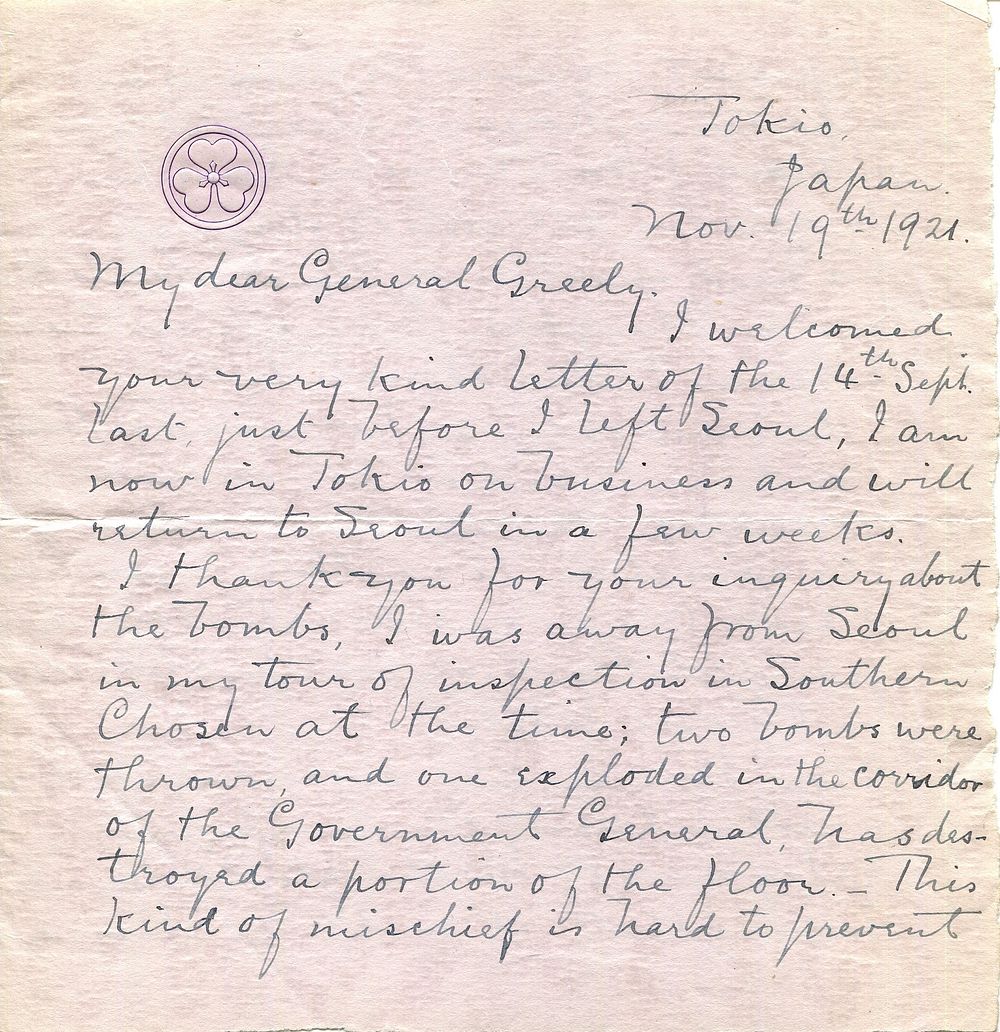
SAITO MAKOTO: (1858-1936) - SAITO MAKOTO: (1858-1936) Japanese admiral and politician who served as Prime Minister of Japan 1932-34, and had previously been Governor-General of Korea 1919-27, 1929-31. Assassinated. A fine A.L.S., M. Saito , three pages, 8vo, Tokyo, 19th November 1921, to General [Adolphus] Greely, on attractive stationery featuring the Saito family crest to the upper left corner of the first page. Saito states that he received his correspondent´s letter just before he left Seoul, and is in Tokyo on business at present and will return in a few weeks, continuing to remark ´I thank you for your inquiry about the bombs. I was away from Seoul in my tour of inspection in Southern Chosen at the tume; two bombs were thrown, and one exploded in the corridor of the Government General, has destroyed a portion of the floor. This kind of mischief is hard to prevent at present because the missiles are imported by Korean malcontents and outlaws from Chinese or Russian borders in all sorts of disguise; the head quarters of these malcontents are in Shanghai, Peking, two or three Siberian towns, Honolulu &c.´ further observing ´Law and order in Korea are maintained fairly well and we are endeavoring to develop the industry and encourage the education´ , and explaining that he will send Greely a pamphlet on the subject under separate cover. In concluding Saito writes that ´Now I am reading everyday with great interest the newspaper telegrams of Washington Conference hoping that it will be carried out with success and the world peace accomplished´ . A letter of interesting content and good association, offering an insight into Japanese governance, security concerns in colonial Korea, and international awareness during the opening days of the Washington Naval Conference. VG Adolphus Greely (1844-1935) American Major General with the United States Army and polar explorer, a recipient of the Medal of Honor. The Washington Naval Conference (officially the International Conference on Naval Limitation) was a landmark disarmament meeting held in Washington, D.C., from 12th November 1921 to 6th February 1922. The conference resulted in three major agreements among the world's leading powers to prevent a post-World War I arms race and stabilize the Asia-Pacific region: The Five-Power Treaty established strict tonnage ratios for capital ships (battleships and aircraft carriers) at 5:5:3 for the United States, Great Britain, and Japan, with lower limits for France and Italy; The Four-Power Treaty committed the U.S., Britain, Japan, and France to respect each other's Pacific territories and consult during disputes, effectively ending the Anglo-Japanese Alliance; and The Nine-Power Treaty formally affirmed China's sovereignty and territorial integrity while reinforcing the ´Open Door Policy´ for equal trade opportunities. Whilst these treaties successfully halted naval expansion for a decade, they eventually lapsed in the mid-1930s as Japan and Italy withdrew, contributing to the rising tensions that led to World War II.