Bidspirit auction | WAGNER RICHARD: (1813-1883) ´ The
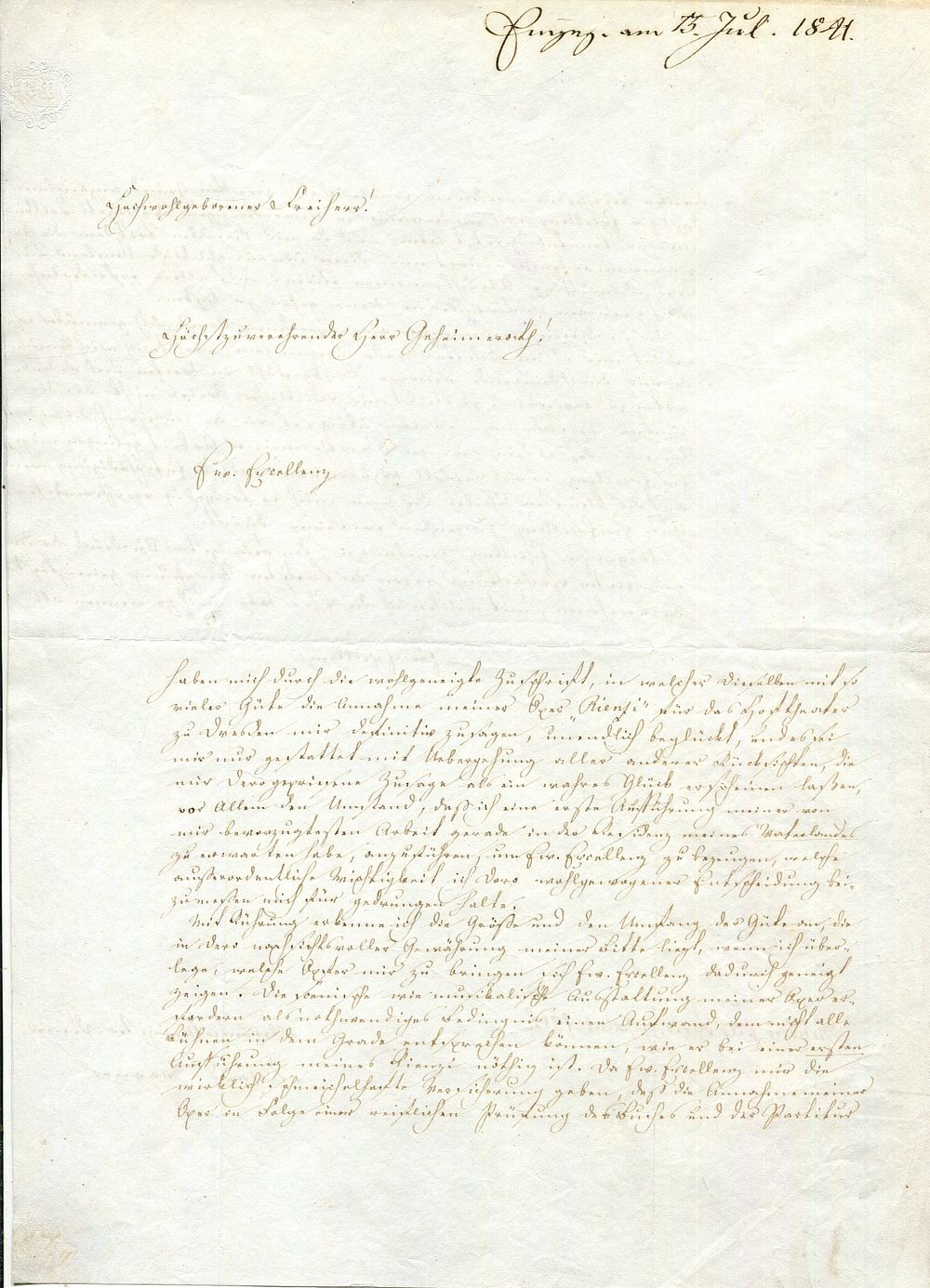
WAGNER RICHARD: (1813-1883) ´ The scenic and musical production of my opera necessitates an expenditure that not all stages can meet to the degree required for a premiere of my ”Rienzi” ´ - WAGNER RICHARD: (1813-1883) German composer. A very fine A.L.S., Richard Wagner , two pages, 4to, Meudon, 9th July 1841, to [Wolf Adolph August Freiherrn von Lüttichau] ( ´Highborn Baron, Most esteemed Court Councillor! Your Excellency´ ), on Wagner´s blind embossed stationery featuring his initials to the upper left corner, in German. Wagner commences by stating ´I have been infinitely delighted by your gracious letter, in which you so kindly and definitively assure me of the acceptance of my opera ”Rienzi” for the Court Theatre in Dresden, and if I may be permitted, setting aside all other considerations that make your praised assurance appear to me as a true blessing, to mention above all the fact that I may anticipate the premiere of my most cherished work precisely in the capital of my fatherland, in order to assure Your Excellency of the extraordinary importance I feel compelled to attach to your gracious decision´ , and further continues ´I acknowledge with deep emotion the magnitude and extent of the kindness inherent in your gracious granting of my request, when I consider the sacrifices Your Excellency is thereby inclined to make on my behalf´ , explaining ´The scenic and musical production of my opera necessitates an expenditure that not all stages can meet to the degree required for a premiere of my ”Rienzi”. Since Your Excellency has given me the truly flattering assurance that the decision to accept my opera was made following a thorough examination of its libretto and score, I have good reason to believe that You have fully familiarised yourself with the scenic demands of the subject, and since you nevertheless promised to accept it, this most fortunate circumstance assures me of your noble intention to stage my ”Rienzi” with all the necessary, not inconsiderable, expense´ . Wagner closes his letter in a highly obsequious, emotionally intense, and strategically deferential manner, writing ´In the face of the magnanimity expressed in these sentiments, it seems to me utterly inadequate should I attempt to pour out the fiery gratitude that fills me in words and phrases. It remains for me, as is fitting, to offer nothing but the simple assurance of the same, as well as the expression of my most ardent wish that the meagre worth of my work may succeed in winning for Your Excellency as much applause as might seem sufficient to compensate, even if only in the smallest part, for the kindness so generously lavished upon me.....´ . An important letter of excellent content. VG Wolf Adolph August Freiherr von Lüttichau (1786–1863) Prussian-born aristocrat who served as the General Director of the Royal Court Theatre in Dresden for nearly four decades (1824–62). Before receiving this letter, Wagner was largely an unknown, struggling composer living in poverty near Paris. Lüttichau held immense power over Wagner's career. By greenlighting Rienzi for its world premiere—and later hiring Wagner as the Royal Kapellmeister (Conductor) in Dresden— Lüttichau effectively launched Wagner into the international spotlight. Despite this their relationship later deteriorated. Wagner’s fiery personality, radical artistic demands, and aggressive push to reform the Dresden theatre constantly clashed with Lüttichau's rigid administrative boundaries. The professional relationship shattered entirely in 1849 when Wagner participated in the socialist May Uprising in Dresden, forcing the composer to flee the country as a wanted political revolutionary. Rienzi, der letzte der Tribunen was composed by Wagner between July 1838 and November 1840 and received its premiere on 20th October 1842, at the newly built Dresden Court Theatre. T he production was a triumphant, life-altering hit for Wagner, transforming him from an impoverished, unknown artist into Germany's most promising young composer. The original performance spanned an astonishing six hours including intermissions. Worried that the audience would walk out, Wagner famously stopped the theatre clock over the stage. Instead of leaving, the spellbound crowd stayed until the end and erupted into massive ovations. The present letter is mentioned by German music historian, critic, and librarian Wilhelm Altmann (1862-1951) in his seminal 1905 book R ichard Wagner´s Briefe nach Zeitfolge und Inhalt ( Richard Wagner's Letters According to Chronological Order and Content ) as No.66, but was considered lost.