Bidspirit auction | NAPOLEON I: (1769-1821) Emperor of
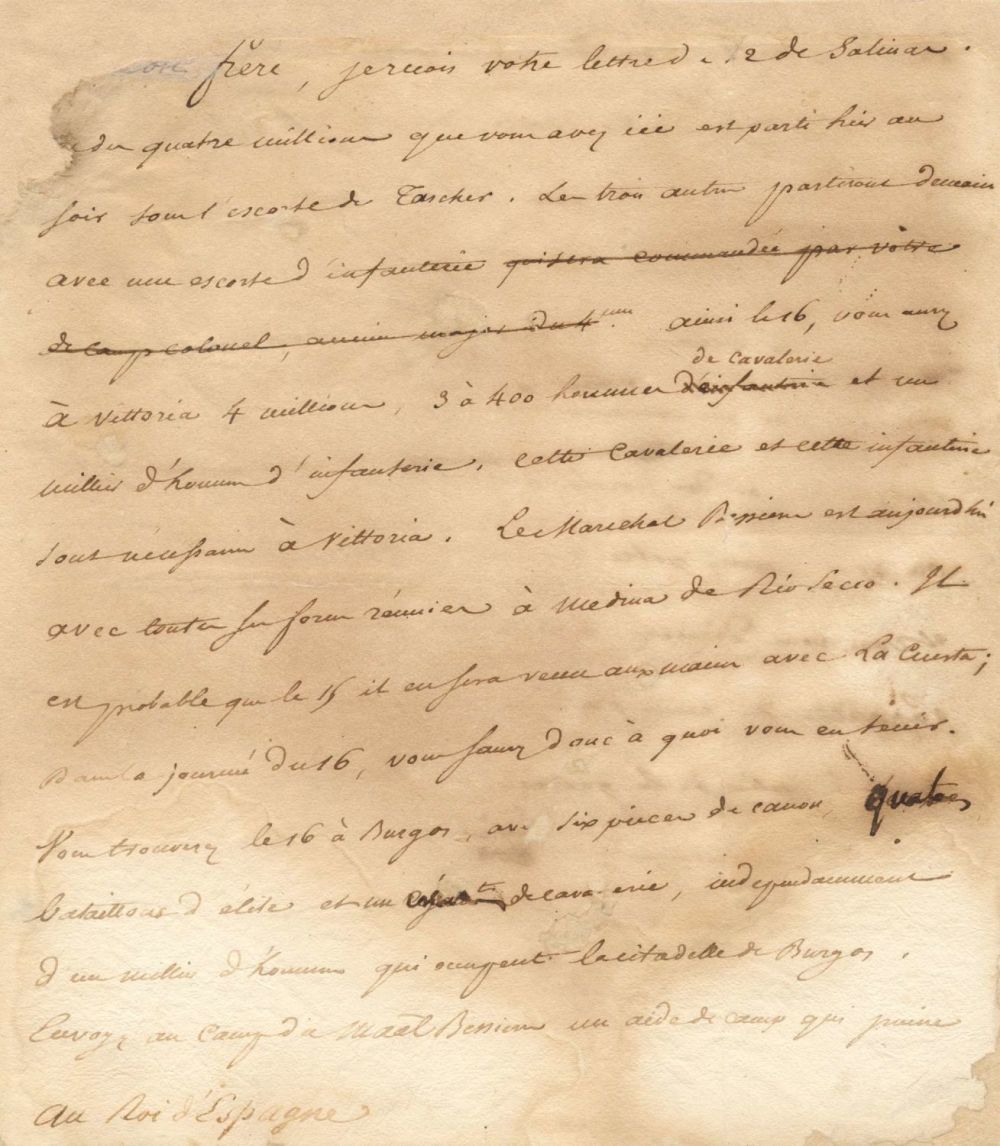
NAPOLEON I: (1769-1821) Emperor of France 1804-14, 1815. An exceptional and rare L.S., `Napoleon - NAPOLEON I: (1769-1821) Emperor of France 1804-14, 1815. An exceptional and rare L.S., `Napoleon´, with a four lines autograph annotation in the hand of Napoleon at the conclusion, four pages, 4to, Bayonne, 13th July 1808, to his brother the King of Spain, Joseph Napoleon, in French. An excellent military content letter with an unusually lengthy annotation by Napoleon, signed with his full name, a good signature example. The Peninsular war started with the 2nd of May 1808 uprising, only two months before the present letter was written, when France turned on Spain, previously its ally. Napoleon states in part `.. One of the four millions that you have here has departed yesterday evening under the escort of Tascher. The other three will depart tomorrow, with an infantry escort. This way you will have on the 16th in Vitoria, four millions, 3 to 400 cavaliers, and one thousand infantry men. All necessary in Vitoria.´ Napoleon further refers to `Marshal Bessieres is today, with all his troops gathered at Medina de Rio Seco. Most probably on 15th May the battle against La Cuesta will take place..´, and to the French troops in Burgos, saying `..you will march with your reserve troops to Marshal Bessieres´ camp, to reinforce his position and to preside yourself the first victory, announcing your arrival to Spain with a major event, and making the battle be followed with words by peace..´ further again, Napoleon shows his discontent with General Savary, stating `..The military positions of the French armies in Spain was excellent. In the war a false positioning changes everything. It is still a good one; but, against my opinion, Savary has disseminated the division You will find attached the orders which I have just dictated to General Bertrand for General Savary, where the army position is described considering all scenarios. Keep this copy. When you will learn that General Bessieres has defeated La Cuesta, your position will be better than ever.´ Napoleon further refers to the French armies and his Generals in several Spanish cities. And beneath his signature Napoleon, in his hand, adds a post-scriptum stating `Do not worry, you will not miss any thing. General Reille, my aide-de-camp, will send tomorrow 10.000 men to Figueres in Catalonia. Be cheerful, and most of all take care of yourself. Reach Madrid.´ One of Napoleon´s lengthier and most important letters to come to the autograph market, with exceptional content, showing how Napoleon was planning and considering meticulously any small eventuality, guiding his brother the King of Spain, step by step, instructing him how to act on each occasion, while still showing him his affection. Overall age wear and creasing. Professionally repaired with reinforced paper, only affecting the reading of few words. F to G £6000-9000 Joseph Bonaparte (1768-1844) King of Naples and Sicily (1806-08) and later King of Spain (1808-13, as Jose I). Elder brother of Napoleon Bonaparte. Jean-Baptiste Bessieres (1768-1813) Marshal of France, Duc d´ Istria. Gregorio Garcia de la Cuesta (1741-1811) Spanish General of the Peninsular War. Garcia de la Cuesta together with Lieutenant-General Blake, were defeated on 14th July at the Battle of Medina de Rio Seco. Napoleon had predicted on the present letter that the victory would take place a day later. Anne Jean-Marie Savary (1774-1833) French general under revolution and Empire and minister of Police. In 1805, shortly before the Battle of Austerlitz, he was sent by Napoleon with a message to the emperor Alexander I with a request for an armistice. In 1808, Savary induced Ferdinand VII, King of Spain, to cross the Pyrenees and go to Bayonne, a decision which cost him his crown and his liberty until 1814. In 1812, the day before the Malet coup d´etat, Malet arrested Savary who was close to be killed by General Guidal. Savary was among the last to desert the Emperor at the time of his abdication, and among the first to welcome his return. Henri-Gatien, Count Bertrand (1773-1844) French General. Grand Marshal of the palace since November 1813, title given to refer to the leader of the Military Household of the Emperor. The responsibilities of his position included: keeping accounts of the expenses and ensuring the security of the household. He exercised his duties during the last days of the Empire as well as in exile on the islands of Elba and Saint Helena, up until the death of the Emperor.