Bidspirit auction | Gustav Klimt: Stehender Akt von
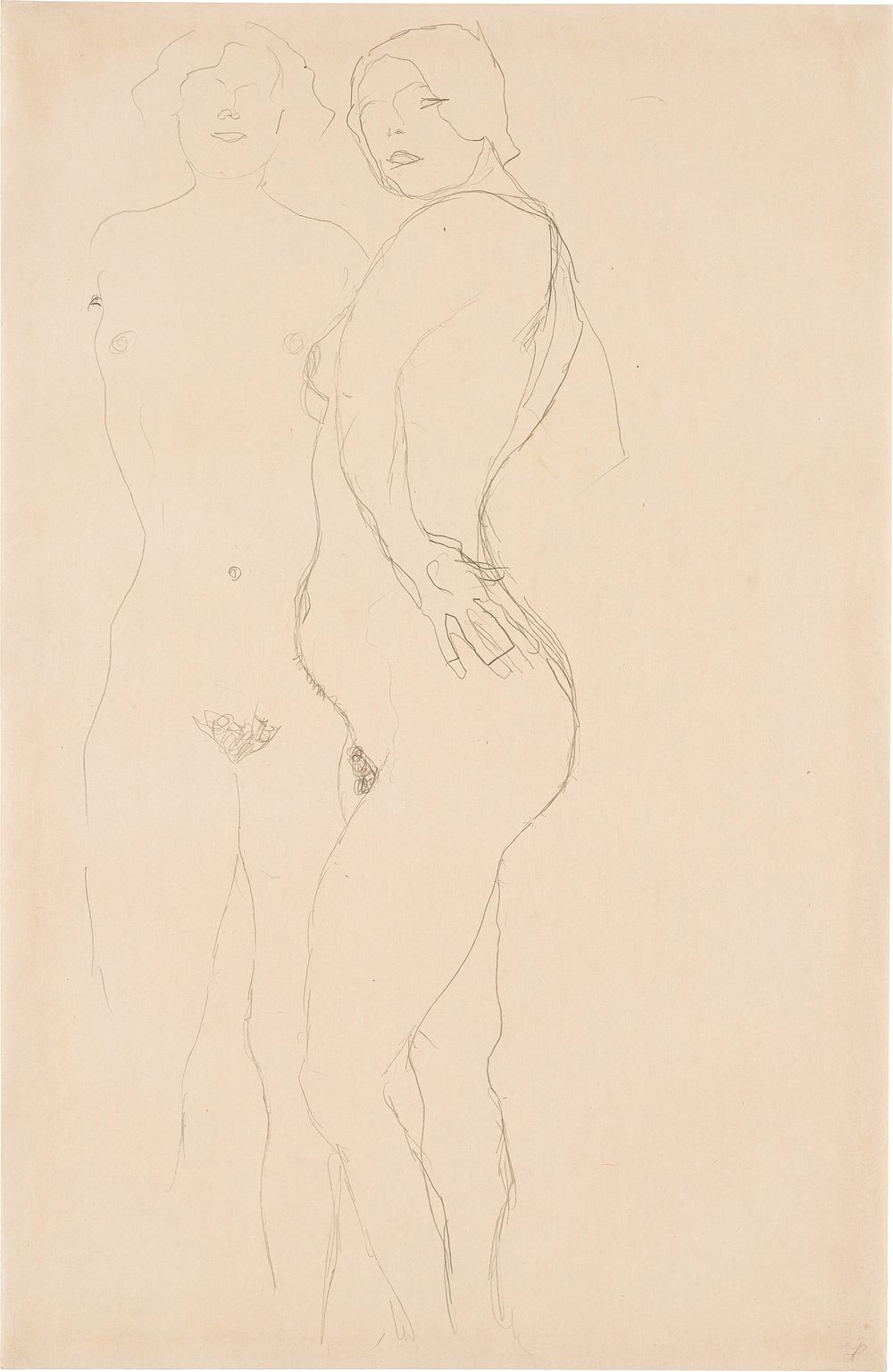
Gustav Klimt: Stehender Akt von vorne, Akt im Profil nach links - Gustav Klimt Stehender Akt von vorne, Akt im Profil nach links, das Gesicht dem Betrachter zugewandt (Studie im Zusammenhang mit ”Die Freundinnen II”, 1916/17) 1916/17 Bleistift auf Papier; gerahmt 57 x 36,7 cm Verso bezeichnet: Nachlass / Gustav Klimt / Zimpel Gustav Nachlass des Künstlers (Gustav Zimpel); Fischer Fine Art, London; österreichischer Privatbesitz Alice Strobl, Gustav Klimt, Die Zeichnungen 1912-1918, Bd. III, Salzburg 1984, Nr. 2771, Abb. S. 165 In Klimts spätem Gemälde ”Die Freundinnen II” (1916/17, 1945 verbrannt) werden zwei aufrecht stehende, aneinandergeschmiegte Frauengestalten unterhalb der Körpermitte vom Bildrand überschnitten. Die linke Figur präsentiert sich jugendlich, nackt, neugierig blickend, als Sinnbild des blühenden Lebens; ihre Partnerin zeigt sich völlig bekleidet und vertritt anscheinend einen etwas reiferen, mondänen Frauentypus. Die zahlreichen Zeichnungen, die Klimt im Kontext dieses Spätwerks zwischen 1915 und 1917 geschaffen hat, drehen sich zum Großteil um die Figur der nackten jungen Frau und weisen zwei Kategorien auf. Die hier gezeigte Darstellung von zwei stehenden Aktfiguren zählt zu jenen Blättern, in denen Klimt seine Modelle in Zweier- oder Dreiergruppen festhält. Die Kombination der seitlich dargestellten Frau, die ihr Gesicht dem Betrachter zuwendet, und der teilweise von ihr überschnittenen, frontal stehenden Aktfigur erinnert entfernt an die Situation der ”Freundinnen” im Gemälde, obwohl hier von einer unmittelbar vorbereitenden Funktion nicht die Rede sein kann. Mit teils heftig geführtem Bleistift registriert Klimt die Umrisse des vorderen, eindeutig nicht-idealen Körpers, wobei er die Wölbungen von Bauch, Gesäßpartie und Brüsten sowie das eckig betonte Schulterblatt markant hervorhebt. Anregungen des Expressionismus sind hier nicht zu übersehen. Wie ein Stenogramm wirkt das dreieckig stilisierte Auge, das zusammen mit dem leicht geöffneten Mund den Ausdruck intensiviert. Was Klimt in seinen mehrfigurigen Studien immer wieder beschäftigt, ist die Interaktion zwischen den rhythmisch fließenden, einander gegenseitig verstärkenden Körperkonturen. Zu den besonderen Eigenschaften dieser Zeichnungen zählt auch die Art, in der er die Geschlechtsmerkmale der posierenden Modelle – in unserem Fall sind es die Brustwarzen und die Schamhaarpartien – pointiert nebeneinander stellt. (Marian Bisanz-Prakken, 2023) Gustav Klimt Standing Nude from the Front, Nude in Profile to the Left, Face Turned Towards the Viewer (Study related to ”Die Freundinnen II”, 1916/17) 1916/17 pencil on paper; framed 57 x 36.7 cm inscribed verso: Nachlass / Gustav Klimt / Zimpel Gustav from the estate of the artist (Gustav Zimpel); Fischer Fine Art, London; private property, Austria Alice Strobl, Gustav Klimt, Die Zeichnungen 1912-1918, vol. III, Salzburg 1984, no. 2771, illus. p. 165 In Klimt’s late painting ”Die Freundinnen II” (”The Girlfriends II”, 1916/17, burnt in 1945), two upright female figures nestling against each other are cut off below the centre of their bodies by the picture’s edge. The figure on the left appears youthful, naked, with an inquisitive gaze, a picture of vitality; her partner shows herself fully clothed and seems to represent a somewhat more mature, sophisticated type of woman. The numerous drawings Klimt produced in the context of this late work between 1915 and 1917 largely revolve around the figure of the nude young woman and fall into two categories. The depiction of two standing nude figures shown here (cat.-no. 8) belongs to those drawings in which Klimt captures his models in groups of two or three. The combination of the woman who is depicted from the side and is turning her face towards the viewer and the frontal nude figure partly overlapped by her is faintly reminiscent of the position of the ”Girlfriends” in the painting, although here there can be no question of a directly preparatory function. Klimt draws the outlines of the frontally shown, distinctly non-ideal body with often fiercely emphatic pencil strokes, markedly emphasising the bulges of the belly, buttocks and breasts as well as the accentuated angularity of the shoulder blade. It is impossible to miss the influence of Expressionism here. The stylised triangular eye is like a shorthand cypher, intensifying the expression together with the slightly open mouth. What preoccupies Klimt again and again in his multi-figure studies is the interaction between the rhythmically flowing, expressively contrasting body contours. One of the special features of these drawings is the way in which he pointedly juxtaposes the sexual characteristics of the posing models – in this case, the nipples and the areas of pubic hair. (Marian Bisanz-Prakken, 2023)