Bidspirit auction | Poster - Five Years to
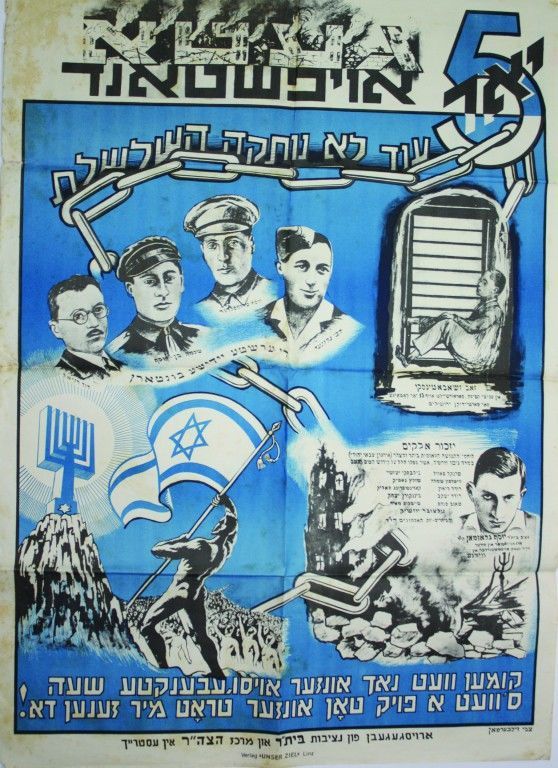
Poster - Five Years to the Warsaw and Vilnius Ghettos Uprising in 1943 - Ha'tzohar and Commissionership of Beitar - Linz, Austria, 1948 - ”5 Yor Ghetto Oyfshtand ” [five years to the Ghetto uprising] - poster commemorating five years to the Warsaw Ghetto Uprising, issued by Beitar commissionership and Tzohar center in Austria. Design: Zvi Zilberman. Published by Unser Ziel. Linz, [1948]. Hebrew and Yiddish. The Warsaw Ghetto Uprising was a constitutive event in the history of the Jewish resistance during World War II. It was a hopeless struggle of few against Nazi Germany, in order to die with dignity. The story of the Uprising, as it was told in Israel, soon became a national myth. The narrative of the Warsaw Ghetto Uprising, as it was presented for dozens of years, emphasized the activity of the members of Eyal - the organization headed by Mordechai Anielewicz. Most of the researchers ignored the part played by the members of the ZZW - the Jewish Military Union headed by Pawel Frenkel and his colleagues of the Beitar Movement. Actually, both Mordechai Anielewicz and Pawel Frenkel were the leaders of the Uprising. However, most history books do not mention Frenkel at all. Only recently, due to the studies of Prof. Moshe Arens and his book ”Degalim Me'al Ha'Ghetto”, did the importance of the Beitari organization become clear: while Eyal participated in the Uprising only during its first two days, the ZZW fought the Nazis for ten days, before its surviving fighters left the ghetto. There is also controversy among the researches regarding the question whether the Vilnius Ghetto Uprising was indeed a true uprising. In January 1942, the representatives of the political parties in Vilnius (among them Aba Kovner of ”Ha'Shomer Ha'Tzair”) gathered in the room of Yosef Glazman, the commissioner of Beitar in Lithuania. They decided on the establishment of an underground organization: FPO. Glazman was a member of Beitar since his childhood. In 1937, he became the commissioner of Beitar in Lithuania. In autumn 1941, Glazman came to the Vilnius Ghetto and started Beitar's diverse activities in the ghetto. He claimed that the Jews had only one option - to resist the enemy and its decrees until an open uprising will be possible. He established contacts with members of other movements and initiated a war against the Nazis at the Vilnius Ghetto, as described by Aba Achimeir (in his article ”Eifa Ve'Aifa Afilu Be'Mishpat Zeh”). Glazman's activity led to the establishment of the ”United Partisan Organization” - the FPO. Glazman was chosen as deputy commander of the organization. Those objecting to the policy of restraint in the Vilnius Ghetto were named after him ”Glazmanists”. Due to various events, he founded with his friends the Jewish partisan base which included about two hundred fighters. In October 1943, the Germans started to besiege the partisan bases. Yosef, with 34 of his friends, tried to flee the area, yet were caught by the Germans and died in battle. In the above article, Aba Achimeir notes painfully: ”the deputy commander of the underground organization was Beitar member Yosef Glazman, who died as a hero in the woods. But he must not be mentioned since he was a Beitarian”. The poster before us expresses the true reality of the heroes of the uprising by presenting the members of Beitar as those who initiated and realized the Warsaw Ghetto Uprising and the Vilnius Ghetto Uprising. This early poster supports recent perception of Jabotinsky and his followers, the leaders of Beitar, as playing an important role in the revolts against the Nazis. It can be assumed that the designer of the poster, Zvi Zilberman, was a Beitarian. The poster is colored in shades of blue and white, the colors of the Hebrew flag, which can be seen among the illustrations that appear in the poster. Illustration of an iron chain connecting between several photos: A. Portraits of Joseph Trumpeldor and Beitar fighters Shlomo Ben Yossef, David Raziel and Dov Gruner (”di ershte yidie bontarn - the first Jewish rebels). B. Ze'ev Jabotinsky in the Acre Jail. C. Names of Beitar and Ha'Tzohar fighters who died during the Warsaw Ghetto Uprising and a portrait of Joseph Glazman. The poster also depicts am illustration of a powerful Jew flying the Hebrew flag in front of the Golden Menorah, with thousands of Jews behind him. On the lower part of the poster appears a citation in Yiddish from the Jewish Partisans song: ”….mir zenen do!” 44x60 cm. Condition: Good. Folding marks.