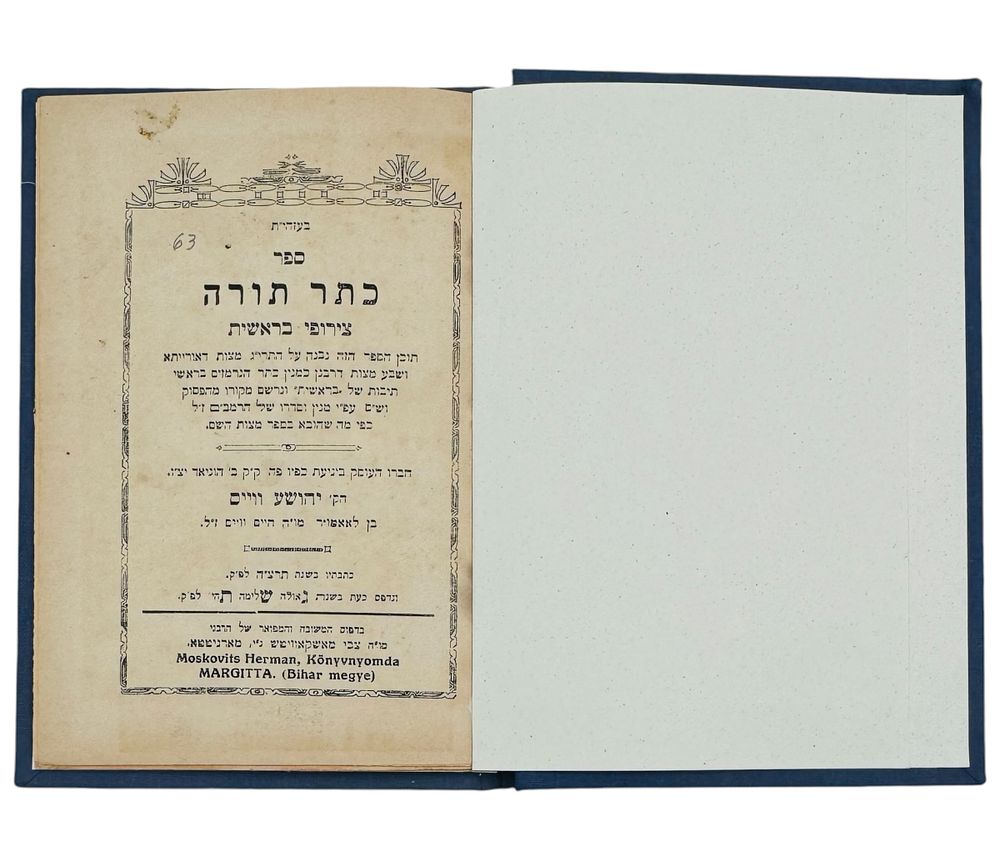
Bidspirit auction | Keter Torah - Tzurofei Bereshit
Keter Torah - Tzurofei Bereshit Author: Rabbi Yehoshua Weiss Place of Publication: Margitata (Hungary) Year of Publication: 1943 (Tashag) Condition: Good, with light stains on the last three pages Book Description: Keter Torah - Tzurofei Bereshit is a unique halachic work written by Rabbi Yehoshua Weiss, a Torah scholar from Hungary, offering original Torah insights and hints derived from the word Bereshit (the first word in the Bible) as it relates to various mitzvot. The book connects the letters of the word Bereshit to the 613 commandments (Taryag Mitzvot) as well as the seven rabbinic commandments, providing a creative and inspiring way to approach the mitzvot. The work also contains important endorsements from several prominent rabbis. However, the book was never completed, as the author tragically passed away during the Holocaust. After the book was published in 1943, it was noted that the author was killed in the Holocaust, and the printing was left unfinished. In the final page of the book, a note explains that the work was never completed because the manuscript was lost during the war, and the author himself passed away — ”may his blood be avenged.” About the Author: Rabbi Yehoshua Weiss was a respected Torah scholar who studied in the yeshivas of Tzelem and Vishvaz and was an important rabbi in the community of Hunyad (Hungary). Around 1943, he was conscripted into a labor battalion in the Hungarian army and ultimately met his death in Ukraine during the war. Details of the Book: Content: The book explores hints and interpretations based on the letters of the word Bereshit, connecting them to the commandments of the Torah (Taryag Mitzvot), as well as the seven rabbinic commandments (Sheva Mitzvot Derabbanan). Incomplete Text: The book was not completed because the author was killed in the Holocaust, and the manuscript was lost, as mentioned in the note at the end of the book. Size: 21 cm Condition: Good – with light stains on the last three pages. Cover Story: The book was published in the context of the horrors of the Holocaust, and the publication ceased after the manuscript was lost. In the introduction, it is noted that the publication of the work was halted after the manuscript was lost and that the author himself was murdered in the Holocaust. A label on the cover further explains that the printing could not be completed due to the tragic loss of the manuscript and the death of the author. Historical Significance: This book stands as one of the last works written during the Holocaust by a Jewish scholar in Hungary. The book's theme of Torah interpretation, through the creative use of the letters of Bereshit, is a testament to the resilience of Jewish spiritual and intellectual life, even in the darkest times. The book today serves as a precious memorial to Rabbi Yehoshua Weiss, a Torah scholar whose work was tragically cut short due to the Holocaust. It remains an important and poignant reminder of the loss of Jewish scholarship and life during this period.