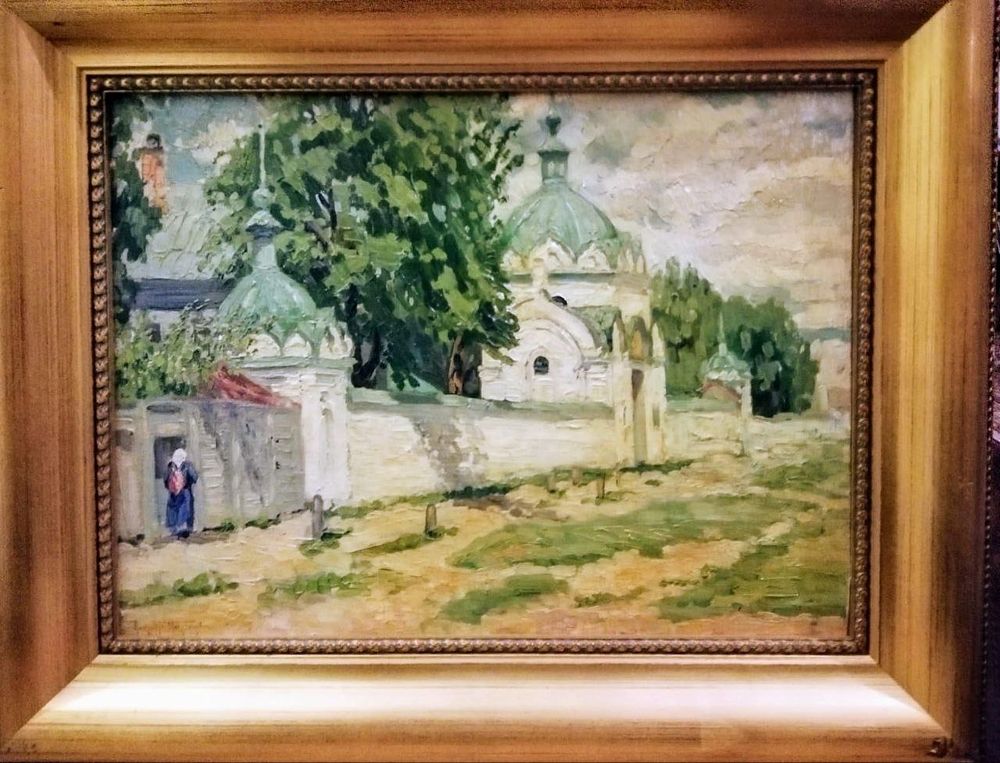
Bidspirit auction | Makovsky Alexander Vladimirovich (1869-1924) ”Near
Makovsky Alexander Vladimirovich (1869-1924) ”Near the church”, 40 x 54 cm, Oil on canvas. Signed on the bottom left: Alexander Makovsky. Expert opinion of the OE GTG Gusarova A.P. - Makovsky Alexander Vladimirovich was born on March 24, 1869 (Moscow) — October 26, 1924 (Leningrad). Painter, graphic artist. He was born into the family of the famous artist Vladimir Makovsky, the nephew of the painters Konstantin, Nikolai, Alexandra Makovsky, the grandson of Egor Makovsky, an amateur artist, art collector and public figure (one of the founders of MUZHVZ). He received his initial art education in the family under the guidance of his father. In 1884 he entered the MUZHVZ, studied with I. M. Pryanishnikov, V. D. Polenov, V. E. Makovsky. In 1888, he was awarded two small silver medals. In 1889, he was awarded a large silver medal for the painting ”Connoisseurs of Art” and graduated from College. In 1891-1893 he lived in Paris, studied at the F. Cormon School. Since 1894 he lived in St. Petersburg. In 1894-1895, he continued his education at the Higher Art College of Painting, Sculpture and Architecture under I. E. Repin. In 1895 he received the title of artist. Since 1897, he taught at the Higher Art and Pedagogical Courses at the Institute of Fine Arts, and was chairman of the competition commission for the review of drawings by secondary school students. In 1887-1890 he repeatedly visited the Crimea. From 1886 he participated in exhibitions of the Moscow Society of Art Lovers (until 1900, with interruptions), the Society of Russian Watercolorists (1897). In 1893-1898 and 1912 he exhibited his works at the Spring Exhibitions in the halls of the Academy of Arts. Since 1893, he has been a member of the Moscow Association of Artists. In 1899 he joined the TPHV, participated in all exhibitions of the Association from 1894 to 1922, in 1907-1923 he was a member of the board of the organization. I traveled a lot in Russia. Almost every year he traveled to Pskov, Novgorod, and the Volga River to work. In 1910 he toured the Kama River, in 1912 he traveled to the North of Russia, visited Vologda, Ferapontov and Kirillo-Belozersky monasteries, Arkhangelsk, Solovki. In 1911-1913 he visited Italy and Germany. In 1911 he was elected an academician. In the same year, he exhibited his paintings at the World's Fair in Rome. In 1912, he took part in the IV International Congress in Dresden on teaching drawing and applied arts. In 1913, he was awarded a gold medal at the Munich Secession exhibition. In 1913-1919 he taught at the Higher Art College of Painting, Sculpture and Architecture in St. Petersburg, from 1914 — professor. In 1919, he participated in the First State Free Art Exhibition in Petrograd. Since 1920, he taught at the Marine College. He was a member of the Council of the Central Geographical Museum. He worked in the field of book graphics, and in 1922 Makovsky's works were exhibited at the International Book Exhibition in Florence. In the last years of his life, he served as chairman of the Expert Commission at the auction hall and art Exhibition in the office of the Russian Red Cross Society. In 1924, he participated in one of the first exhibitions of the AHRR. The author of works on drawing and painting techniques, in 1905 he wrote and published the ”Guide for drawing teachers”, in 1918 — ”The experience of painting with oil paints”. In 1960, a retrospective exhibition of the artist's works was held in the halls of the Scientific Research Museum of the USSR Academy of Arts. He worked in landscape, portrait, and everyday genre. He was a follower of Vladimir Makovsky and the traditions of the Wanderers. However, unlike his father, he did not emphasize accusatory intonation, but sought to reflect everyday, everyday life in all its manifestations. Alexander Makovsky's works are characterized by a clear, confident, though somewhat ”dry” drawing, restrained color scheme, and attention to detail. The artist's works are in private and museum collections, including the State Tretyakov Gallery, the Russian Academy of Fine Arts Research Museum, and others.