Bidspirit auction | Dmitriev-Caucasian Lev Yevgrafovich (1849-1916). ”The
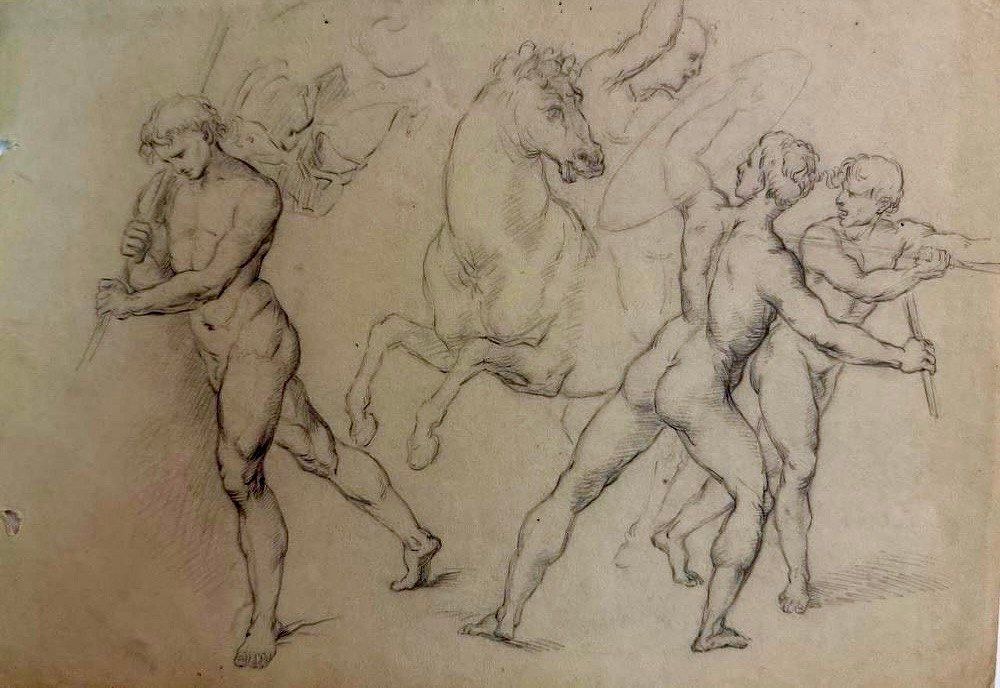
Dmitriev-Caucasian Lev Yevgrafovich (1849-1916). ”The Flag Bearers and the battle group.” Paper, pencil. 21x30 cm. After Francesco Scotto (1760-1829), after Raphael Santi (1483-1520). - The drawing by Lev Evgrafovich Dmitriev-Kavkazsky, “Standard-Bearers and a Battle Group, ” is an expressive academic study rooted in the classical tradition of composition “after a model” (after Francesco Scotto — after Raphael). The sheet unfolds a motif of ceremonial movement: on the left stands a standard-bearer with a banner pole; on the right, a compact group of figures engaged in active interaction; at the center, a horse that imparts inner momentum to the scene and a sense of rapid forward motion. The artist concentrates on the plasticity of the human body and the logic of movement: precise, confident pencil lines construct anatomy, emphasizing torsion of the torso, points of support, and the distribution of weight. The figures are treated as a unified “flow” — diagonals of gestures and banner poles organize the space, creating rhythm and tension characteristic of the Renaissance school. The sheet is valuable as evidence of the master’s professional graphic culture and his attention to the fundamentals of drawing — form, proportion, and dynamics. Lev Evgrafovich Dmitriev-Kavkazsky was a Russian draftsman and engraver, a pupil of Fyodor Iordan, and a representative of post-reform St. Petersburg academicism; he was a painter, etcher, master of portrait printmaking, and illustrator. He was an Academician of the Imperial Academy of Arts. Lev Evgrafovich Dmitriev-Kavkazsky (Lev Kavkazsky) was born in 1857 in the city of Kislovodsk, in the Caucasus. From childhood he was captivated by the beauty of the surrounding mountain landscapes and showed a keen interest in drawing. After receiving his initial artistic education at a local gymnasium, Kavkazsky went to Moscow, where he entered the Moscow School of Painting, Sculpture, and Architecture. His years of study in Moscow became a period of intensive creative work and the formation of his individual style. Kavkazsky immersed himself in the study of the Russian landscape school, adopting the technical methods and manner of such great masters as Ivan Shishkin and Alexei Savrasov. After completing his studies, Kavkazsky returned to the Caucasus, where he began to work actively on creating his pictorial compositions. His landscapes are distinguished by remarkable precision in conveying natural details, richness of color, and depth of spatial rendering. The artist virtuously employed various painterly techniques, creating vivid, saturated canvases filled with air and light. In 1883–1884 Dmitriev-Kavkazsky edited the illustrated journal Lastochka (“The Swallow”), which published reproductions from drawings primarily by Russian artists; subsequently, for three years he headed the artistic department of the journal ”Vsemirnaya Illustratsiya” (“World Illustration”). In 1887 he was one of the founding members of the Society of Russian Illustrators. He repeatedly traveled to the Caucasus, and in the summer of 1887 journeyed through the Trans-Caspian region and Central Asia. He worked primarily in etching and drypoint. He executed more than 65 engravings, most of which were assembled in the collection of the well-known connoisseur of original etchings, Senator E. E. Reitern. Among his principal works are portraits of A. S. Pushkin (1874), Charles Darwin (1879), F. M. Dostoevsky (1880), F. F. Gorshelt, Archimandrite Ignatius (Brianchaninov), the singer M. D. Kamenskaya (before 1882), and N. A. Chelishchev (1892); as well as illustrations for the book “The War of the Russian People with Napoleon in 1812” by I. N. Bozherianov (St. Petersburg, 1910; 2nd ed., 1911). He also painted landscapes such as “Ruins of a Fortress on the Amu Darya, ” “In the Lower Reaches of the Kuban” (c. 1881), “Quiet Morning” (c. 1884), *“Dacha, ”* and others. He produced drawings for the St. Petersburg journals *Svet* (“Light, ” 1870s–1880s), *Vsemirnaya Illustratsiya* (1880s–1890s), and ”Lukomorye” (1910s). He is the author of the book “Across Central Asia. Notes of an Artist (1887–1889), with 199 illustrations by the author” (St. Petersburg, 1894).