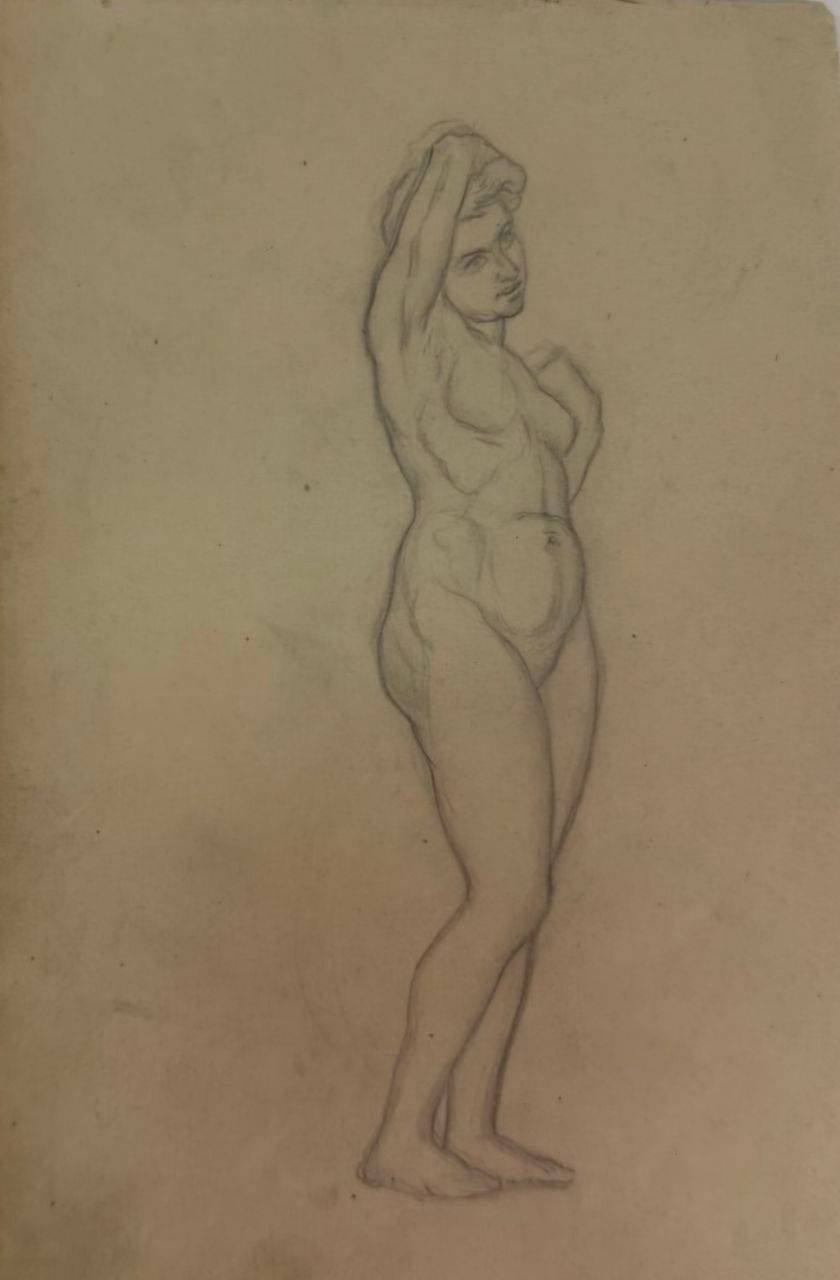
Bidspirit auction | Dmitriev-Caucasian Lev Yevgrafovich (1849-1916). ”Naked.”
Dmitriev-Caucasian Lev Yevgrafovich (1849-1916). ”Naked.” Paper, pencil, 21.5 x 13.5 cm. - The pencil drawing by Lev Yevgrafovich Dmitriev-Kavkazsky, ”Nude”, is an intimate academic study in which the artist concentrates on what matters most: the plasticity of the body, the precision of proportions, and the expressiveness of line. The restrained graphic language conveys not so much portrait individuality as the harmony of form and the clarity of construction — from the overall silhouette to anatomical nuances and soft tonal transitions. The work demonstrates the high professional culture of drawing at the turn of the late 19th to early 20th century: a confident line models volume, indicates light and shadow, and emphasizes the natural rhythm of the figure. The small format enhances the sense of intimacy and the “studious” honesty of the sketch, transforming it into a complete artistic statement — calm, restrained, and exceptionally precise. Lev Yevgrafovich Dmitriev-Kavkazsky was a Russian draftsman and engraver, a pupil of Fyodor Iordan, a representative of St. Petersburg academicism of the post-reform era, a painter, etcher, master of portrait printmaking, and illustrator. He was an Academician of the Imperial Academy of Arts. Lev Yevgrafovich Dmitriev-Kavkazsky (Lev Kavkazsky) was born in 1857 in the town of Kislovodsk, in the Caucasus. From an early age, he was captivated by the beauty of the surrounding mountain landscapes and showed a strong interest in drawing. After receiving his initial artistic education at a local gymnasium, Kavkazsky moved to Moscow, where he enrolled at the Moscow School of Painting, Sculpture, and Architecture. His years of study in Moscow became a period of intense creative work and the formation of his individual style. Kavkazsky immersed himself in the study of the Russian landscape school, adopting the techniques and manner of great masters such as Ivan Shishkin and Alexei Savrasov. After completing his studies, he returned to the Caucasus, where he began working actively on his pictorial compositions. His landscapes are distinguished by remarkable accuracy in rendering natural details, richness of color, and depth of spatial representation. The artist virtuously employed various painting techniques, creating vivid, saturated canvases filled with air and light. In 1883–1884, Dmitriev-Kavkazsky edited the illustrated journal ”Lastochka”, which published reproductions of works primarily by Russian artists; subsequently, for three years he headed the artistic department of the journal ”Vsemirnaya Illustratsiya”. In 1887, Dmitriev-Kavkazsky was one of the founding members of the Association of Russian Illustrators. He repeatedly traveled to the Caucasus, and in the summer of 1887 journeyed through the Trans-Caspian region and Central Asia. He worked mainly in etching and drypoint. He produced more than 65 engravings, most of which were collected by the well-known connoisseur of original etchings, Senator E. E. Reitern. Among his principal works are portraits of Alexander Pushkin (1874), Charles Darwin (1879), Fyodor Dostoevsky (1880), F. F. Gorshelt, Archimandrite Ignatius (Bryanchaninov), the singer M. D. Kamenskaya (before 1882), and N. A. Chelishchev (1892); as well as illustrations for the book ”The War of the Russian People with Napoleon in 1812” by I. N. Bozherianov (St. Petersburg, 1910; 2nd ed., 1911). He also painted landscapes, including ”Ruins of a Fortress on the Amu Darya”, ”In the Lower Reaches of the Kuban” (c. 1881), ”Quiet Morning” (c. 1884), ”Dacha”, and others. He contributed drawings to the St. Petersburg journals ”Svet” (1870s–1880s), ”Vsemirnaya Illustratsiya” (1880s–1890s), and ”Lukomorye” (1910s). He is the author of the book ”Through Central Asia. Notes of an Artist (1887–1889)” with 199 illustrations by the author (St. Petersburg, 1894).