Bidspirit auction | Natalia Sergeevna Goncharova (1881-1962) ”The
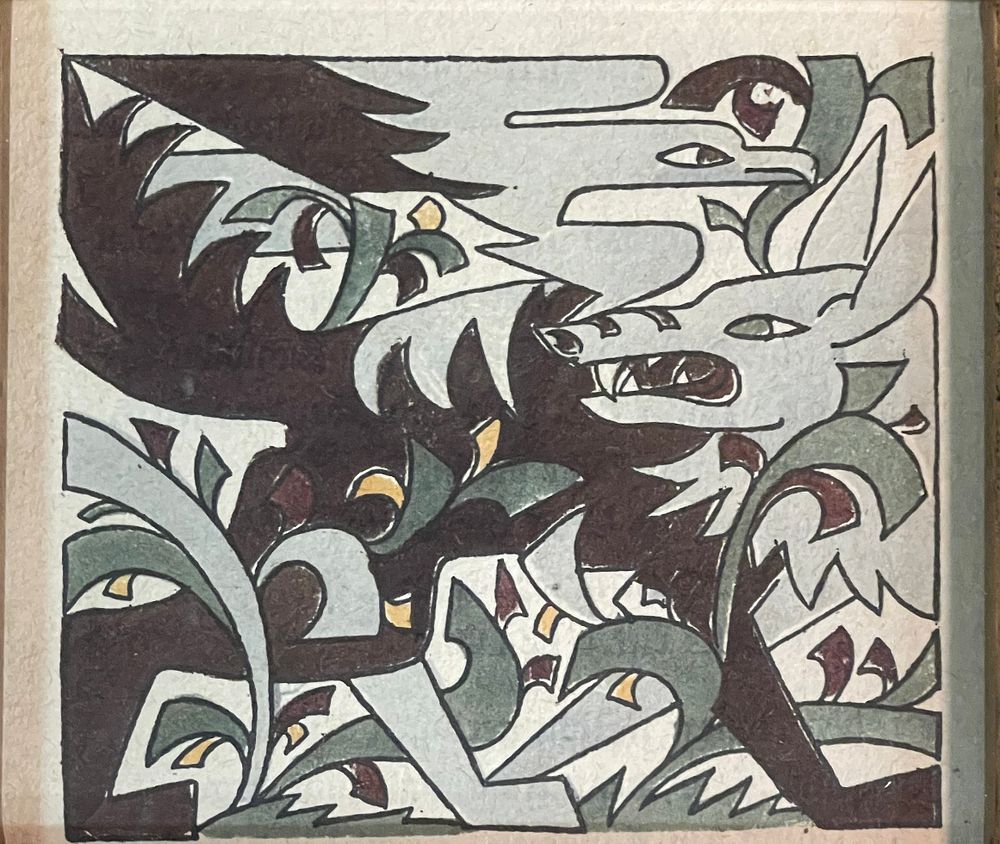
Natalia Sergeevna Goncharova (1881-1962) ”The Wolf and the Falcon”. A joke from the album ”The Word about Igor's Regiment” is on it. language. 1921, Berlin. One of the 669 copies. A hand-painted drawing based on stencils and under the personal supervision of the artist to a famous ancient Russian legend. This joke is from the album No. 666. 10x11.5 cm - In the pochoir ”Wolf and Falcon”, Natalia Sergeyevna Goncharova creates a striking, almost heraldic image in which animals are transformed into signs and symbols. The composition is built on a clash of characters and rhythms: the predatory plasticity of the wolf, its sharp contour and tense snarl, are set against the swiftness and “airiness” of the falcon. Generalized forms, an active line, and a decorative flatness turn the scene not into an illustration in the conventional sense, but into a visual formula of the ancient epic, imbued with a sense of primordial force and mythological energy. The pochoir technique — hand-applied stencil coloring — gives the sheet a distinctive material presence: color is laid down in pure, flat areas, emphasizing the ornamental quality and the dynamic silhouettes. It is significant that this edition belongs to the Berlin album ”The Tale of Igor’s Campaign” in German (1921) and was produced under the artist’s personal supervision, which enhances its collectible value as an authorial work closely connected to the book culture of the Russian avant-garde. Pochoir from the album ”The Tale of Igor’s Campaign” (German edition). Berlin, 1921. One of 669 copies. Sheet no. 666. Hand-colored using stencils under the personal supervision of N. S. Goncharova. Size: 10 × 11.5 cm. Natalia Sergeyevna Goncharova (21 June [3 July] 1881 — 17 October 1962) was a Russian avant-garde artist, graphic artist, and stage designer, and a representative of Rayonism. She was the wife of Mikhail Larionov. Goncharova was born on 21 June 1881 at her father’s estate of Ladyzhino in Tula Governorate. Her parents were the architect Sergey Goncharov and Ekaterina Belyaeva, the daughter of a professor at the Moscow Theological Academy. The future artist belonged to a noble family descended from the Kaluga merchant Afanasy Goncharov, the founder of the Polotnyany Zavod. She was also a great-great-niece of her namesake Natalia Goncharova, the wife of Alexander Pushkin. In 1891 the family moved to Moscow, where Goncharova entered the Fourth Women’s Gymnasium and graduated with a silver medal. She briefly enrolled in medical courses but abandoned them after three days. In 1901 Goncharova entered the Moscow School of Painting, Sculpture, and Architecture, joining the sculpture department in the class of Pavel Trubetskoy. There she met the artist Mikhail Larionov, who told her: “You have an eye for color, yet you are occupied with form. Open your eyes to your own eyes!” Under his influence, she began creating Impressionist works and transferred to the painting course under Konstantin Korovin. At the same time, she continued to work in sculpture; in 1904 she received a small silver medal for her animal studies. In the 1910s Goncharova became one of the leaders of Russian Futurism, experimenting with abstract painting, Cubism, and Rayonism. Works from this period are characterized by geometrized forms, vivid contrasting colors, and dynamic compositions. In addition to painting, she was active in many other fields: she created stage sets and costumes for theatrical productions, worked in book illustration, and designed textiles and household objects. Her art was distinguished by extraordinary diversity and innovation. In 1915 Goncharova traveled to France to work on the ”Ballets Russes”, where her works aroused great interest among the European artistic elite. She actively participated in avant-garde exhibitions, produced illustrations, and promoted Russian culture internationally, including through illustrated publications, gaining recognition and renown worldwide. Throughout her career, Natalia Goncharova remained in constant search of new artistic forms. Her unique style, combining traditional Russian motifs with avant-garde experimentation, had a profound influence on the development of modern art. She died in 1962 in Paris, leaving a rich artistic legacy that continues to inspire and captivate today.