Bidspirit auction | Natalia Sergeevna Goncharova (1881-1962) A
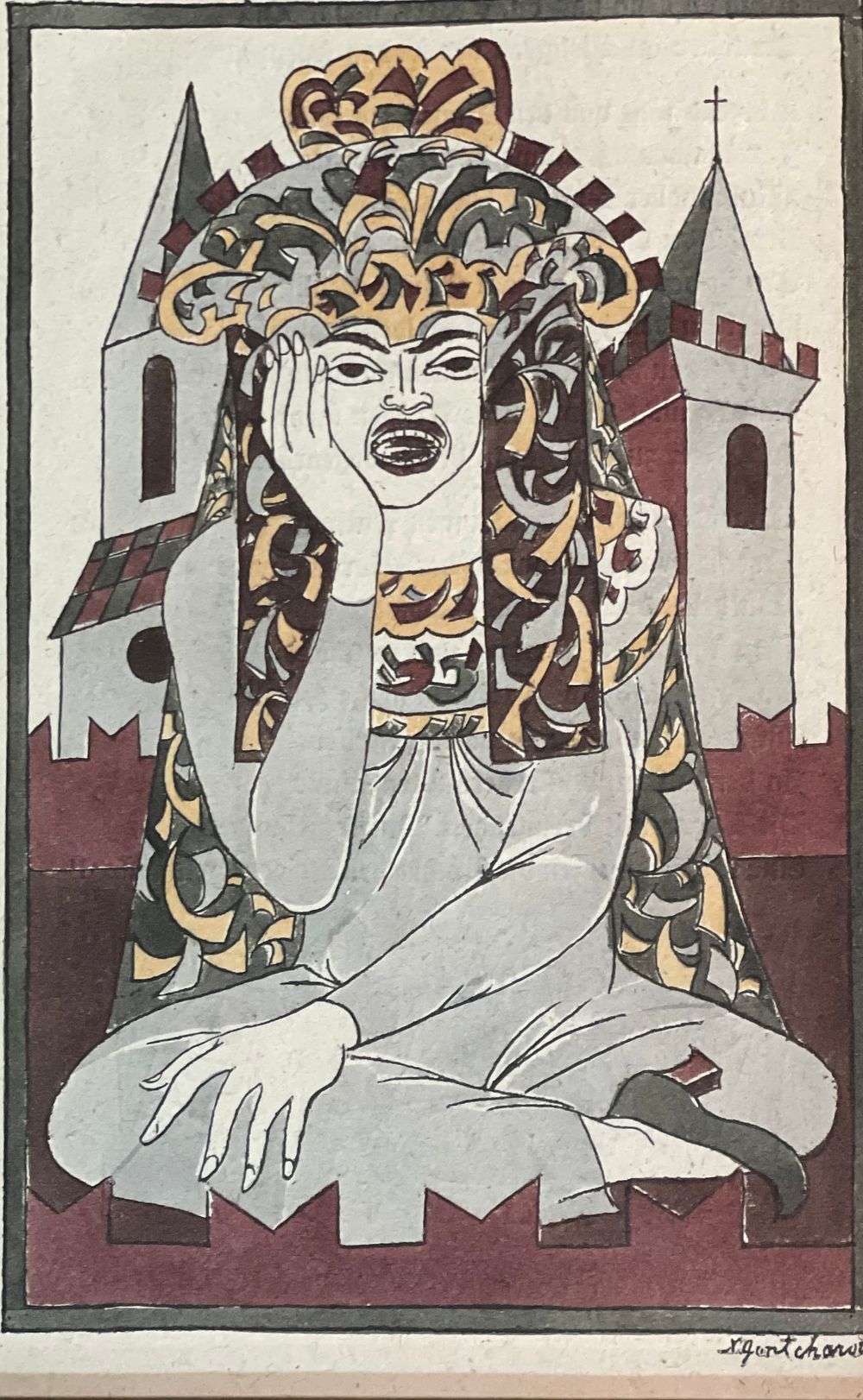
Natalia Sergeevna Goncharova (1881-1962) A joke from the album ”The Word about Igor's regiment” on german language. 1921, Berlin. One of the 669 copies. A hand-painted drawing based on stencils and under the personal supervision of the artist to a famous ancient Russian legend. This joke is from the album No. 666. ”Yaroslavna's Cry” Size: 22x14 cm. - Natalia Sergeevna Goncharova's sewing from the album ”The Word about Igor's Regiment” (German edition) is one of the artist's most expressive works in the field of book and easel graphics of the emigration period. Turning to one of the key texts of ancient Russian literature, Goncharova translates the epic plot into the language of a decorative, iconic composition — with the emphasized flatness, energy of line and ornamental rhythm characteristic of her artistic thinking. The sheet ”Yaroslavna's Lament” reveals the theme of personal sorrow and tragic premonition against the background of historical narrative, combining archaic imagery with avant-garde expressiveness. The technique of pochoir, stencil coloring, gives the work a special materiality and picturesqueness: each copy was hand—painted and produced under the personal supervision of the artist. Natalia Sergeevna Goncharova (June 21 (July 3), 1881 — October 17, 1962) was a Russian avant-garde artist, graphic artist, and set designer. A representative of luchism. Mikhail Larionov's wife. Natalia Goncharova was born on June 21, 1881 in her father's Ladyzhino estate in Tula province. Her parents were architect Sergei Goncharov and the daughter of Professor Ekaterina Belyaeva of the Moscow Theological Academy. The future artist belonged to a noble family, which descended from the Kaluga merchant Afanasy Goncharov, the founder of the Linen Factory. She was also the great—grandniece of her namesake Natalia Goncharova, the wife of Alexander Pushkin. In 1891, the family moved to Moscow, where Natalia Goncharova entered the Fourth Women's Gymnasium and graduated with a silver medal. Goncharova tried to enroll in medical courses, but dropped out after three days. In 1901, Goncharova entered the Moscow School of Painting, Sculpture and Architecture in the sculpture department in the class of Pavel Trubetskoy. There she also met the artist Mikhail Larionov, who told her: ”You have eyes for color, and you are busy with form. Open your eyes to your own eyes!” Under his influence, the artist began to create impressionist paintings and switched to a painting course with Konstantin Korovin. However, Goncharova continued to practice sculpture. So in 1904, she received a small silver medal for animal studies. In the 1910s, Goncharova became one of the leaders of Russian futurism, experimenting with abstract painting, cubism, and luchism. Her paintings of this period are distinguished by their geometrized shapes, bright contrasting colors and dynamic compositions. In addition to painting, Natalia Goncharova proved herself in other forms of art - she created sets and costumes for theatrical productions, engaged in book graphics, design of fabrics and household items. Her work was incredibly diverse and innovative. In 1915, Goncharova traveled to France to work on the Russian Seasons, where her work aroused great interest among the European artistic elite. She actively participated in avant-garde exhibitions, worked on creating illustrations and was engaged in popularization of Russian culture, including through illustrated publications, gaining recognition and fame all over the world. Throughout her creative career, Natalia Goncharova has been constantly searching for new artistic forms. Her unique style, combining traditional Russian motifs with avant-garde experiments, had a significant impact on the development of world art. Natalia Goncharova died in Paris in 1962, leaving a rich creative legacy that still inspires and delights today.