Bidspirit auction | Granovsky Samuel (Chaim) ”Portrait of
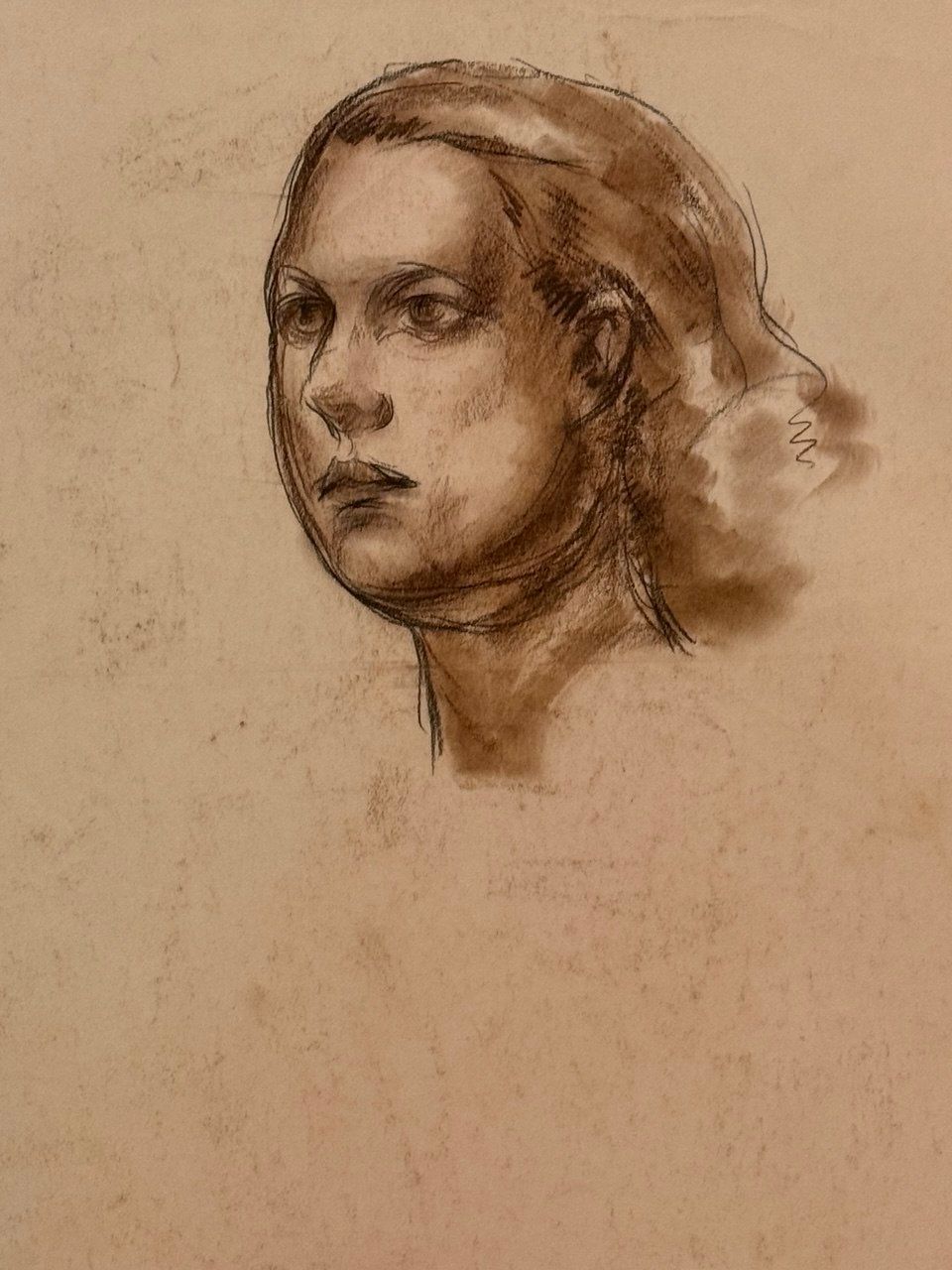
Granovsky Samuel (Chaim) ”Portrait of a woman” 1930s. Paper, sepia, charcoal, wet brush. 64x50 cm . The author's signature in the lower left corner is ”S. Granovsky”. - ”Portrait of a Woman” by Samuel (Chaim) Granovsky (1930s) is an expressive sheet in which the artist achieves a rare combination of psychological precision and painterly softness of graphics. The image is based on tonal modeling of the shape: the facial features and the turn of the head are lined up with a confident line and nuanced stretches, so that the portrait is perceived as whole and ”breathing”, without excessive detail, but with a clear character. Sepia combined with charcoal and wet brushwork creates a rich, velvety texture. A warm tone unites the composition, charcoal enhances contrasts and accents, and blurring gives the chiaroscuro a smoothness, as if bringing the drawing closer to a picturesque sketch. Liszt gives the impression of an independent, finished work — chamber in mood and very professional in performance. Granovsky Samuel (Chaim) October 5, 1889 (Yekaterinoslav) 1942 (Paris (?). Painter, graphic artist, sculptor. Biographical information about the master is scarce. He studied at an art school in Odessa. In his youth, he settled in Paris, where he maintained close ties with many representatives of the ”Russian diaspora.” In the early 1920s, he became interested in Dadaist art. Collaborated in the Via group. In 1923, together with S. Delaunay and V. S. Barth, he designed the production of T. Tzara's play ”The Airy Heart”. He created a number of abstract sculptures, which he exhibited at the Salon of Independents. Among the Montparnasse bohemians, he was considered one of the most colorful and spiritual figures. According to the art critic M. Reinal, ”Granovsky's stuff... they don't remind us of the reality around us in any way... they are not in any way consistent with our ideas about existing objects, despite the fact that, by their constructive nature, they retain the same commonality with a ball or cube, like any object. Therefore, we have the right to ask ourselves whether his works are not the starting point for a renewed art that will eventually find its own aesthetic inherent in him...” In July 1942, the artist was arrested and sent to a concentration camp.