Bidspirit auction | Sergey Alekseyevich Luchishkin (1902–1989), *Village
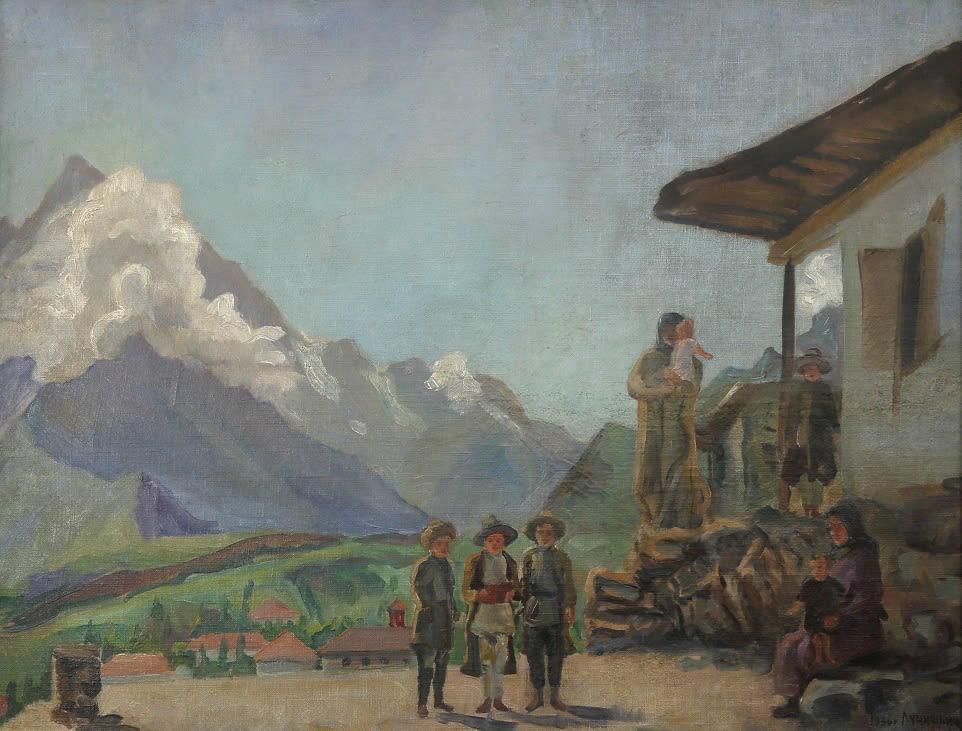
Sergey Alekseyevich Luchishkin (1902–1989), *Village in the Caucasus Mountains*, 1936. Oil on canvas. 59 × 77.7 cm. Signed and dated in the lower right: “1936. Luchishkin.” Expert opinion by Yu. V. Rybakova. - Sergei Alekseevich Luchishkin's work ”Village in the Caucasus Mountains” (1936) is a picturesque landscape with a genre motif in which majestic nature and everyday human life form a single, harmonious whole. In the background, a panorama of a mountain range with a snow-capped peak opens up; soft transitions of tones and a finely structured aerial perspective create a feeling of transparent, light-filled space. The foreground is designed as a ”scene” of rural life: at the house, on the site at the foot of the mountains, the figures of the inhabitants are shown — calm, natural, as if stopped in a short moment. Their presence sets the scale and emphasizes the monumentality of the landscape, and the composition itself is based on the contrast of the stable horizontals of the valley and the diagonals of the mountain slopes. The color is restrained and noble: the cool bluish-gray tones of the mountains are balanced by the warm earthy shades of buildings and the foreground. The work is distinguished by clarity of construction, precision of observation and lyrical mood — characteristic qualities of painting of the 1930s, where attention to reality is combined with the poetization of nature and labor. Artist, stage designer, and theatre practitioner. From 1919, he studied at VKHUTEMAS under A. Arkhipov and A. Exter. At the same time, he attended the Institute of Declamation, studying directing. He was a member of the groups ”Projectionists” (1922), OST (from 1925), ”Izobrigada” (1930), and the ”Method” group (1924). As part of the post-revolutionary “second wave” of the Russian avant-garde, he took part in some of the most radical artistic experiments of the 1920s (including ”Coordinates of the Pictorial Surface”, 1924, State Tretyakov Gallery). He worked on the film ”Circus” (directed by G. G. Alexandrov, 1936). In the late 1930s–early 1940s, he specialized in sports-themed works. His works are held in the collections of the State Tretyakov Gallery and the State Russian Museum.