Bidspirit auction | Belyakova Ekaterina Mikhailovna (1891-1980) ”Figures
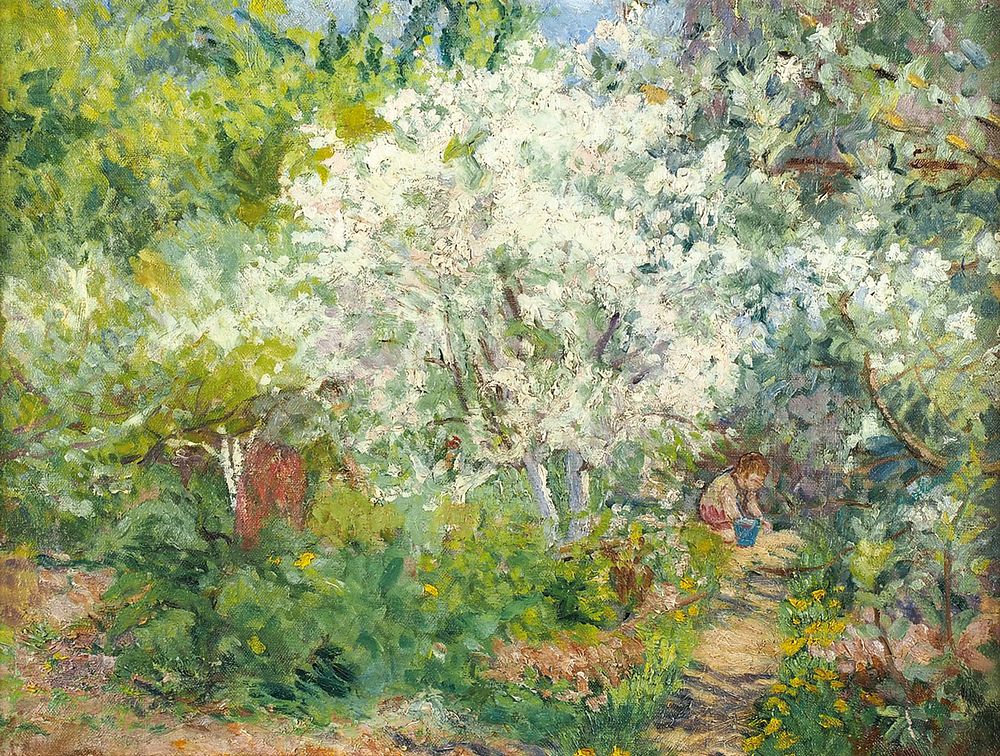
Belyakova Ekaterina Mikhailovna (1891-1980) ”Figures in the garden”. The second quarter of the twentieth century. Oil on canvas, 45×60 cm. Expert opinion by T.M. Levina. - In Ekaterina Mikhailovna Belyakova’s work ”Figures in the Garden” (second quarter of the 20th century), the genre motif is organically dissolved into the plein-air landscape: amid dense greenery and blossoming crowns, the lightly indicated figures become not a “subject” but a subtle, living accent that sets scale and a sense of presence. The composition is built on spatial depth—the viewer’s gaze is drawn into the garden, where light breaks through the foliage and falls onto the ground in shimmering patches. The painting is distinguished by a free, energetic manner of execution: broad brushstrokes and nuanced transitions of green, ochre, and light tones create an impression of air and movement, while the texture of the paint layer conveys the vibration of a sunlit day. Belyakova subtly maintains a balance between the decorative quality of color masses and attentive observation of nature, transforming the scene into a lyrical image of tranquility and summer abundance. Painter, graphic artist, monumental artist. Studied at the Stroganov Central School of Art and Industry (1909–1913) under S. V. Noakovsky and P. P. Pashkov; at the Moscow School of Painting, Sculpture and Architecture (1913–1917) under N. A. Kasatkin, A. M. Korin, S. V. Malyutin, S. D. Miloradovich, L. O. Pasternak, A. E. Arkhipov, and A. M. Vasnetsov; and at Vkhutemas (1921–1924), in the monumental department of the painting faculty under P. V. Kuznetsov and N. M. Chernyshev. In the 1920s, she made copies of frescoes from Novgorod churches. In the early 1930s, as part of a team of artists, she participated in the decoration of the Kaluzhsky Bor sanatorium. In the 1930s–1940s, she worked at the Workshop of Monumental Painting of the Academy of Architecture of the USSR and took part in the decoration of building facades and interiors. She was the author of landscapes, portraits, and still lifes, and worked extensively in watercolor. In the 1930s–1950s, she repeatedly worked in Crimea. Her works are represented in many museum collections, including the State Tretyakov Gallery and the State Russian Museum.