Bidspirit auction | Yeliseyev Konstantin Stepanovich (1890-1968) The
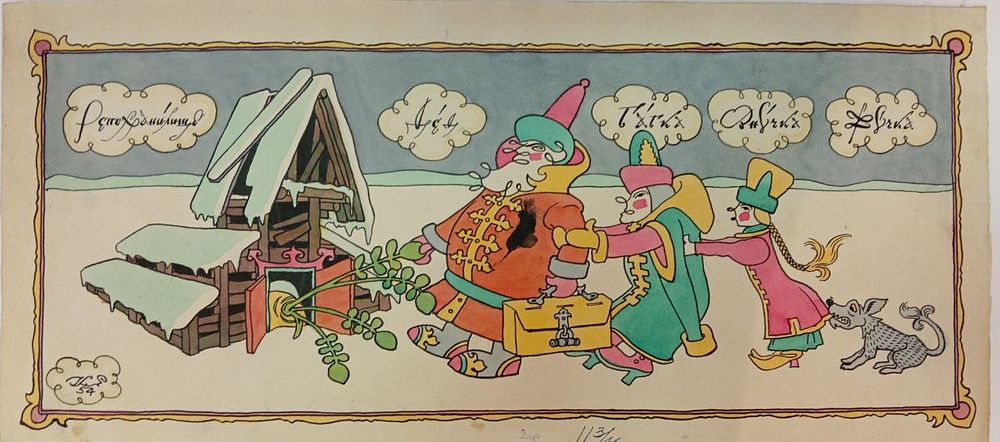
Yeliseyev Konstantin Stepanovich (1890-1968) The Turnip. Illustration for the magazine ”Crocodile” No. 36 1954. Paper, ink, pen, brush, watercolor, 22.3 x 49.7 cm. In the lower left corner is the author's signature and date, On the reverse side is the label of the magazine ”Crocodile”, author's and editorial inscriptions. Silaev's expert opinion. - Konstantin Stepanovich Eliseev's illustration ”Turnip”, made for the magazine ”Crocodile” No. 36 (1954), is a vivid example of his satirical graphics, where a folk story turns into an accurate caricature metaphor. The fairy-tale scene is built as a dynamic chain of characters: grotesque figures, exaggerated gestures and ”talking” facial expressions create a sense of action, and comedy is born from the contrast of the solemn seriousness of the characters and the absurd simplicity of what is happening. Eliseev masterfully combines the means of drawing and painting touch-ups: the confident line of the pen and brush captures the character and silhouette, ink sets the rhythm and graphic clarity, watercolor enhances the decorative and poster expressiveness of the sheet. The work is perceived as a finished magazine illustration — accurate in observation, light in intonation, and at the same time very ”crocodile” in wit. Eliseev worked in satirical graphics. Since the early 20s, he drew cartoons on political and everyday topics for the Moscow newspapers Gudok (1922-1968), Searchlight (1923-1935), Behemoth (1924-1928), Crocodile (1924-1968), and others. Designed a number of performances: ”At the Bottom” by A.M. Gorky (1920, together with S.M. Eisenstein), ”Sleep on the Mound” by Ya. Kupala and others. He created sketches of costumes at the Mosfilm studio: Alexander Nevsky (1938), and Lenin in 1918 (1939). The artist's works were exhibited at foreign exhibitions: Zagreb (1973), etc. Personal exhibitions were held in Moscow (1948, 1951, 1968), Minsk (1952), Yaroslavl (1954). The artist's works are in many regional museums, as well as in private collections in Russia and abroad.