Bidspirit auction | Anatoly Timofeevich Zverev (1931-1986) ”Remembering
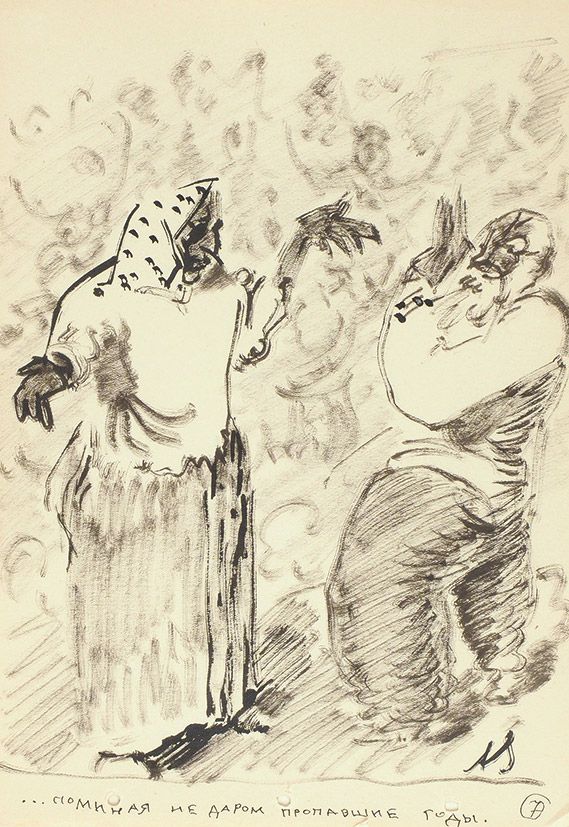
Anatoly Timofeevich Zverev (1931-1986) ”Remembering the lost years.” Illustration to N.V.Gogol's novella ”The Terrible Revenge”. 1956. Paper (sheet from album), ink. 28.5x 20 cm. Expert opinion of Silaev V.S. - The sheet belongs to the early cycle of illustrations by A.T. Zverev to the works of N.V. Gogol, one of the most integral and rare layers of his graphic heritage of the mid-1950s. The artist does not strive for the literal ”picturesqueness” of the narrative: he snatches out the emotional core of the scene and translates Gogol's intonation into the language of instant drawing — intense, extremely precise and free. Zverev's ink sounds like calligraphy.: The fast, elastic stroke and the contrast of black and white create a dramatic light effect. In this laconic manner, an image is born in which it is not the details that are more important, but the psychological state — the bitter memory, the fracture and the hidden anxiety contained in the very title ”Remembering the lost years.” The work retains a sense of improvisation and ”first touch” — qualities for which the early graphics of the master are highly appreciated. The illustrations in this series are relatively rare and of considerable collector's interest; the presence of an expert opinion confirms the attribution. Anatoly Timofeevich Zverev, 1931-1986. Born on November 3, 1931 in Sokolniki, Moscow, in the family of a Civil War invalid, his mother is a worker. He studied at the drawing school at the lessons of the graphic artist Nikolai Vasilyevich Sinitsyn (a student of A.P. Ostroumova-Lebedeva). In 1954, he entered the Moscow Regional Art College in Memory of 1905, from where he was soon expelled for bohemian-anarchic behavior. Participant of apartment exhibitions 1959-1962. His first foreign exhibition was in 1965 at the Moth Gallery, Paris. Anatoly Zverev's creative path was in many ways a challenge to philistine ”common sense”, a semi-conscious self-rejection of the deadening bureaucracy of established norms and generally accepted ideas about art. The influence of his innovative creative experience on all modern painting is still noticeable. The culmination, the maximum personal rise of his work took place at the turn of the 50 -60s. and was a kind of living embodiment of the spirit of free ”independent underground” trends in art. He was an undoubted leader in the context of the nonconformism of the 60s, acting at the same time as Impressionist No. 1. But he remained true to his individuality and did not allow himself to be drawn into rigid ideological schemes and did not show blind loyalty to any art groups, although the underground environment of that time was often formed precisely from such lonely, non-institutionalized artists. Among the majority of artists of his generation and his allies in independent art, he stands out for the fact that he does not fit into any of the communities that have developed there. His works are in the collections of the State Tretyakov Gallery, Moscow Museum of Modern Art, Moscow. Museum of Contemporary Art ART4.RU, Moscow. The State Historical Museum, Moscow. The New Museum, St. Petersburg. Jane Voorhees Zimmerli Museum, Norton and Nancy Dodge Collection, Rutgers University, New Brunswick Campus, New Jersey, USA. Museum of Modern Art, New York, USA. The Bar-Gera Collection, Cologne, Germany. The Kostaki Collection, Athens, Greece. The drawing under study belongs to the magnificent early cycle of illustrations by A.T. Zverev to the works of N.V. Gogol, many of which he knew almost verbatim. These illustrations are distinguished by their virtuosity of execution, liveliness and fluency of lines, and precision of drawing. Zverev's skill as a draughtsman is admirable, and makes every such drawing a masterpiece. The illustrated illustration for the story ”Terrible Revenge” from the magnificent cycle ”Evenings on a farm near Dikanka” is no exception. A.T. Zverev's drawing ”Remembering the lost years” for N.V. Gogol's novella ”The Terrible Revenge” is rare and has museum significance.