Bidspirit auction | Alexey Vasilyevich Grishchenko (1883-1977), ”Landscape
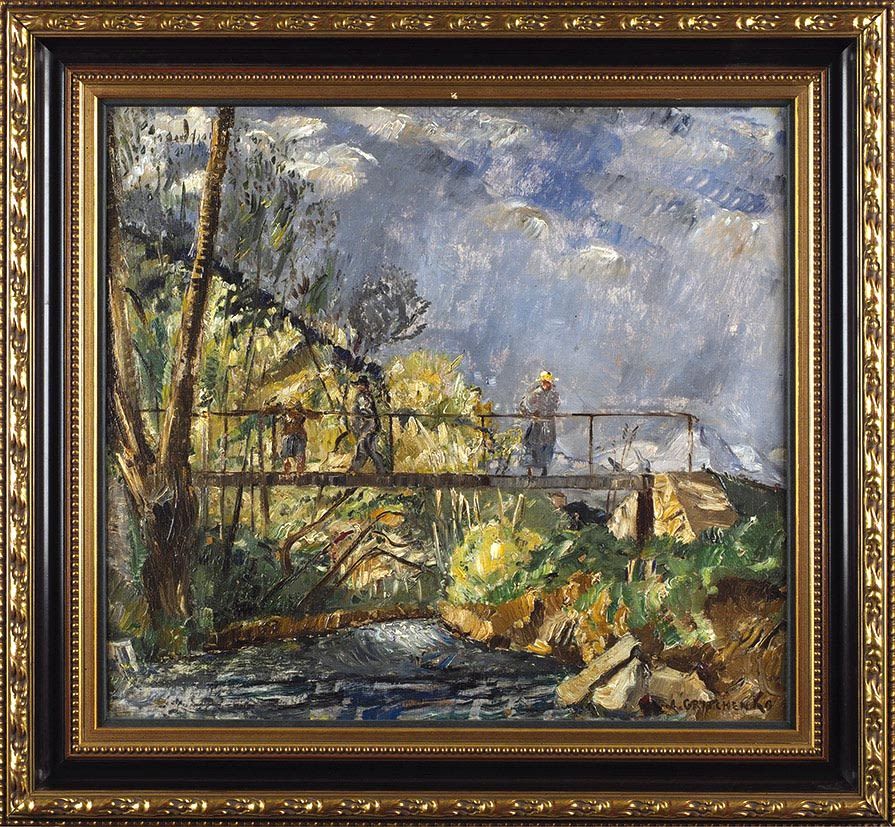
Alexey Vasilyevich Grishchenko (1883-1977), ”Landscape with a bridge”. 45.5 x 50cm. Plywood, oil. On the right is the author's signature: ”Gritchenko”. On the back is a sticker: 50 x 45 Gritchenko Lagnes au printemps. Expert opinion by T.M. Levina - ”Landscape with a Bridge” is an expressive example of Alexey Grishchenko's mature manner, in which the impression of nature is combined with the generalizing power of form and color. The artist builds the composition as a living, dynamic fragment of space: The bridge becomes a semantic “bridge” between the planes, and the movement of the brushstroke and the rhythm of the lines give the scene an inner pulse — a feeling of air, water and light. Grishchenko works with a broad, temperamental writing: dense textured layers and an active brush transform the image into an independent pictorial matter. Color relations do not sound descriptive, but emotional — through the contrasts of warm and cold, light flashes and deep shadows. As a result, the landscape is perceived as an experience of a place, ”captured” in the moment — not so much a view as a state. The use of plywood enhances the effect of the study's immediacy, and the signature ”Gritchenko” confirms the author's character of the work. The sticker on the back with the French attribution ”Lagnes au printemps” (Lan/Lanes in spring) adds the context of the artist's European period to the work and captures the existence of the thing. The expert opinion of T.M. Levina increases the attributive and collectible significance of the work. Alexey Vasilyevich Grishchenko is one of the brightest representatives of cubofuturism and primitivism in Russian art, a painter, graphic artist, and art theorist. In 1905 he studied in the studio of the painter S. I. Svyatoslavsky in Kiev, in 1910-1911 — in the studios of K. F. Yuon and I. I. Mashkov in Moscow. In 1911 he visited Paris, and in 1914 he traveled to Italy. In 1911 he took part in the exhibition of the Moscow Salon, a year later — in the exhibition of the ”Jack of Diamonds” in Moscow, in 1913 he exhibited his works at the exhibition of modern painting, in 1913-1914 participated in the expositions of the Youth Union, in 1915 - in the exhibition of leftist movements in art. In the 1910s, he became known not only as a painter, but also as the author of sharp polemical reports and articles on art issues. He emigrated in 1920. In 1922 he moved to France. In 1922, he participated in the First Russian Art Exhibition at the Van Diemen's Gallery in Berlin. Personal exhibitions of the artist were held in the Paris galleries Dominique (1923), Percier (1924), Bing (1926), Drouet (1928-1930, 1933). In 1928, he sent his works to an exhibition of Modern French art in Moscow. In the 1930s and 1960s, he continued to work and exhibit a lot. Retrospective exhibitions of the master's works were held in Gothenburg (1937), Lviv (1937), Limoges (1943-1944), Paris (1945, 1947, 1957), Strasbourg (1952-1953, 1955), New York (1958, 1966), Toronto (1977). Grishchenko's works are in the State Museum of Fine Arts, the State Museum of Fine Arts, the Pushkin State Museum of Fine Arts, the Museum of New Art in Madrid, the National Museum of Modern Art in Paris, the Royal Museums of Copenhagen and Brussels.