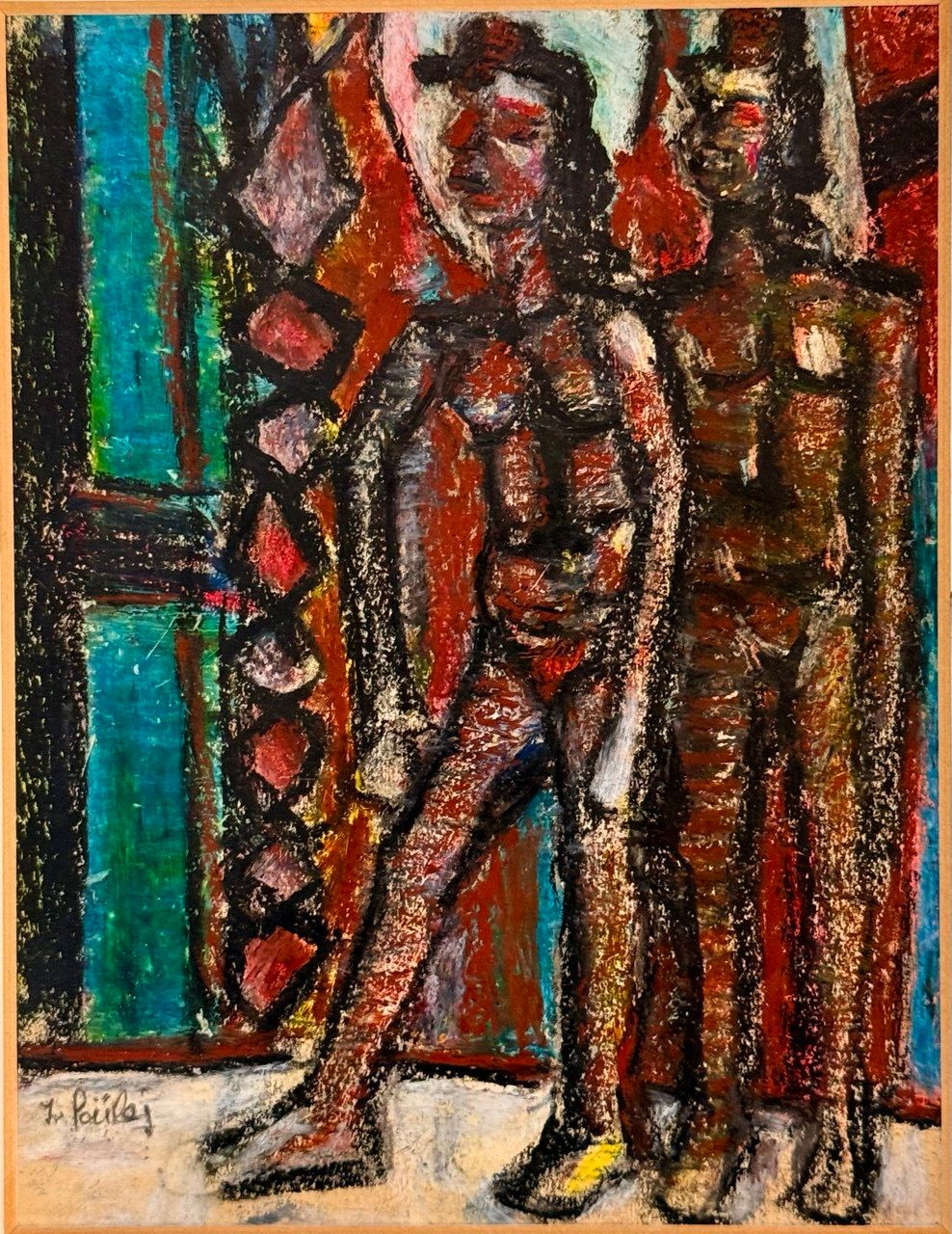
Bidspirit auction | Isaac Pyles (1895 - 1978)
Isaac Pyles (1895 - 1978) ”Two”, the second quarter of the twentieth century. Paper, mixed media. 17x13 cm. In the lower left corner is the author's signature: ”I.Pails”. - The chamber composition ”Two” reveals one of the most subtle aspects of Isaac Pyles' work — the ability to talk about human relationships through a laconic gesture and intonation. The small format sets an intimate scale: what we have in front of us is not a plot, but a moment of intimacy and inner dialogue, conveyed with restraint and precision. The mixed technique allows the artist to combine the graphic clarity of the contour and the painterly softness of the tonal spots. The line captures character and movement, and the transparent layers create a sense of air and light, leaving the image light, ”unsaid” — like a memory or a quick sketch of an impression. In this combination of freedom and precision, the Parisian culture of drawing and the painterly musicality characteristic of the master are especially noticeable. The signature ”I. Pails” in the lower left corner reinforces the author's character of the work and complements its collector's appeal. Payles Isaac December 13, 1895 (Kiev) 1978 (Paris). Painter, graphic artist. Biographical information about the artist is scarce. He graduated from the Kiev Art School. Around 1913 he went to France, studied sculpture in private workshops in Paris. Around 1915 he returned to Russia and took up painting. In February 1920, he exhibited his work at the First Jewish Art Exhibition in the Hall of the Cultural League in Kiev. In the same year, he emigrated to France and became a French citizen. He was friends with M. Kikoin, P. Kremen, O. Zadkin and other artists of Montparnasse who came from Russia. In 1923, he participated in the Udar group exhibition, and exhibited his works in Parisian salons. After the Second World War, he achieved recognition and commercial success. He held a number of solo exhibitions at the Carstairs Galleries in New York (1950) and Mason Francaise (1963), and the Kaganovich Gallery in Paris (1958). He painted mainly landscapes of Paris, the south of France, Corsica in a manner reminiscent of M. Utrillo, as well as abstract compositions with a barely noticeable landscape beginning.