Bidspirit auction | Hanging Silver Sabbath Lamp by
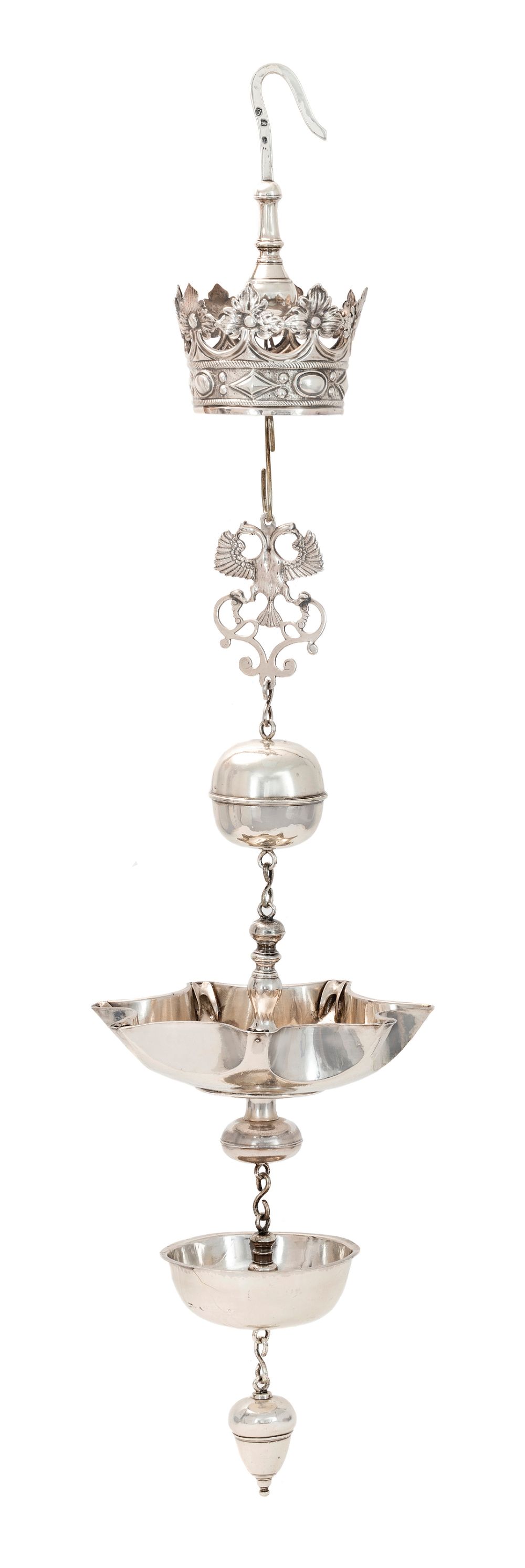
Hanging Silver Sabbath Lamp by Abraham Lopes de Oliveyra, the First Jewish Silversmith in England – London, 1726 - Hanging lamp for Sabbath and festivals, produced by silversmith Abraham Lopes de Oliveyra (also, de Oliveira). London, 1726. Silver, cast, pierced, chased and repoussé; fully marked with English duty mark, fineness mark, date-letter L (1726) and maker's mark – a crowned AO monogram (Grimwade, No. 70); some parts marked with later Dutch import mark (in use since 1953; marks are detailed below). An exceptionally fine Judaica object of notable rarity and importance, distinguished by a solid and well documented provenance dating back to 1882; one of only two hanging Sabbath lamps produced by the famed silversmith de Oliveyra (the other lamp – London, 1734 – is found in the collection of the Jewish Museum of London); one of the few Judaica objects by de Oliveyra to remain in private hands, and one of just a few silver hanging Sabbath lamps produced in London, and indeed in England, in the 18th century. Physical Description and Hallmarks Hanging Sabbath and festival lamp, of a type used by Jews of Spanish-Portuguese descent, primarily in the Netherlands. The lamp is composed of seven parts, six of which conform to the classic model of Dutch hanging Sabbath lamps: 1. A large suspension hook, terminating in a pear-shaped ornament. 2. A round, open crown ornament, decorated with geometric patterns, its upper edge undulating, surmounted by eight flower shaped ornaments. A square silver rod is soldered at the center of the crown, fitted with suspension rings. 3. A double-headed eagle ornament, clasping a stylized vegetal motif in its talons. 4. A slightly flattened spherical spacer, serving as a reflector. 5. A large oil bowl in the shape of a seven-pointed star, with a tall central stem (screwed in). At the points are wick holders shaped as curved, rounded tabs with wide splits. 6. A deep, circular drip pan, with a central stem (soldered). 7. A heavy, acorn-shaped weight. Most parts of the lamp are fitted with round rings for suspension, allowing the components to be hung one beneath the other using S-shaped silver hooks. Besides the present lamp, one other Sabbath lamp by Abraham Lopes de Oliveyra is known, produced in London in 1734, currently part of the collection of the Jewish Museum of London (item JM 373; this lamp was purchased by the museum in 1952 and is on permanent exhibit). The two lamps are highly similar, both in overall structure and in design: the suspension hooks of the two lamps are nearly identical; the crown of the 1726 lamp closely resembles that of the 1734 lamp, except that the latter is also supplemented by four fleur-de-lis ornaments; the double-headed eagle is absent from the 1734 lamp and is unique to the present one (see below); the reflector of the 1726 lamp is shaped somewhat differently than that of the 1734 lamp; the oil bowl is designed identically in both lamps, although the stem in the 1726 lamp appears to be longer; the wick holders in the 1726 lamp are identical to those of the 1734 lamp, and most likely were produced and installed in both lamps by de Oliveyra himself; and finally, the drip pan and bottom weight are identically designed in both lamps. A prominent difference between the two lamps is the double-headed eagle ornament, which does not appear in the 1734 lamp and is unique to the present lamp. In his study ”Anglo-Jewish Silver”, Arthur Grimwade notes that Richard Barnett – of the British Museum, the Jewish Historical Society of England, and editor of the Jewish Museum of London catalogue – posited that this ornament may indicate that the lamp was produced for Baron Diego (Moshe) López Pereira d'Aguilar, a merchant and descendant of a Marrano family from Portugal who settled in London in 1757, becoming a central figure in the local Spanish-Portuguese community. However, the year the lamp was produced, d'Aguilar was living in Vienna, not in London, but perhaps, conjecture Barnett and Grimwade, it was sent to him as a gift, with the double-headed eagle representing the Holy Roman Empire (d'Aguilar was conferred the title of Baron by Emperor Karl VI in 1726). And indeed, this ornament is unusual and does not generally appear in hanging Sabbath lamps of this type. A double-headed eagle appears sometimes, in various forms, on German Sabbath lamps (”Judenstern”) made of brass. However, as a separate component it is documented only on a few silver Sabbath lamps. These include an 18th-century lamp from Hamburg (formerly in the Zagayski collection); a 19th-century German lamp, in which both the ornament and suspension hook bear the marks of Thomas Whipham & Charles Wright of London, ca. 1760; and a lamp from London produced by Thomas Paine Dexter in 1812. In his ”Memorbook”, M.H. Gans notes that the eagle is one of the symbols of the ”Baron d'Aguilas”, apparently referring to d'Aguilar (p. 161). However,