Bidspirit auction | Historia Real de la Gran
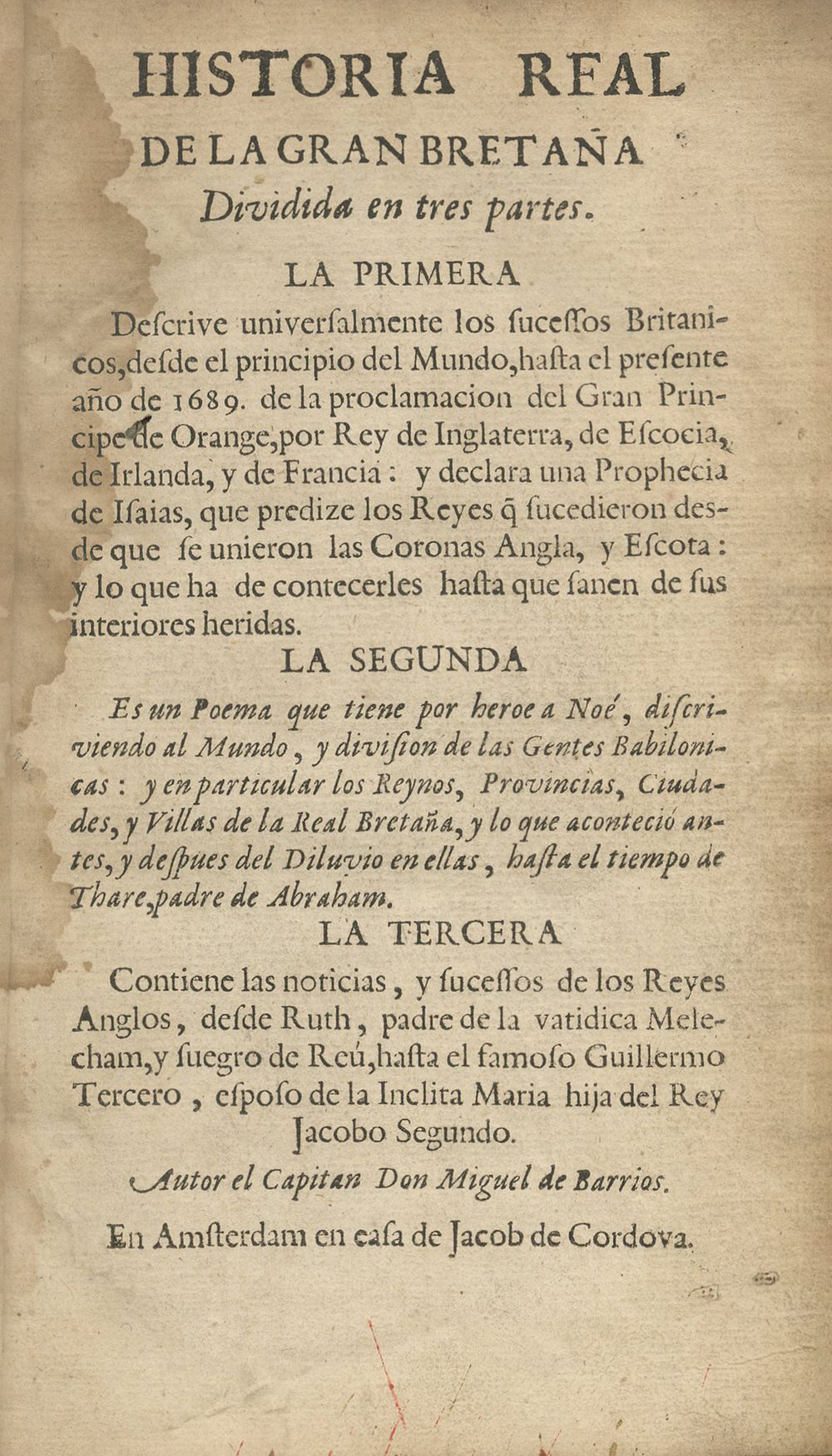
Historia Real de la Gran Bretaña – Daniel Levi de Barrios – Amsterdam, 1688-1689 – Exceptionally Rare - Historia Real de la Gran Bretaña, dividida en tres partes [Royal history of Great Britain, divided in three parts], by Daniel Levi de Barrios. Amsterdam: Yahacob de Cordova, [ca. 1688-1689]. Spanish. A chronicle of Great Britain, tracing its history from Biblical times to the author’s own time, interwoven with poetic, kabbalistic, etymological, and prophetic-mystical elements. Written and printed during the dramatic events of the Glorious Revolution (1688), which saw the deposition of the Catholic King James II and the coronation of the Protestant William III of Orange, Prince of the Netherlands. De Barrios describes the historical events and the central figures involved, while emphasizing the position of the Spanish-Portuguese Jewish community in Amsterdam, which was politically and economically aligned with William III and enjoyed the protection of the House of Orange. Notably, the book includes the text of a prayer recited in the synagogue in Amsterdam on October 27, 1688, imploring divine aid for the success of William’s military expedition and safe passage of his invasion fleet to the shores of England. This prayer was also translated into Dutch and distributed separately among the community. The book contains important early references to the Jewish communities of Amsterdam and London, as well as mentions of Jewish communities throughout the British Empire, including Jamaica, Barbados, the Caribbean, and Madras (India). The printing of the book began shortly before the deposition of the Catholic King James II in November 1688 and was completed on July 28, 1689, after the coronation of the Protestant king William III. The political upheaval compelled de Barrios to make substantial textual changes in the book – omitting passages dedicated to the deposed king and inserting gatherings extolling the new monarch. In the copy preserved in the British Library, presumably bound in late 1688, passages in praise of James II appear alongside rites for his victory over William III. The present copy, presumably bound in July 1689, omits the laudatory references to James II and incorporates gatherings and additional leaves printed after the coronation of William III. The main differences between the copies are as follows: I. The British Library copy has a different title page, with a title dedicated to James II (Atlas Angélico de la Gran Bretaña, declaracion a su Gran Rey Jacobo Segundo), followed by a notice of the birth of his son, James Francis Edward Stuart. Pages 1-2 contain a text extolling James II. The present copy is bound with a different title page emphasizing the historical contents of the work (Historia Real de la Gran Bretaña), omitting references to James II. The title page is followed by a blank page. II. The present copy includes pages 61-64. These are missing in the British Library copy, where they are replaced by a separate poem, dated 1688, praising the leaders of the Talmud Torah congregation in Amsterdam (with handwritten pagination). In the present copy, the poem appears at the end, typeset and paginated 1-4. III. Both the British Library copy, and the present copy lack eight pages (pp. 127-134; gatherings E and H), likely omitted during the preparation for the publication of the book. The British Library copy contains instead two independent works: a poem (dated 1684) dedicated to the Spanish general governor of Flanders (Clarin de la antiguedad belgica) and an epistle dated 1682 (Epístola al excelentísimo señor don Otón de Acareto). The present copy includes only the latter. IV. The principal difference between the two copies lies in an entire section present in the present copy but absent from the British Library copy (which concludes on p. 162). The present copy contains over forty additional pages (pp. 163-208; gatherings Ll-Rr), comprising fifteen short chapters printed after the coronation of William III as King of England in April 1689. These chapters reference the dramatic historical events that unfolded during the printing of the book: the landing of William’s army on the shores of England, the deposition of James II, the magnificent coronation ceremony in Westminster Abbey (in the ”Bishop’s Chapel”) in London, with colorful details concerning the participants, costumes, and medals distributed), the alliances with the Protestant powers, the war with Louis XIV of France, the fierce criticism of the Pope and the Catholic Church, and more. De Barrios declares that he had foreseen these events, interweaving the historical narrative with mystical-theological interpretation, portraying William’s rise to power as the fulfillment of the prophecies of Isaiah and Daniel. These chapters also include remarks on the production and distribution of the book. De Barrios notes that on September 28, 1688, before William departed with his army from Amsterdam to England,