Bidspirit auction | Certificate of Appointment for Rabbi
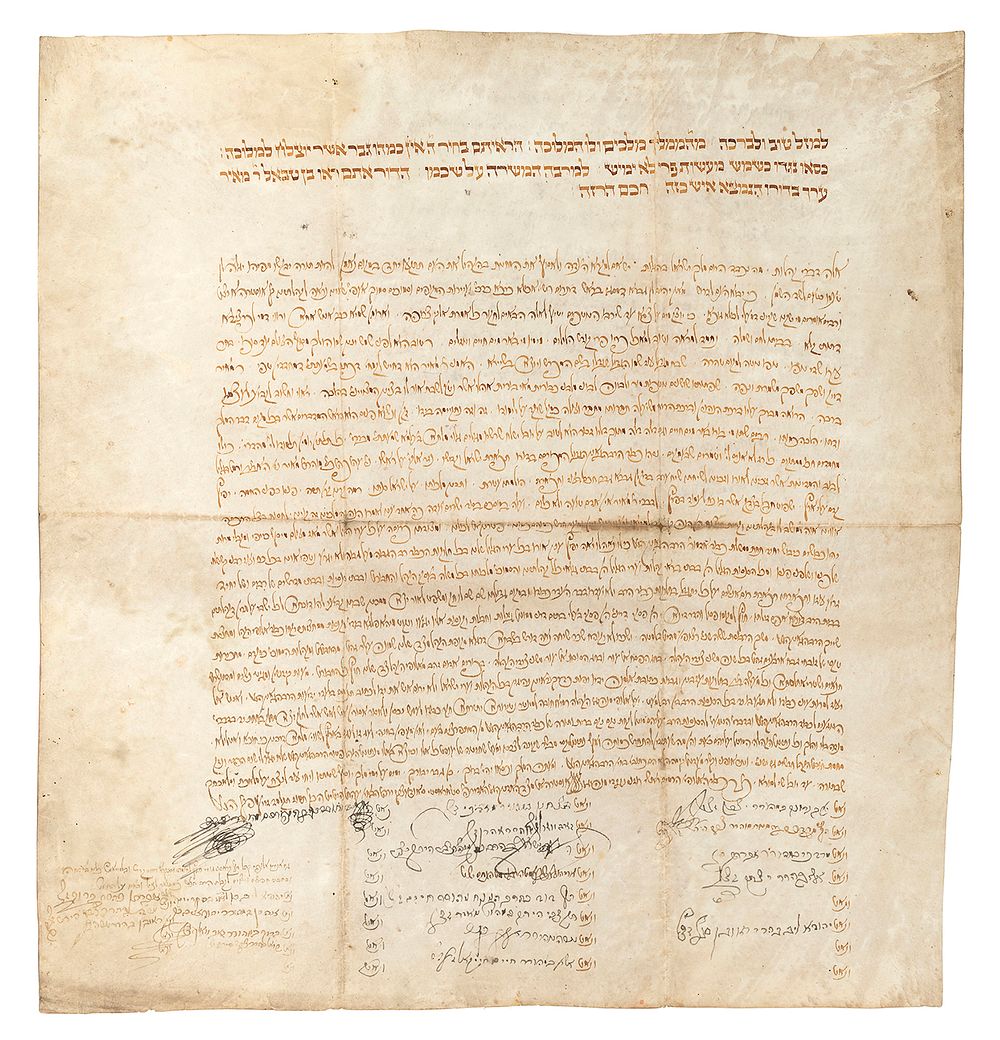
Certificate of Appointment for Rabbi Meir Margolies, Author of Meir Netivim, Disciple of the Baal Shem Tov and One of His ”Sixty Warriors”, as Rabbi of Ostroh – Ostroh, 1777-1784 – Fulfillment of the Prophecy of the Baal Shem Tov that Rabbi Meir Margolies Would Be Appointed Rabbi of Ostroh - Manuscript on large parchment leaf – certificate of appointment for R. Meir Margolies, author of Meir Netivim and disciple of the Baal Shem Tov, as Rabbi of Ostroh and its suburbs, signed by 21 of the city's community leaders. Ostroh, Tamuz 1777. On verso: Extension of the rabbinic appointment, accorded after six years, with 8 signatures. Ostroh, Nisan 1784. Neat cursive script. The three lines of the heading are in Stam script: ”For good fortune and blessing, from the appointer of kings to Whom kingship belongs… See, generation… could we find any such knower of secrets?”. The appointment, proffered by all the communities in the city, begins with the following words: ”These are the words of the communities, how glorious is the day the king of Israel is revealed…”, and addresses R. Meir Margolies, ”Rabbi and yeshiva dean in the Lviv region”, with numerous titles of honor and veneration. R. Meir Margolies' appointment as rabbi of Ostroh constituted the fulfillment of the prophecy of his teacher, the Baal Shem Tov. This prophecy was pronounced after R. Meir Margolies, together with the Noda BiYehudah and R. Gershon of Kitov, brother-in-law of the Baal Shem Tov, stood firm against some powerful members of the Brody community, prohibiting a distinguished woman to her husband, despite the persecution they would endure on this account (see following article for more details). According to Chassidic lore, when the Baal Shem Tov was informed of this episode, he declared that all three would be accorded greatness from Heaven for sanctifying G-d's Name in public, prophesying that R. Yechezkel would become Rabbi of Prague, R. Meir Margolies would become Rabbi of Lviv and Ostroh, and R. Avraham Gershon would settle in the Holy Land – and so it was. In those days, the city of Ostroh was split into two communities (”sides”). The division of the community was a result of the division of the city in 1690 between two nobles. Most parts of the city enclosed within the wall were under the jurisdiction of one ruler, and were known as the ”duke's side”; while the streets beyond the wall belonged to a different governor and were known as the ”voivode's side” (see: Mazkeret LiGedolei Ostraha, Berditchev 1907, p. 4). Both of the Ostroh communities accepted upon themselves the Meir Netivim as their rabbi. This certificate of appointment was drawn up and signed by the leaders of the ”duke's side” community, while the leaders of the ”voivode's side” community affixed their signatures on the bottom. The certificate includes each side's commitment in regard to the rabbi's salary. The certificate concludes: ”So are the words of the distinguished heads… leaders of the Ostroh community, from the side of the mighty ruler Starosta Sandecki, who hereby affix their signatures today, Thursday, 26th Tammuz 1777, in the abovementioned community”. This is followed by 14 signatures handwritten by the community leaders. At the bottom of the certificate, the signatures of the community leaders of the ”voivode's side” – from the streets beyond the wall: ”We too, leaders of the Krasnohirska community, outside the wall, Tatarska and Belmazh streets, all wish, with love and affection, to accept this rabbi…”, with 7 signatures. The certificate stipulates that the appointment is to be in effect for six consecutive years from the date stated, while on the verso of the leaf, an extension of the rabbinic contract, dated Chol HaMoed Pesach 1784, was recorded, without any time limitation: ”We have come now to renew the kingship and make a new covenant… that he should serve as our rabbi and dean, here in Ostroh and the region, for his entire life, from now forever, for his entire life we will not exchange him for someone else… so are the words of the heads… leaders of Ostroh, from the side of the mighty ruler Referendarz Koronny, Thursday, Chol HaMoed Pesach 1784”. This extension contract bears eight signatures. R. Meir Margolies Rabbi of Ostroh (1700/1708-1790), author of Meir Netivim, was a leading and prominent rabbi in his times. In his youth, he served as Rabbi of Yazlovets and Horodenka. In 1755, he was appointed Rabbi of the Lviv region, an area covering a huge territory, which included the city of Brody (R. Meir served as Rabbi of the Lviv region, but not of the city of Lviv itself, which had its own rabbi; after the Partition of Poland in 1772, this region was divided between Poland and Austria, and R. Meir served as rabbi of the Polish area). In 1766, he was appointed by the King of Poland as chief rabbi of Ukraine and Galicia. In 1776, he received an official letter of appointment from the King of Poland,