Bidspirit auction | Manuscript, Homilies for the High
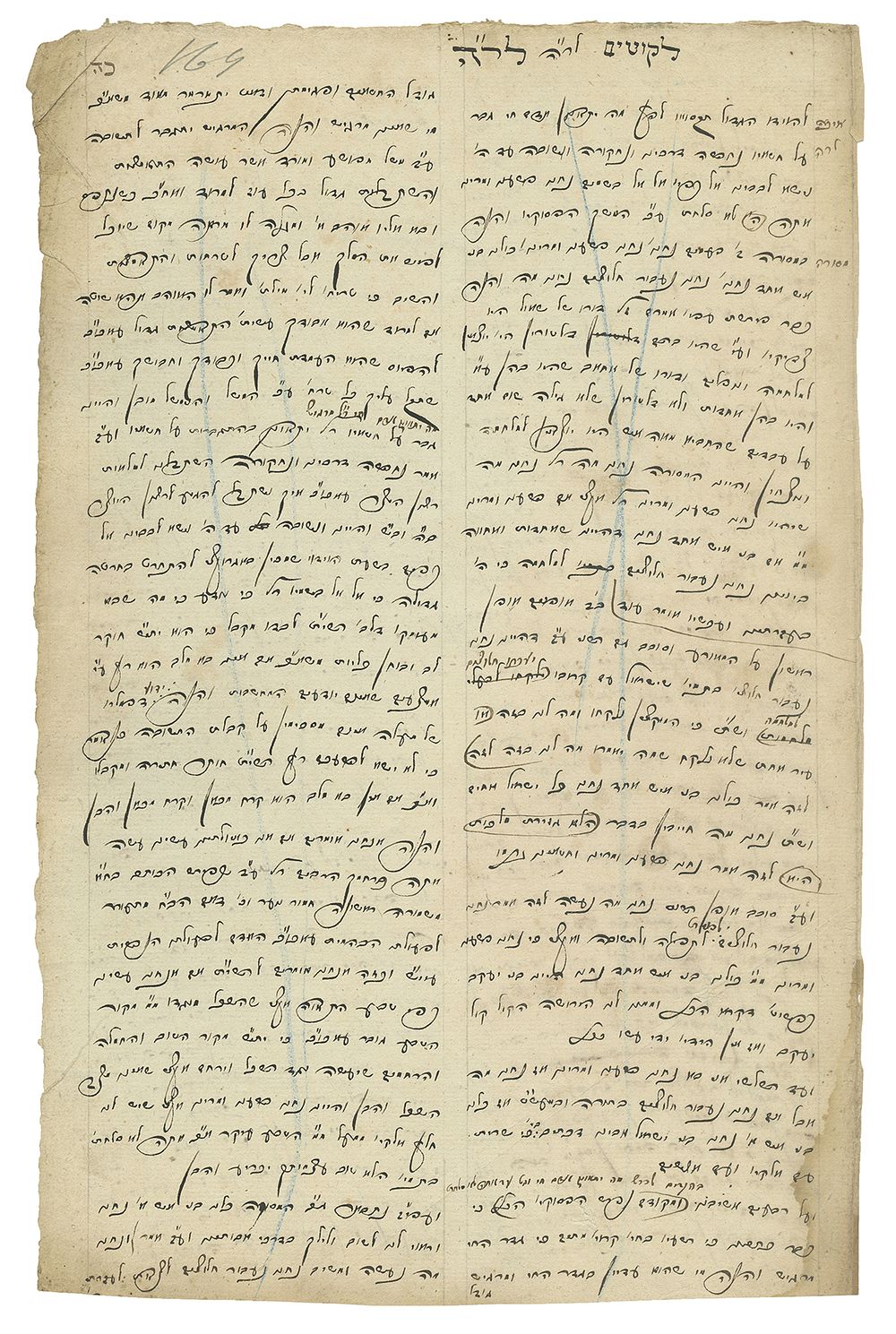
Manuscript, Homilies for the High Holidays by the Yismach Moshe – Glosses Handwritten by the Yitav Lev of Sighet, His Grandson and Disciple – Dozens of Glosses Handwritten by the Editor, Rebbe Moshe David Teitelbaum Rabbi of Laposch - Manuscript, homilies for Rosh Hashanah and Yom Kippur, by R. Moshe Teitelbaum Rabbi of Ujhel (Sátoraljaújhely) – author of Yismach Moshe. Written by scribes, with about ten glosses and editorial transition sentences handwritten by his grandson and disciple Rebbe Yekutiel Yehudah Teitelbaum Rabbi of Sighet (Sighetu Marmației) – the Yitav Lev [Gorlice/Sighet, ca. 1848-1861]. With dozens of glosses by the grandson and disciple of the Yitav Lev, Rebbe Moshe David Teitelbaum Rabbi of Laposch [Târgu Lăpuș, first decade of 1900s]. The contents of this manuscript were published in several parts of the Yismach Moshe series. The leaves of this manuscript were in the possession of the Yitav Lev and his grandson and disciple Rebbe Moshe David Teitelbaum (see below). Both edited portions of this manuscript and printed them in the Yismach Moshe books which they published. These leaves therefore contain their handwritten glosses and notes, occasionally on the same page, side by side. When the Yitav Lev prepared his grandfather's series of books on the Torah for print, he selected several sections from the present manuscript and published them in the Yismach Moshe books (Lviv, 1849-1861). Rebbe Moshe David later extracted sections from these leaves relating to the Book of Tehillim, and published them in the Tefillah LeMoshe commentary on Tehillim by the Yismach Moshe (Cracow, 1880). One of the present leaves contains the Hanhagot Tovot (good practices) by the Yismach Moshe, which were printed in the commentary on Tehillim. Rebbe Moshe David later edited and published all the other sections (most of the present manuscript) in a work titled Tochachat Chaim Amirah Ne'imah (high holiday homilies), printed in Yismach Moshe (on Neviim, Ketuvim, Megillot and various topics; Sighet 1908). One section was placed in Yayin HaRekach, as part of the same book. While preparing the book for print, the Yitav Lev added in the manuscript several glosses as well as introductory and transitional sentences in his handwriting (most of which appear in the printed version). R. Moshe David subsequently also added his own glosses, additions, introductory and transition sentences, in the portions which he edited. One of the present leaves contains a gloss handwritten by the Yitav Lev, which was omitted in print. Several leaves contain sentences which he placed in parentheses or crossed out, indicating that they should not be printed, presumably due to censorship constraints. One of the censored passages reads: ”I delivered this entire sermon on Rosh Hashanah 1788, when decrees were frequent and troubles were unremitting, especially the taking of Jews as soldiers [in reference to forced conscription of Jews to the army, towards the end of the reign of Emperor Joseph II], where their beards were shaven and their clothing changed for soldiers' uniforms. May G-d have mercy on His people”. Rebbe Moshe Teitelbaum, Rabbi of Ujhel (1759-1841), was an illustrious Chassidic leader in Hungary and Galicia. An outstanding Torah scholar and kabbalist, sharp and well-versed in all facets of Torah, revealed as well as hidden. During his lifetime he was renowned as a holy wonder-worker benefiting from divine inspiration. He first served as Rabbi of Shinova (Sieniawa) from 1785-1808, and in 1808, was appointed Rabbi of Ujhel (Satoraljaujhely) and the region. R. Moshe was originally an opponent of Chassidut, and in his youth, he travelled to Vilna to study Torah under the Vilna Gaon (R. B. Landau, HaGaon HeChassid MiVilna, p. 291, in the name of R. Zalman Weber; the Klausenburg Rebbe cites an interesting testimony from that visit, related by his great-grandfather the Yismach Moshe, regarding the conduct of the Vilna with his disciples – Responsa Divrei Yatziv, Part IV, Yoreh Deah, section 131). Over the years, R. Moshe gravitated towards Chassidut, influenced by his son-in-law R. Aryeh Leib Lipschitz of Vishnitza (Nowy Wiśnicz), author of Responsa Aryeh DeVei Ila'i, who convinced him to travel to the Chozeh of Lublin. There, R. Moshe he became aware of clear manifestations of ruach hakodesh, and from that point on he became the Chozeh's close disciple, devoting himself to the Chassidic way and disseminating its teachings. This transformation took place while he was still serving as Rabbi of Shinova. He also travelled to the Ohev Yisrael of Apta. Starting in 1815, he began to distribute amulets to those in need of salvation, thereby performing countless wonders. Reputedly, he hesitated whether to continue making amulets until he heard a pronouncement from Heaven: ”Do not fear, for I am with you” (Tehillah LeMoshe). To this day, most of the amulets and shemirot in Ashkenazic lands can be traced to the amulets of the Yismach Moshe,