Bidspirit auction | Early and Important Esther Scroll
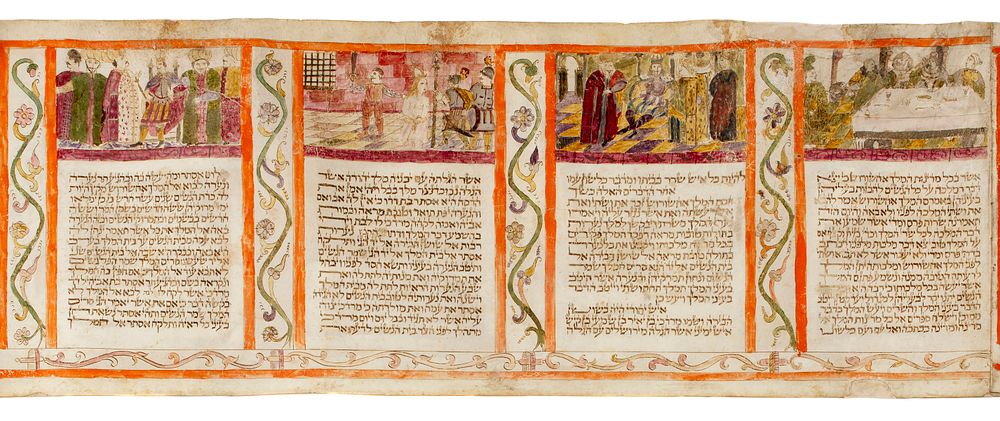
Early and Important Esther Scroll – Italy, First Half of the 17th Century – In the Style of Scrolls by Moshe ben Avraham Pescarolo - Handwritten and hand-illuminated Esther Scroll. [Northern Italy, first half of the 17th century]. Ink and color paint on parchment. Esther scroll written in Italian Stam script, on ten parchment sheets sewn together, 33 columns of text, 12-15 lines per column. An exceptionally long scroll (approx. 5.5 meters), richly illuminated throughout with hand-painted illustrations in red, orange, ochre, green, purple and blue, as well as silver and gold, especially prominent in the figures' garments. The scroll's decorative layout, with the upper third devoted to narrative illustrations in rectangular frames and the lower two-thirds containing the text and vegetal-decorated frames, accords with design practices known from Italian Esther scrolls of the first half of the 17th century; paleographically, the letterforms likewise correspond to those found in Italian Esther scrolls of the period. Illustrations All text columns are enclosed within orange rectangular frames and rectangular panels decorated with a repeating vegetal motif in several variations. At the top of each column appears a miniature narrative illustration (33 illustrations in total), each with a rectangular crimson frame along its lower edge. The thirty-three illustrations above the text columns depict episodes from the Esther narrative, as well as events drawn from Midrashic literature. They are arranged in chronological sequence, generally corresponding to the text below. The illustrations depict central scenes in detail (some include two scenes simultaneously) and portray the protagonists of the Megillah – King Ahasuerus, Vashti, Haman, Esther and Mordechai, as well as eunuchs, servants, soldiers and additional figures – clad in a mixture of Renaissance and Oriental dress, with emphasis on elaborate textile ornamentation. Architectural settings shown in scenes outside the royal palace are rendered in Renaissance style, with some elements in an Oriental idiom. While the figures display a certain schematic quality reflecting the folk character of the artist, many scenes nevertheless demonstrate the artist's effort and ability to maintain perspective and volume, balanced proportions between figures and space, and particular attention to interior design, including wall decorations, columns, tiled floors and furniture. The subjects of the illustrations are as follows: • The ministers of the provinces assemble before Ahasuerus (damaged). • The feast of King Ahasuerus. • The king with several of his eunuchs. • Vashti's feast and the arrival of the king's eunuchs. • The king and his eunuchs. • The beheading of Vashti. • King Ahasuerus (holding a scroll) with several eunuchs. • Esther is brought to the king's palace; the king extends his hand toward her. • Mordechai stands at the king's gate; to his right are Bigthan and Teresh. • King Ahasuerus gives his ring to Haman. • The scribes write the decree. • Mordechai at the king's gate, clothed in sackcloth and ashes. • Hathach brings the decree to Esther. • Jews gather at Esther's command, ”Go, assemble all the Jews who are present in Shushan and fast on my behalf…” (?); Esther looks out from a window. • King Ahasuerus extends the golden scepter to Esther. • A messenger of Ahasuerus hastens to summon Haman (?); at left, a figure holding a missive. • The king's sleep is disturbed, his servants read before him from the Book of Records. • Haman stands in the outside court of the king's palace, the king's attendants announce this to him. • The king in his chamber, seated on the throne, instructs Haman to clothe Mordechai in royal raiment. • Haman leads Mordechai on horseback. • The king and Haman at Esther's second feast (Esther points her finger toward Haman). • Haman kneels before Esther, pleading for his life; King Ahasuerus stands beside her. • Esther and Mordechai stand beside the king, the king holds his scepter and extends his ring to Mordechai; in the background: the hanging of Haman. • At right – inside the palace – two of the king's scribes write scrolls; at left – outside the palace – the couriers ride on horseback. • One of the couriers rides on horseback and blows a horn (shofar), galloping across a bridge leading to a city; in the background, figures, a dog and buildings. • Mordechai in royal raiment. • The Jews ”lay hands” on those who sought their harm, with arrows and spears. • The ten sons of Haman hanging from a beam. • Esther and Mordechai stand before King Ahasuerus. • A celebratory feast with five figures seated around a table. • Jews dancing at a ball with a mandolin player, three wear ”medico della peste” masks with long beaks. • Women at a ball with a violinist. • A scene apparently depicting Purim night in a synagogue, at center are children holding Purim rattles.