Bidspirit auction | Moreh Nevuchim by the Rambam
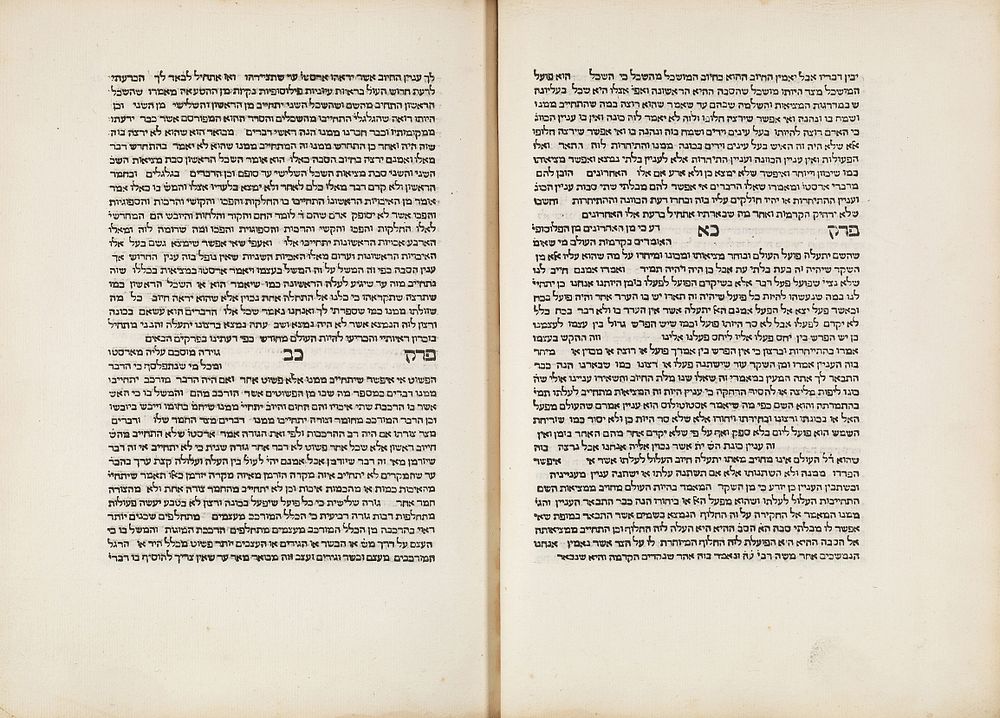
Moreh Nevuchim by the Rambam – Incunabulum – Rome, Ca. 1473-1475 – First Edition of a Fundamental Work of Jewish Philosophy – One of the First Hebrew Books to be Printed - Moreh Nevuchim by the Rambam, translated into Hebrew by R. Shmuel ibn Tibbon. [Rome, ca. 1473-1475 (see below for further details on the location and date)]. First edition. Incunabulum. First edition incunabulum, especially rare, of Moreh Nevuchim, a fundamental work of medieval Jewish thought and the philosophy of Judaism, authored by the Rambam (Maimonides), a leading halachic authority and philosopher of all time. Moreh Nevuchim, known in English as Guide for the Perplexed, was authored in Judeo-Arabic ca. 1185-1190. It was originally titled Dalālat al-Ḥā'irīn (literally, Guidance of the Perplexed). Its Hebrew name, Moreh Nevuchim, was coined by its first translator, R. Shmuel ibn Tibbon, and this name was used in all Hebrew editions of the book. Ibn Tibbon worked on his translation in Montpellier, Provence, during the Rambam's lifetime, and the Rambam wrote him at least one letter in support of his translation endeavor, providing explanation, general guidance, instructions for accuracy and translation assistance. The book was written by the Rambam for his disciple, R. Yosef son of Yehudah ibn Shimon. Written as a guide for the titular ”perplexed”, confronted with the disparity between Torah study and contemporary philosophical thought, the book is composed of three parts: Its first part (76 chapters) discusses biblical expressions whose surface meaning implies the corporeality of G-d, explained by the author as abstractions, expounding a system of negative theology and demonstrating the incorporeality of G-d. In the second part (48 chapters), he discusses the proofs for G-d's existence and the question of the eternity of the world, and examines the concept of prophecy and its meaning. The third part (54 chapters) begins by discussing the prophetic vision of the Merkavah, providence and recompense, concluding with an extensive study of the rationales for the commandments. The Rambam's writing was heavily influenced by Greek philosophy, especially Aristotelean thought, and by his Islamic commentators, Al-Farabi (cited often in Moreh Nevuchim) and Avicenna, whose works he had thoroughly studied. The last five leaves contain a summary of the contents of each chapter, made by R. Yehudah al-Charizi. Ashkenazic square type. No page headers, foliation, collation or catchwords. Watermark of an encircled bow (very similar to Briquet 746, and to Piccard IX, Werkzeug und Waffen, 12: 2388/89; see illustration in Tishby, plate A8). Printed on especially thick and high-quality paper, with fine wide margins. Handwritten annotations on several pages by various writers, including several long glosses. In Part II, Chapter 48, a lengthy annotation opening with the words: ”Understand this discourse and know its true intent…”, signed: ”Avraham Eliyahu Cohen”. On verso of last page, signatures of censors Luigi da Bologna and Renato da Modena, and signature of censor Camillo Jaghel dated 1613. [154] leaves. Collation: [i]9 (lacking first blank leaf), [ii-xv]10, [xvi]5 (lacking last blank leaf). Verso of fifth leaf in last gathering blank. 27.5 cm. Good condition. Stains. The book has been professionally cleaned. First twenty leaves supplied from Schocken copy (margins repaired with paper filling from the period of printing). Large open tear to last leaf, not affecting text, repaired with paper filling. Early binding (contemporaneous with printing of book), with clasps. Bookplate to inside of front cover. The Influence of Moreh Nevuchim Moreh Nevuchim was highly consequential for both Jewish thought and Western philosophy, including non-Jewish thinkers. Islamic philosophy had previously dealt with topics such as negative theology as a way of defining G-d, and the Rambam was viewed as offering a Jewish interpretation, influencing Muslim thinkers who viewed it as a natural part of Arabic Aristotelean philosophy. The book was also influential in Europe, and was soon translated into Latin in the 13th century, and several distinguished thinkers were influenced by it, including Albertus Magnus and Thomas Aquinas, who mentions Maimonides at times in his own writings. The book's influence at a later date is also discernible in the thought of Baruch Spinoza, the famous philosopher and Jewish apostate. Almost from the outset, this book was greeted with an ambivalent reception in the Jewish world. Many banned the book, or even burned it, decrying the author's legitimization of philosophical study, or claiming non-Jewish influence upon the book. The book's chief opponents included R. Shlomo of Montpellier and his disciple R. Yonah Gerondi (who reputedly so regretted his support for the burning of the book that he traveled to the Rambam's grave in Eretz Israel to beg his forgiveness).