Bidspirit auction | Torah Shield – Augsburg, 17th
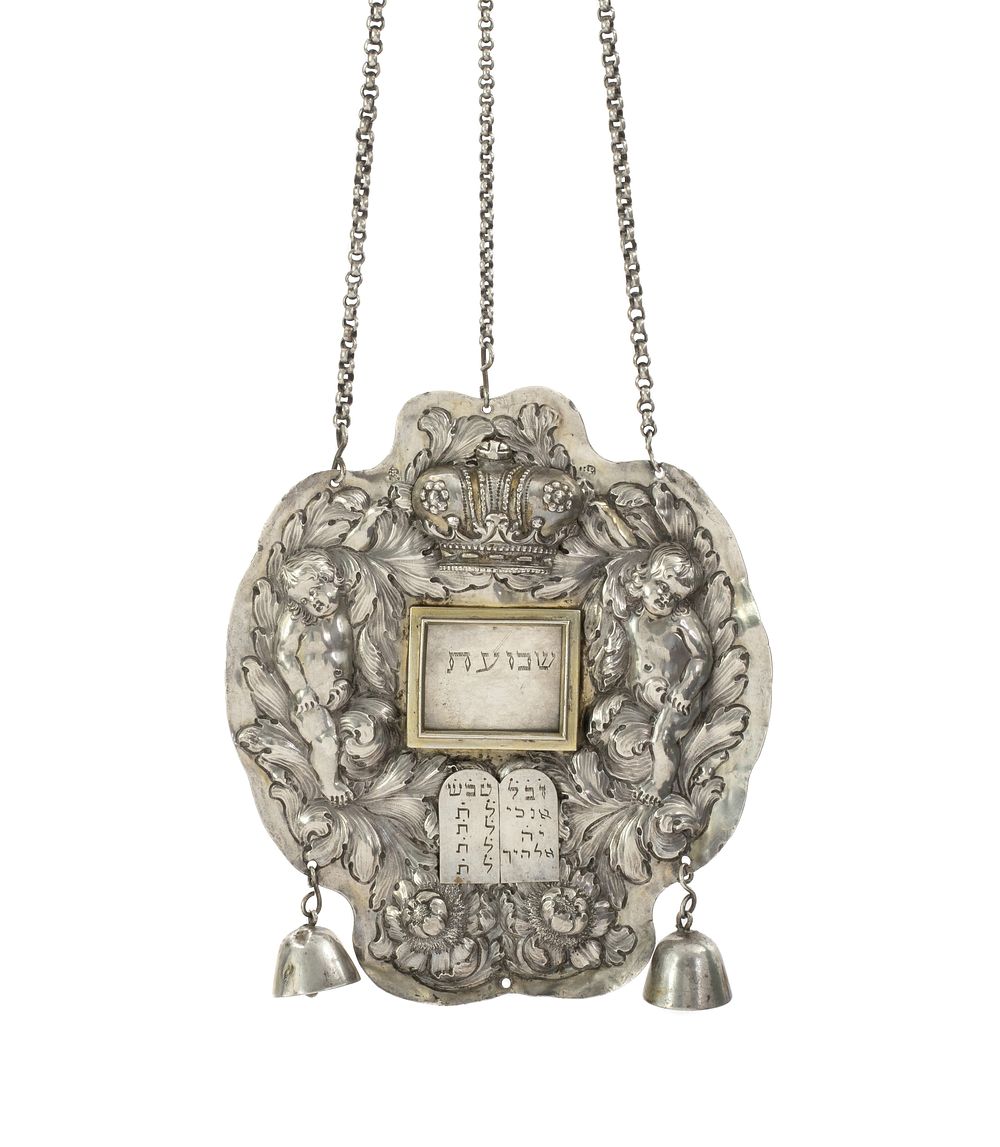
Torah Shield – Augsburg, 17th Century – From the Synagogue of the Jewish Community of Goßmannsdorf, Bavaria - Torah shield. Augsburg, ca. mid-17th century. Silver, repoussé, cut and engraved. Marked with the Augsburg city mark (in use ca. 1645-1670) and with the maker's mark HP within an oval frame, apparently that of Hieronymus Priester, a master silversmith from 1649 onward (Seling 1555). Bells marked with partial 17th-century fineness marks from Frankfurt am Main (eagle). This Torah shield was documented by Theodor Harburger in the village of Goßmannsdorf between ca. 1925 and 1932; owing to this documentation, its precise provenance in a small Bavarian Jewish community is known. A small Torah shield, adorned with high-relief vegetal motifs in rich Baroque style and with a pair of putti figures. At the top is a crown-shaped ornament, affixed with two screws. At center is a rectangular compartment for interchangeable plaques (four double-sided plaques are present, possibly later), secured by two pins on the reverse. At the bottom is an ornament in the form of the Tablets of the Law, also affixed with two screws. Engraved on the tablets are abbreviated forms of five of the Ten Commandments, and above them are engraved the letters ”ז'ב'ל' / ט'ב'ש'”, apparently the initials of the couple who dedicated the shield to a synagogue. Three long suspension chains are attached through three dedicated holes along the upper edge. Three bells are suspended from dedicated holes along the lower edge (one bell non-original). The shield originates from the collection of Simon Brueckheimer (see below). In a list compiled by Brueckheimer's son, Lazar (Eliezer), in 2014, it is noted that the shield was created through secondary use of a silver ornament from an antique piece of furniture. This hypothesis may explain the presence of the putti figures on the shield – an ornamental motif uncharacteristic of ritual objects of this type – although similar figures also appear on another Torah shield from Bavaria, originating in the town of Coburg, Upper Franconia (documented by Harburger, p. 144, P160-405). A Jewish community in the village of Goßmannsdorf am Main, located approx. 16 km south of Würzburg, Lower Franconia, existed continuously from the 16th century onward, although it was always small and subject to restrictions imposed by the authorities. Jews from Goßmannsdorf are first mentioned in a document from 1510; another document, from 1532, lists ten Jewish men in the village, apparently attesting to the existence of a small community. By the 17th century, a Jewish community certainly existed there: in 1655, six Jewish families resided in the village, earning their livelihood primarily through trade in cattle and horses, raw materials and agricultural produce. At the end of the 17th century, a Jew named Baruch ben Jirmiahu Naftali established a synagogue in his home for the village community and arranged for the writing of a Torah scroll. In 1720, a decision was made to establish a new synagogue in the home of a Jew named Mayer, but this initiative failed, and only in 1764 was official permission granted by the authorities to build a synagogue. This synagogue was inaugurated in 1765, in a festive ceremony during which the Torah scrolls were transferred from the old prayer room to the new building. Regular services were held in the synagogue until the early 20th century; in subsequent years, the community required assistance from Jews outside the village to complete a minyan. During Kristallnacht in November 1938, Nazi rioters destroyed the interior of the synagogue, desecrated the last Torah scroll still kept there, and damaged the remaining ritual objects (some items had been transferred in advance to Munich). In 1939, the synagogue building was sold to the Goßmannsdorf municipality, under unjust conditions imposed upon the representatives of the village's destroyed community. Height: 16 cm (including chains: 46 cm). Width: 14.2 cm. Overall good condition. Provenance: • Jewish Community of Goßmannsdorf, Bavaria. • Collection of Simon Brueckheimer. Reference: Theodor Harburger, Die Inventarisation jüdischer Kunst- und Kulturdenkmäler in Bayern, Fürth: Jüdisches Museum Franken, 1998, p. 229 (P160-620). Additional information regarding the Jewish community of Goßmannsdorf appears on the Alemannia Judaica website. Proceeds of sale will be donated. The Collection of Simon Brueckheimer Simon Brueckheimer was born in Külsheim in 1889. He moved to Marktbreit in 1911 and served there as a schoolteacher from 1920 onward. In 1929, he initiated a project to document Jewish ritual objects and property in the communities of Bavaria, which he conducted during school vacations as part of the Verband Bayerischer Israelitischer Gemeinden (Association of Bavarian Jewish Communities). During Kristallnacht, Brueckheimer fled to Frankfurt, where he was arrested and sent to the Buchenwald concentration camp.