Bidspirit auction | Autograph Letter by Felix Mendelssohn-Bartholdy
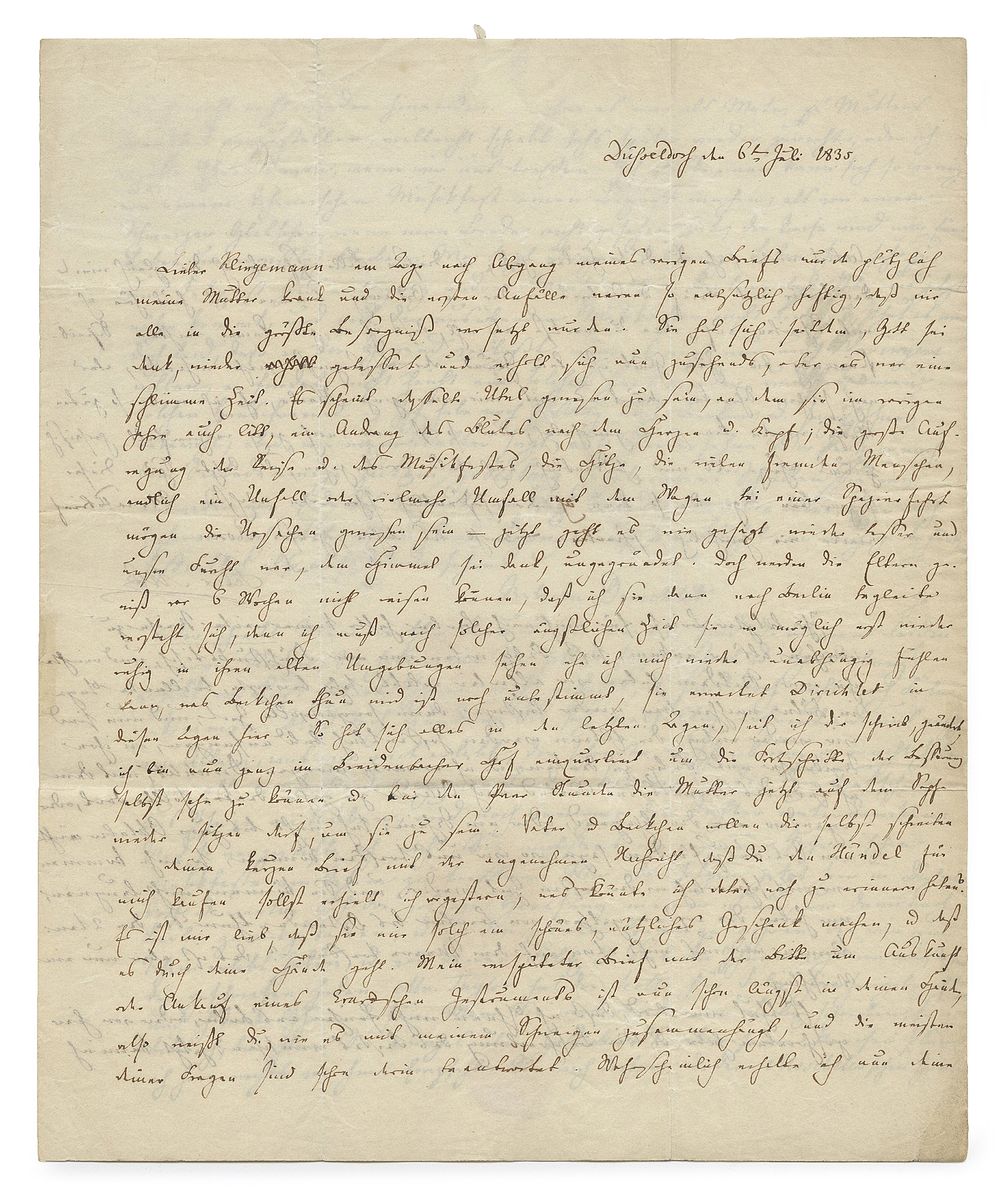
Autograph Letter by Felix Mendelssohn-Bartholdy – With Letters by His Father Abraham Mendelssohn-Bartholdy and Sister Rebecka Dirichlet – Düsseldorf, 1835 – Sent to Karl Klingemann - Double leaf (4 pages) – Signed autograph letter by composer Felix Mendelssohn-Bartholdy; accompanied by another signed autograph letter by his sister, Rebecka Lejeune-Dirichlet, and an additional letter (in Rebecka’s hand) signed by his father, Abraham Mendelssohn-Bartholdy, son of philosopher Moses Mendelssohn. Düsseldorf, 6 July, 1835. German. An intimate family letter, signed by three members of the Mendelssohn-Bartholdy family (son and two grandchildren of Moses Mendelssohn); sent to a family friend, the diplomat and poet Karl Klingemann, then serving on the staff of the Embassy of Hanover in London. The letter was written shortly after the conclusion of the Niederrheinisches Musikfest (Lower Rhine Music Festival), held that year in Cologne under Mendelssohn’s artistic direction. At the opening of the letter, Mendelssohn recounts the sudden illness of his mother, Lea Mendelssohn, which struck shortly after their return from the festival; he attributes the deterioration in her condition to the excitement of the events, the intense heat, and a carriage accident that occurred on the way. Owing to her condition, Mendelssohn notes, his parents would be required to remain in Düsseldorf for approximately six additional weeks, and he plans to accompany them back to Berlin once she has recovered. At the close of his letter, Mendelssohn thanks Klingemann for acquiring musical scores of Handel (apparently the oratorio 'Solomon', translated into German by Klingemann and conducted by Mendelssohn-Bartholdy at the Cologne festival) and for handling the purchase of a piano by the renowned maker Erard. On pages 2-3 appear additional letters by Mendelssohn’s sister and father (both written in Rebecka’s hand). In her letter, Rebecka describes the intense experiences of the Cologne festival, notes the improvement in Felix’s spirits, and relates her plans to meet her husband, the mathematician Johann Peter Gustav Lejeune-Dirichlet, and their forthcoming journey to the seaside resort of Ostend in Belgium. In his letter, dictated to his daughter Rebecka, Abraham Mendelssohn reproaches Klingemann for failing to attend the Cologne festival: ”You are and, alas, will remain a great sinner; as you yourself say, you had time and money to spare… and yet you did not come to Cologne… you would have enjoyed it in many ways and afterwards would have given us the most beautiful description of all that we witnessed… London cannot drive the German out of you, and still less suppress the poet [in you]”. Felix Mendelssohn-Bartholdy (1809-1847), grandson of philosopher Moses Mendelssohn and among the foremost composers of the Romantic period. The present letter was written at a pivotal juncture in his career, shortly before leaving his post as municipal music director in Düsseldorf and assuming the conductorship of the renowned Leipzig Gewandhaus Orchestra. Rebecka Lejeune-Dirichlet (1811-1858), younger sister of Felix Mendelssohn and Fanny Hensel; a salonnière and accomplished musician in her own right. In 1832 she married the distinguished mathematician Johann Peter Gustav Lejeune-Dirichlet. Their home in Berlin (and later in Göttingen) served as a cultural salon and musical center, hosting leading artists of the era, including Clara Schumann and Johannes Brahms. Abraham Mendelssohn-Bartholdy (1776-1835), Berlin banker and philanthropist, son of Moses Mendelssohn. In 1822 he converted to Christianity and adopted the name Bartholdy. He played a decisive role in the musical education of his children and is credited with the remark: ”Formerly I was my father’s son; now I am my son’s father”. He died in Berlin on 19 November 1835, only months after signing the present letter. Karl Klingemann (1798-1862), poet and diplomat, member of the Hanoverian foreign service in London from 1827. His association with the Mendelssohn family began in 1825, when Hanover's diplomatic legation was housed in the family residence in Berlin. Klingemann played a key role in establishing Mendelssohn’s standing in England; he hosted the composer during his London visits and accompanied him on his celebrated journey to the Scottish Highlands (1829), which inspired the 'Scottish Symphony' and the overture 'The Hebrides' ('Fingal’s Cave'). He collaborated with Mendelssohn in writing and translating various libretti, including the German translation of Handel’s oratorio 'Solomon', performed by Mendelssohn at the Cologne festival (see: Hellmuth Christian Wolff, ”Mendelssohn and Handel”, The Musical Quarterly, Vol. 45, No. 2, April 1959, pp. 175-190). Their close friendship endured throughout their lives and is documented in more than 300 letters exchanged between them. [1] double leaf (4 pages). 26.5 cm. Good condition. Folding marks. Minor tears at margins and along fold lines.