Bidspirit auction | Introduction to the Art of
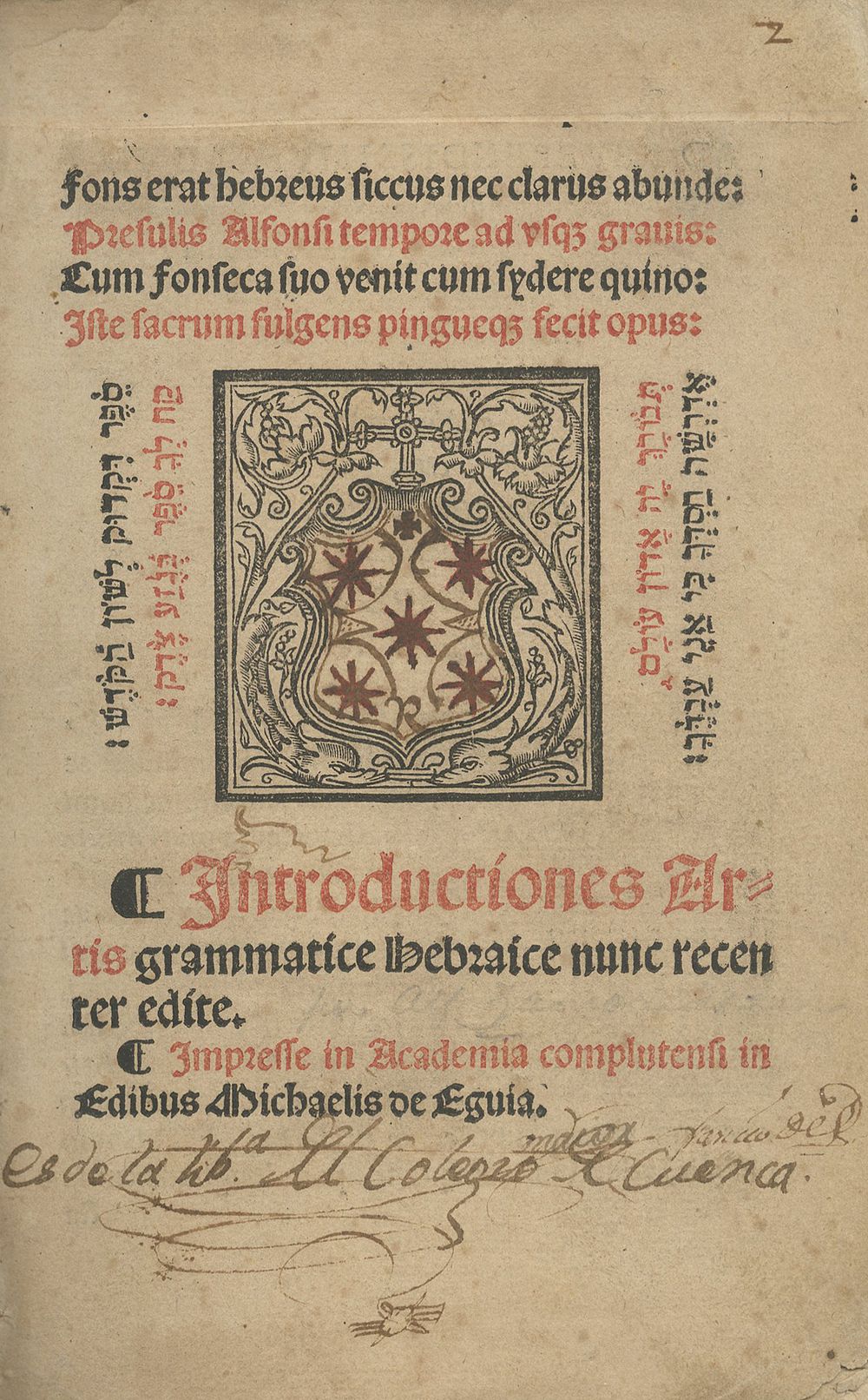
Introduction to the Art of Hebrew Grammar – Alfonso de Zamora – Spain, 1526 – First Complete Edition, Including Epistle to the Jews of Rome - Introductiones Artis Grammatice Hebraice [Introduction to the Art of Hebrew Grammar], by Alfonso de Zamora. Alcalá de Henares (Spain): Michaelis de Eguia, 1526. Latin and Hebrew. Hebrew grammar, one of the most important and influential grammars published in Renaissance-era Europe. An abridged edition of this work was earlier printed in 1515 as part of the Complutensian Polyglot – the first multilingual Bible, considered one of the most impressive achievements of early printing. The present edition, published in 1526, is the first complete and standalone edition of the work. It was printed by the same printer in the same type as the Polyglot, but with a lengthy section not included in the abridged edition: the author's epistle to the Jews of Rome. The epistle, written in Hebrew (with a Latin interlinear translation) persuades the Jews of Rome of the truth of Christianity and encourages them to convert. The present book is considered one of the most beautiful exemplars of early printed Hebrew typography. Semitic philologist Dr. Joshua Bloch declared that ”virtually nothing like their beauty is to be met in the types of fifteenth-century printing”. Title page in red and black, with Hebrew text across width of leaf. Coat of arms of Archbishop of Toledo, Alonso de Fonseca, patron of the author – five red stars in a shield decorated with flowers and dragons (in this copy, the stars are painted red). Text decorated with illustrated initial panels (woodcuts). The book’s author, Alfonso de Zamora (ca. 1480-1558), a Jewish converso and scholar of Spanish origin. He was the editor of the Hebrew and Aramaic sections of the Complutensian Polyglot, the world’s first multilingual Bible. Work on this edition began just a few years after the Expulsion of the Jews from Spain, at the behest of the Grand Inquisitor, Cardinal Francisco Jiménez de Cisneros (1436-1517). Since most of the Christians of Spain acquainted with Hebrew were in fact converts from Judaism, the job of writing and editing the Hebrew section was entrusted to three learned Jewish converts to Christianity. Chief among these scholars was Alfonso de Zamora, author of the present volume. [223] leaves (old handwritten foliation up to 224). 18 cm. Fair-good condition. Stains. Creases and wear to margins. Tears and worming to margins of some leaves, affecting text in some places. Top of title page trimmed (not affecting text). Early handwritten inscriptions. Fine leather binding with gilt spine; rubbing and peeling to binding. See: Joshua Bloch, Early Hebrew printing in Spain and Portugal, New York: New York Public Library, 1938; reprinted in: C. Berlin, (ed.), Hebrew Printing and Bibliography, 1976, pp. 46-47. Bookplate of Mozes Heiman Gans.