Bidspirit auction | Maaseh Rokeach – Amsterdam, 1740
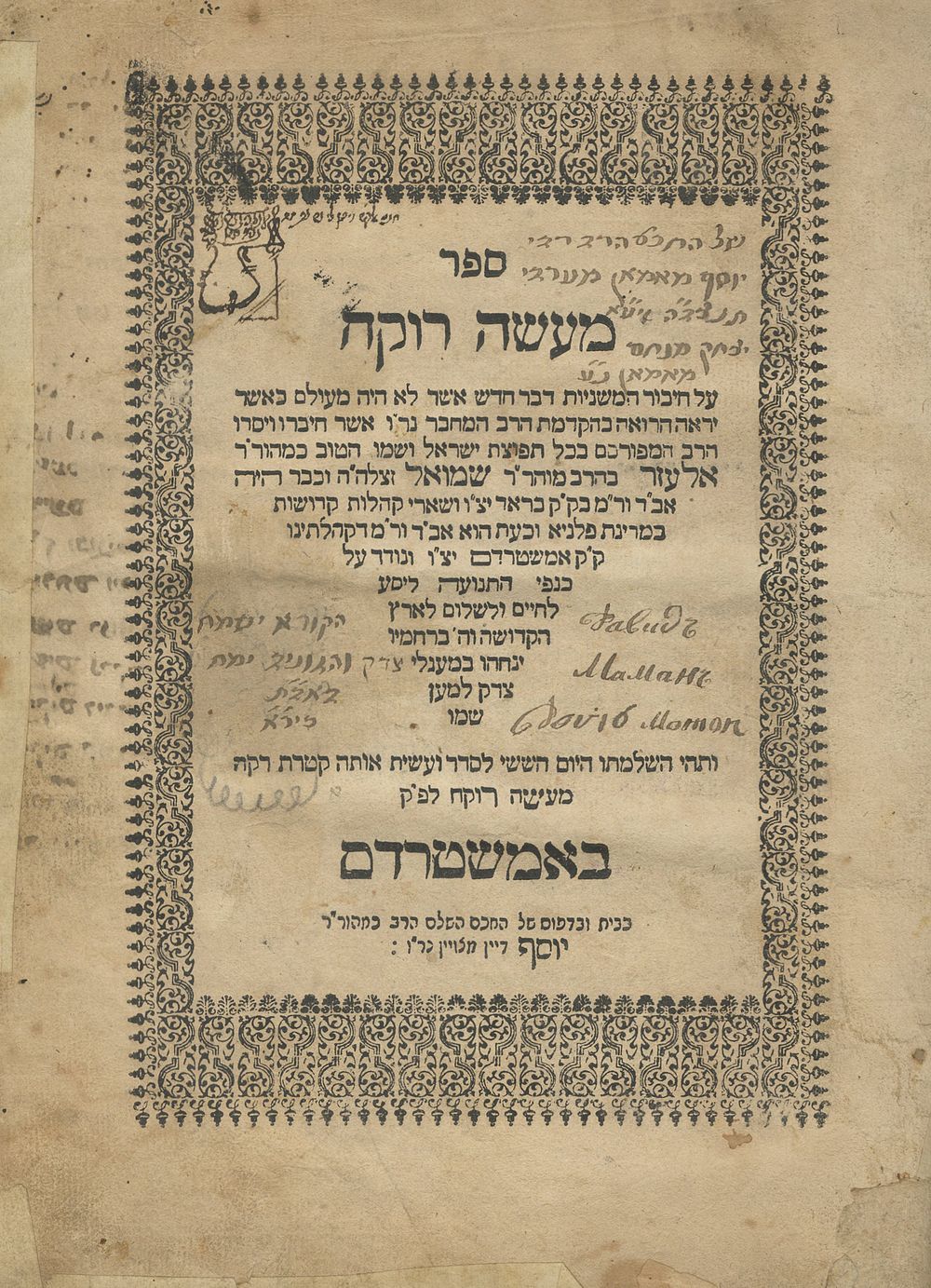
Maaseh Rokeach – Amsterdam, 1740 – Segulah for Happiness – Distinguished Copy - Maaseh Rokeach, kabbalistic allusions on several chapters of Mishnah, by R. Elazar Rokeach. Amsterdam: Yosef Dayan, [1740]. First edition. The author, R. Elazar Rokeach (1685-1742), Rabbi of Brody and Amsterdam. He printed his Maaseh Rokeach in his final years, on the way to Eretz Israel. R. Moshe Berin Blum Rabbi of Vyshnivets writes in his approbation (to the second edition, printed in Mohyliv-Podilskyi, 1817): ”…he was endowed with Heavenly inspiration, as it is universally acknowledged that this Torah scholar availed himself of divine inspiration akin to the early Sages…”. The current Rebbe of Belz wrote in his approbation to the 1993 edition: ”It is well known that this holy book was particularly cherished by our holy rabbis [Rebbes of the Belz dynasty, descendants of the author], and in 1955, my uncle the Rebbe [Rebbe Aharon Rokeach] gave his blessings for publishing this book, quoting his father the Maharid, who asserted that studying this holy book is a Segulah for happiness”. Distinguished copy. On title page, ownership inscription with calligraphic signature: ”G-d graciously gave me this, Yaakov Aryeh” – R. Yaakov Aryeh, a rabbi of Jerusalem in the mid-18th century, and a member of the Beit Yaakov yeshiva, established in Jerusalem in 1691 by the philanthropist Yaakov Ferrera of Amsterdam, where R. Refael Yitzchak Zerachiah Azulai (father of the Chida), R. Yedidiah Moshe Vakil, R. Avraham Almosnino and others studied. Another ownership inscription on title page: ”Belongs to R. Yosef Maman Maaravi, Yitzchak Menachem Maman” [R. Yosef Maman, a rabbi of Safed (1752-1823), known as R. Yosef Maaravi for his ancestry in the Maghreb. A rabbi of Morocco, he immigrated to Safed in 1770, was dispatched as emissary to Persia in 1792, and had a profound and lasting impact on the Jews of Bukhara – see enclosed material]. Another non-Hebrew ownership inscription of David Maman. Additional inscriptions on title page. On verso, inscription in Oriental script, with notable homily on Proverbs 18:10. Several handwritten glosses, in Oriental script. [1], 121; 6 leaves. Leaf 120 bound after leaf 2 in second sequence. 23.5 cm. Fair-good condition. Stains, including dark dampstains. Wear. Marginal tears and open tears to title page and other leaves, repaired with paper. Worming. Islamic leather binding (with shamsa medallions inscribed on front and back), with wear and many defects.