Bidspirit auction | Josephus – Augsburg, 1470 –
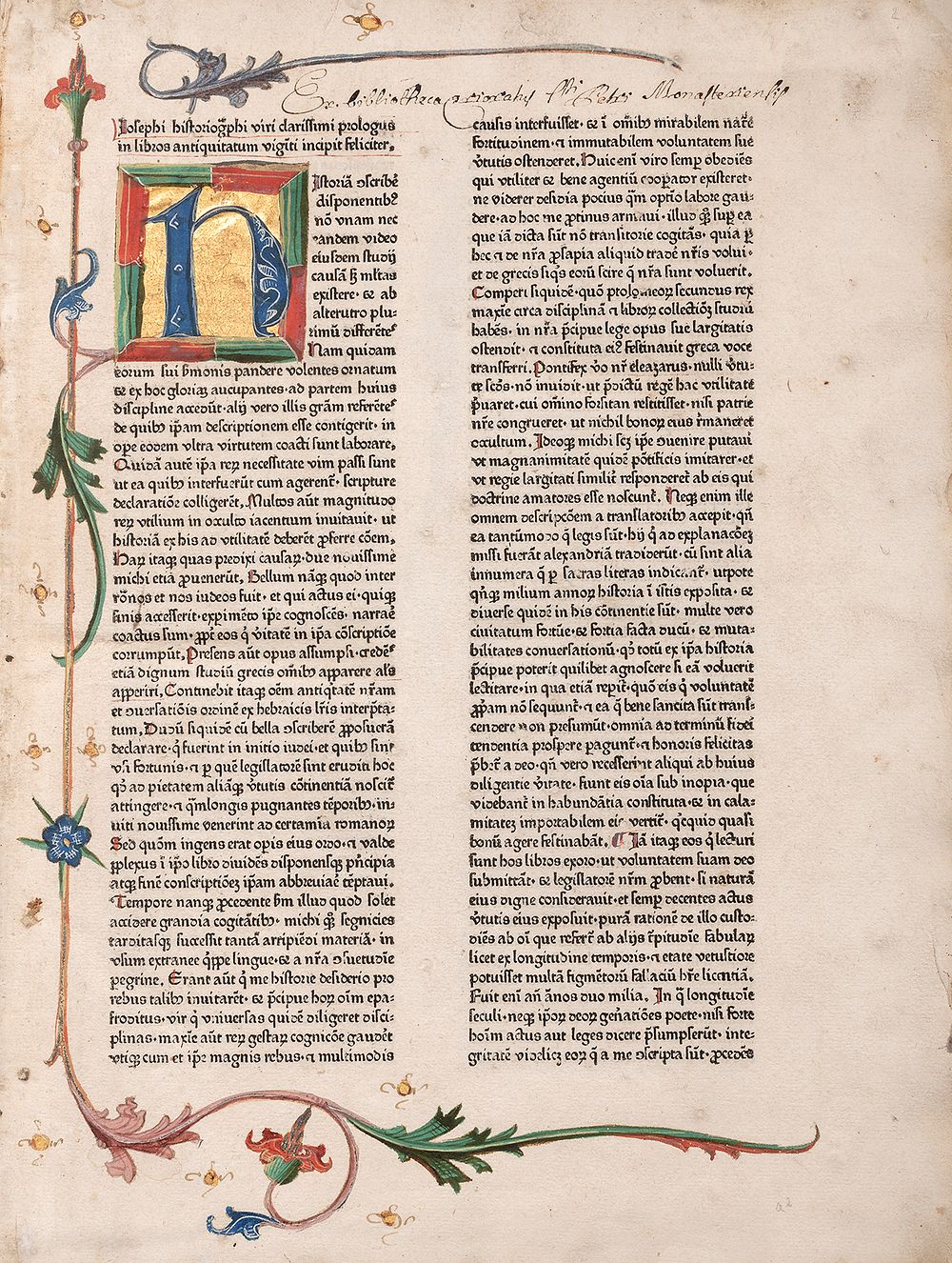
Josephus – Augsburg, 1470 – First Edition of Antiquities of the Jews and the Jewish War – Fine Copy in Elaborate Binding - De antiquitate Judaica / De bello Judaico, two works by Josephus, in Latin translation. Johann Schüssler: Augsburg, 28 June and 23 August 1470 (name of printer, location of printing and date printed in colophon on last page of each work). Latin. Incunabulum. First edition of the Latin translation of two works by Flavius Josephus, one of the most important post-Biblical sources of Jewish history. Impressive, crisp copy, printed on thick, high-quality paper with wide margins, well preserved, illustrated, decorated and bound in an elaborate contemporaneous binding. The text is printed in two columns per page, 50 lines per column, artistically decorated throughout: each book (liber) begins with a large initial panel, hand-decorated and illustrated with ink and pigment in red, purple, pink, brown, green and blue, in floral and vegetal patterns (Maiblumen) and other decorations. The volume comprises a total of 24 initial letters illustrated in square panels, covering ten lines each, and five narrow initial letters extending into the margin or between the columns. In addition, the introduction on the first page features the initial letter ”H” sketched in blue and decorated with a white vegetal pattern on a bright gold background, surrounded by a red and green frame. The page margins feature decorations in a pattern of acanthus leaves and colorful flowers in green, blue, red and brown, and dotted golden flowers. Initial panels opening each chapter (capitulum) in the volume are sketched in red and blue, covering two lines; the initial letters of each paragraph, as well as letters and other notations, are emphasized in red. The book is bound in a contemporaneous binding from Augsburg, made of pigskin over wooden boards, and decorated with various floral and vegetal decorations – palmettes, rosettes, various geometric patterns and birds. Four cast brass corner ornaments, a central ornament and one decorated clasp are affixed to the front board (a second clasp is a later restoration). The back board is fitted with a central ornament and two clasps (the missing corner ornaments are later replacements). The corner ornaments on the front binding are dated to 1465, with the inscription ”Maria hilf uns aus Not Ma” appearing across the edge. Like other extant copies of the Antiquities of the Jews and the Jewish War in this edition, the present volume's binding and the brass ornaments appear to have been made in the printer Schüssler's own bookbindery (for more information, see: Paul Needham, Transactions of the Cambridge Bibliographical Society, 9(1), 1986, p. 73, note 13; similar brass ornaments dated to 1465 (corner ornaments) and 1464 (central ornaments) are affixed to a copy sold by Sotheby's (London, 7 June 2017, Lot 203); another copy with similar binding ornaments was sold by Christie's, New York, 23 April 2001, Lot 69). The Works of Josephus The Antiquities of the Jews (De Antiquitate Judaica), completed in 93 CE, surveys Jewish history from Creation until the Great Revolt. In this twenty-book work, Josephus continues his task of portraying Judaism to the Hellenistic world in a positive light, emphasizing the rational quality of Jewish laws and institutions. Josephus retells Biblical history up to the fourth century BCE; for later periods he relies on a diverse range of sources, including Dionysius of Halicarnassus, Nicolaus of Damascus, Polybius, Strabo, apocryphal literature and more. The original Greek of Antiquities of the Jews was not printed from manuscript until 1544; the present Latin translation was produced at the request of the Latin scholar Cassiodorus (485-585 CE), probably based on a manuscript in his library, and the translator took certain liberties with the Greek original (for more information on the translation of the work, see: H. Schreckenberg, Die Flavius-Josephus-Tradition in Antike und Mittelalter, Leiden, 1972, p. 105). The Jewish War (De Bello Judaico) was evidently authored in Aramaic between 75 and 79 CE (no original Aramaic manuscript survives, but Josephus himself supervised the received Greek version). This work recounts the history of the Roman conquest of Judea in the first century CE. The core of the book describes the Jewish revolt against the Roman Empire that took place in the years 66-70, including a description of the destruction of Jerusalem and the burning of the Temple. The work is based on Josephus' firsthand experience as commander of the Jewish forces of the Galilee and his capture by the Romans. The work's tone is apologetic, aiming both to reconcile the Empire with the Jews and to prevent a further Jewish rebellion. Apart from the information on the Jewish-Roman war and Roman military tactics, among other subjects, this work is of singular importance as a primary source for first-century Judaism.