Bidspirit auction | Rabbeinu Bachya on the Torah
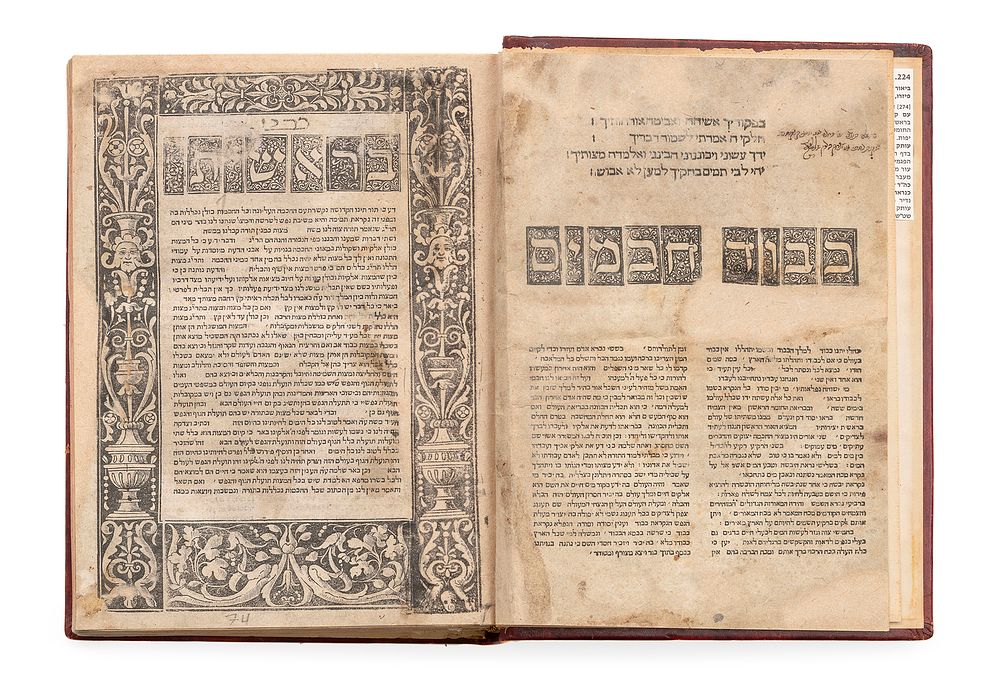
Rabbeinu Bachya on the Torah – Pesaro, 1514 – Printed by Gershom Soncino – Signature of the Nagid Rabbi Yitzchak HaKohen Sholal - Rabbeinu Bachya – Torah commentary by R. Bachya son of Asher ibn Halawa. Pesaro: Gershom Soncino, 1514. On title page: ”Rabbeinu Bachya, Torah commentary”. Author's introduction on verso of title page. Printed in square typeface, in two columns. Decorated woodcut title page on second leaf, with another woodcut decoration around the word ”Bereshit” (similar decorations are featured in the introduction on the verso of the title page, and at the beginning of the Books of Shemot and Vayikra; the present copy has the illustrated frame on the front of the second leaf, as the leaf was bound in reverse; the recto of this leaf originally continued the introduction, with the illustrated frame on the verso). Colophon on last page (Hebrew): ”In Italy, by the youngest of the typesetters, least of the students, residing there [a play on the name Gershom] in Pesaro, [1514]…”. The author, Rabbeinu Bachya son of Asher ibn Halawa (1255-1340), was a Torah scholar of Gerona and prominent biblical commentator. A disciple of the Rashba. Rabbeinu Bachya's commentary employs four methods of exegesis: pshat – based on Biblical commentators who interpret the text based on the plain meaning; drash – based on midrashim; intellect – based on philosophy; and a method he terms the ”way of kabbalah” or ”way of light”, based on kabbalistic works and scholars, including passages corresponding to teachings of the Zohar, which had not been published at the time, but which was apparently used by Rabbeinu Bachya. Rabbeinu Bachya's commentary is innovative in its integration of these four methods, and in the expansion of the kabbalah approach – expounding upon and clarifying kabbalistic concepts tersely hinted at in Ramban's commentary. Rabbeinu Bachya's commentary soon gained widespread recognition. The Tosafot Yom Tov writes that many would study it every Shabbat, and R. Avraham Zacuto attested in Sefer Yuchasin that the book was renowned worldwide. Rabbeinu Bachya is quoted extensively in Tzenah URenah, demonstrating that the book was popular among the general public. Copy of the Nagid R. Yitzchak HaKohen Sholal. On verso of title page, signed ownership inscription in his handwriting: ”In Jerusalem, by R. Yosef Korkus, I purchased it, Yitzchak HaKohen Shalal”. R. Yitzchak HaKohen Sholal (Shalal) was appointed Nagid (prince, or leader of the Jewish community of Egypt, a position held by the Rambam and his descendants) in 1502, and he led the communities of Egypt and Eretz Israel. Among other activities, he founded and supported two important yeshivas in Jerusalem, and his Beit Din issued several important regulations and initiatives. The most famous one, issued in 1509, exempted Torah scholars from taxes. A letter written by an Ashkenazi Jew who visited Jerusalem during that period describes ”the Nagid of all these lands, whose name is the perfect scholar, the great rabbi, his highness R. Yitzchak Shalal, who would provide for students of Torah in all of Eretz Israel, scholars and students…” (Yaari, Igrot Eretz Yisrael, p. 178). With the Ottoman conquest of Egypt in 1517, the Nagid institution was discontinued (thus R. Yitzchak HaKohen Sholal was the last Nagid of Egypt), and he then immigrated to Jerusalem, where he settled until his passing on Rosh Chodesh Kislev 1524. R. David ibn Abi Zimra (the Radvaz) studied in his yeshiva, as mentioned in Kore HaDorot and Shem HaGedolim by the Chida in his entry on the Radvaz. R. Yosef (Mahari) Korkus was a distinguished Torah scholar of Jerusalem and Egypt and yeshiva dean in the generation of the Arizal and R. Yosef Karo. He was likely a disciple and peer of the Radvaz. In one of his letters, the Arizal recommends studying at his yeshiva (Benayahu, R. Yitzchak Nissim Jubilee Volume, V, Jerusalem, 1985, p. 241). The Chida writes of him (Shem HaGedolim): ”R. Yosef Korkus was a descendant of those expelled from Spain, and he authored a wondrous work on the Rambam cited by the Beit Yosef in Kesef Mishneh… The Chazon Nachum quotes some of it. He calls the Radvaz a peer and contends with him in a responsum, section 340. R. Yosef Korkus, apart from the famous work he authored on the Rambam, also authored a responsa work on the questions he was asked about the Rambam… He also authored responsa, as mentioned in the responsa printed in Venice…” (see further: Avraham David, Chachamim BiYerushalayim BaMeah Ha-16, Shalem V [1987], pp. 243-244 (Hebrew); in note 118 he mentions the present inscription, inferring from it that R. Yosef Korkus was already in Jerusalem by the second or third decade of the 16th century, i.e. before the passing of the Nagid R. Yitzchak Sholal; see also: R. Yaakov Shmuel Spiegel, Kuntres Teshuvot LeR. Yosef Korkus, Moriah 367-368 [XI, 7-8], pp. 13 ff.; Hebrew). Many inscriptions on title page, including birth inscriptions and other inscriptions.