Bidspirit auction | Chiddushei Halachot by Maharsha, Part
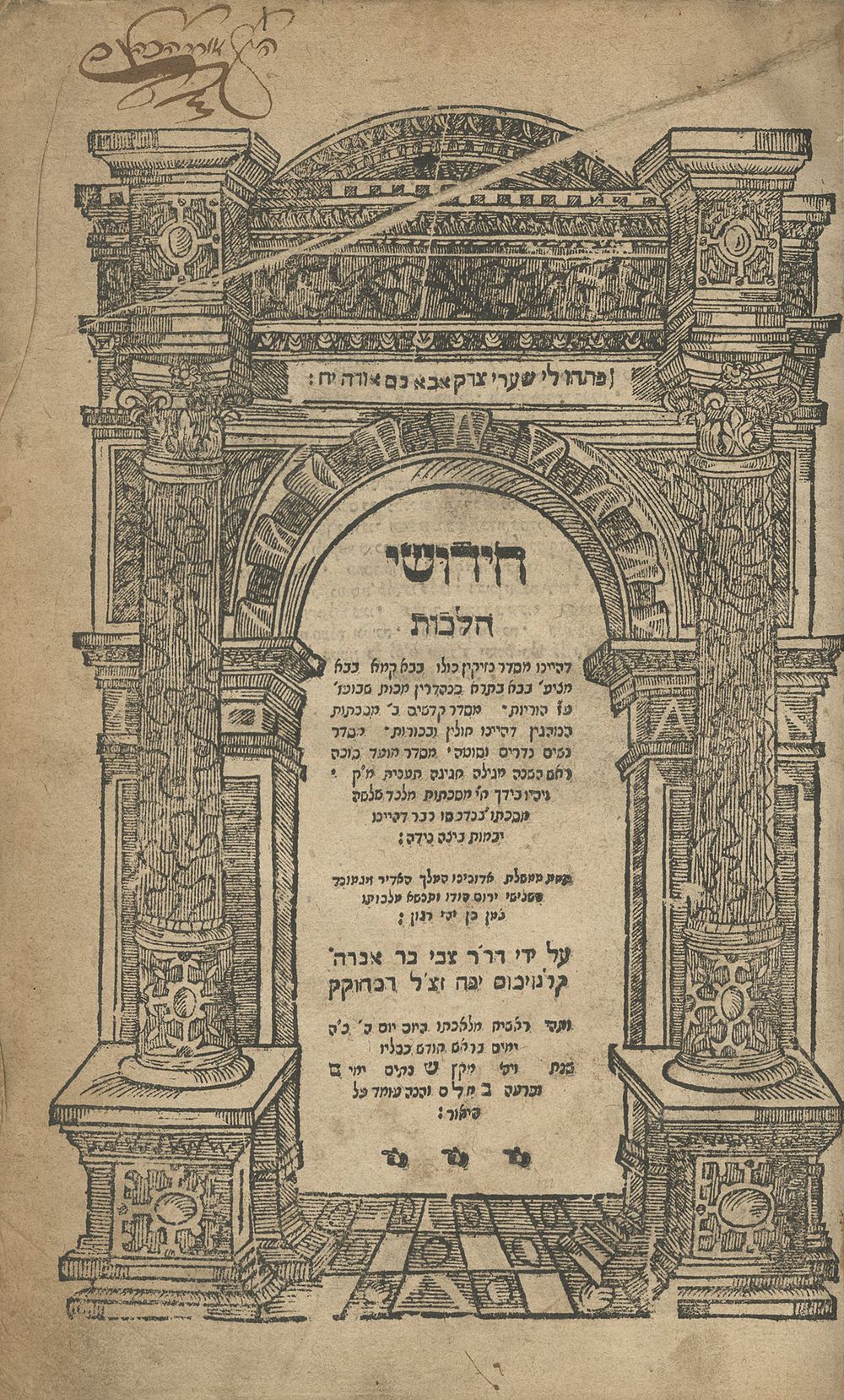
Chiddushei Halachot by Maharsha, Part I – Lublin, 1611 – First Edition, Printed in the Author's Lifetime – Especially Rare - Chiddushei Halachot, Part I, Talmudic novellae by R. Shmuel Eliezer HaLevi Eidels – the Maharsha. Lublin: Tzvi son of Avraham Kalonymus Yoffe, 1611. First edition, printed in the author's lifetime. Decorated woodcut title frame. The present volume is the first part of Chiddushei Halachot, which the Maharsha printed in Lublin, comprising novellae on eighteen tractates: Bava Kama, Bava Metzia, Bava Batra, Sanhedrin, Shevuot, Avodah Zarah, Makkot, Horayot, Chullin, Bechorot, Rosh Hashanah, Sukkah, Chagigah, Megillah, Taanit, Moed Katan, Sotah and Nedarim. Part II of Chiddushei Halachot, which is not part of the present volume, was printed in Lublin, 1621, comprising novellae on ten more tractates: Berachot, Menachot, Shabbat, Eruvin, Pesachim, Yoma, Beitzah, Ketubot, Gittin and Kiddushin (as well as the eighteen tractates in the present volume). As mentioned on the present volume's title page, the author's novellae were previously printed three times, on three tractates (some anonymously): novellae on the first chapter of Yevamot (Prague, 1598); novellae on Beitzah and Yevamot (Basel, 1599-1600; see Kedem, Auction 108, Lot 87); and novellae on Niddah (Prague, 1602). In the author's introduction on leaf [2], the Maharsha writes that he decided to focus on the straightforward explanation in both the halachic and aggadic portions of his novellae, so as to avoid esoterica to which he was not privy. The Maharsha likewise portrays his work quite humbly, refusing to deem it his own accomplishment: ”I always had friends to listen and approve of this, to follow the Talmudic passages through to locate the simple meaning of each thing, and I took but a hint of that… and I decided to set them to be remembered in a book…”. Towards the end of the introduction, the Maharsha expresses his regret at not publishing his halachic and aggadic novellae as one intertwined work, as it is in the Talmud, and he asks the reader to study both simultaneously. Per the Maharsha's wishes, the Metz printers decided to combine both works in their Talmud edition, using smaller type to differentiate Chiddushei Aggadot from Chiddushei Halachot. Since then, the Maharsha's commentaries have been printed in all known Talmud editions following that format. On the verso of the title page is an introduction by the proofreader, R. Shaul Shimon of Lublin, the author's brother. R. Shmuel Eliezer HaLevi Eidels – the Maharsha (ca. 1555-1632), a leading Talmudic commentator of the Acharonim period. He was born in Kazimierz near Cracow (though some place his birth in Posen) to his father, R. Yehudah HaLevi the Sephardi, according to one tradition a brother of R. Shmuel HaLevi Segal, father of the Taz, and his mother Gittel, born to the family of the Maharal of Prague (another tradition traces his lineage to R. Yehudah HeChassid). The Maharsha was known from childhood as a prodigy, and he was distinguished for his many acts of kindness throughout his life, and his home which was open to any poor or needy person. He married the daughter of Eidel Lipschitz, widow of R. Moshe Lipschitz Rabbi of Brisk, and she was the one who sustained the Maharsha and his yeshiva in Ostroh; the Maharsha in turn treated her as a second mother, which gave him his surname Eidels. He served as Rabbi of Chelm, Tiktin (Tykocin), Lublin and Ostroh, where he even established a yeshiva, where he was also buried. His halachic and aggadic novellae gained lasting renown, and became a staple of Talmudic study, especially study of Tosafot, and they appear in virtually all modern Talmud editions. Signature on title page: ”Uri HaKohen”. Trimmed ownership inscription on last leaf: ”Belongs to the official --- R. Ahar---”. Complete copy. Bava Kama and Bava Metzia: [2], 34 leaves. Bava Batra: 29 leaves. Sanhedrin: 22 leaves. Shevuot: 13 leaves. Avodah Zarah, Makkot, Horayot, Chullin, Bechorot: 23, 22-46 leaves. Rosh Hashanah, Sukkah, Chagigah, Megillah, Taanit, Moed Katan, Sotah, Nedarim: 39 leaves. 30.5 cm. Varying condition; fair-good to fair. Stains, including large dark dampstains to many leaves. Wear and creases. Worming. Marginal tears and open tears to several leaves, repaired with paper. Old binding, with wear and defects. Each tractate (or grouping of tractates) is printed with a new foliation, and they may have been printed separately (and sold as such) at different times, with the joint title page added in 1611 (the order of tractates differs from the present volume in certain copies). Especially rare edition. To the best of our knowledge, it has not previously been sold at auction . Praise for the Maharsha and His Novellae Leading Torah personalities have praised the Maharsha and his Talmudic novellae extensively. The Chida, in his Shem HaGedolim, writes of the Maharsha: ”An exceptional rabbi… authored halachic novellae on most of the Talmud,