Bidspirit auction | Maaseh Hashem – Venice, 1618
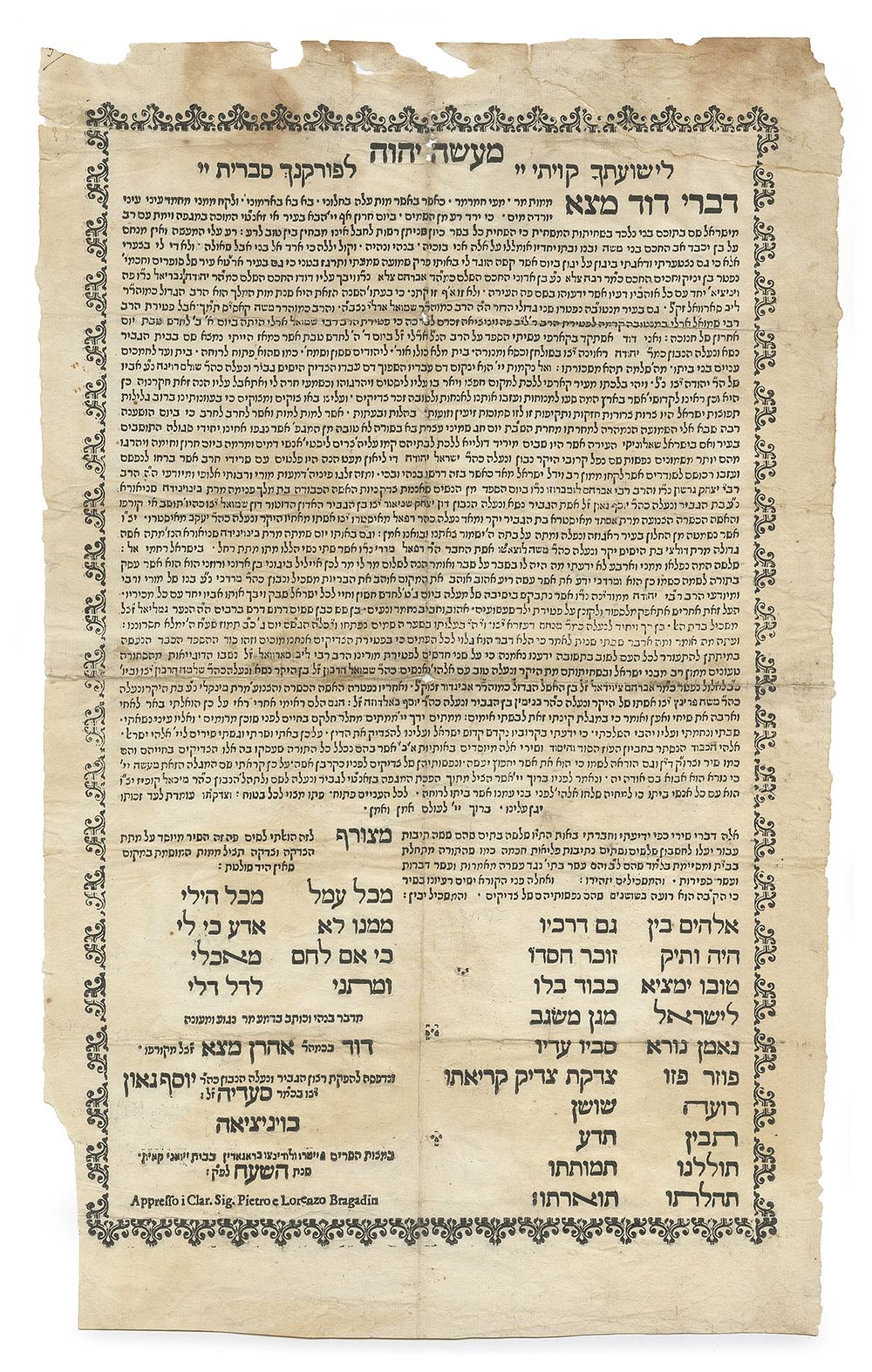
Maaseh Hashem – Venice, 1618 – Printed Leaf, with Lamentation and Poems by Rabbi David Mazza of Corfu – Only Extant Copy - Printed leaf, Maaseh Hashem, lamentations and poems for the passing of the author's family in a plague and many others, some from his circle of friends and acquaintances, by R. David Mazza of Corfu. Venice: Giovanni Cajon for Pietro and Lorenzo Bragadin, 1618. Large-format leaf, printed on one side. Text framed. Top of leaf captioned ”Maaseh Hashem”, and on both sides: ”I hope for Your salvation, O Lord” (Bereshit 49:18) in Hebrew and Aramaic. The author, R. David Mazza , begins with a lengthy lamentation for members of his family and acquaintances who died of various causes, some tragically. The author begins with a lament for his son Moshe and his two sons, who perished in a plague on Zante (Zakynthos, Greece) with many others. He next mentions several rabbis and Torah scholars who passed away: Rabba Tzala son of R. Avraham Tzala (Tzalach) of Arta (northwestern Greece, d. 1517); ”the great rabbi” R. Leib Saraval (a noted Venetian Torah scholar); R. Shmuel Arli and R. Moshe Cases of Mantua, whom the author calls ”leaders of the generation” (and he mentions that he had eulogized R. Shmuel Arli a year earlier in Corfu); R. Shulam Ravenna, who was murdered by bandits on the road. The author goes on to mention one of the most terrible incidents in the history of the Jews of Salonika – the killing of over eighty Jewish merchants who were taken captive on their way back from the Dulia fair on 14th Elul 1618, including one of his friends (the author notes that news of their murder reached him on Shemini Atzeret 1618). It also mentions the death of R. Yehudah Aryeh of Modena's eldest son (whom the author considers his teacher and friend), Mordechai, who passed away at the age of 26, as well as names of other Torah scholars and several women who passed away. After detailing the many names of the deceased, the author stresses that G-d's decree must be justified, so he authored these poems as a sort of acceptance of the decree and thanksgiving to G-d, naming it Maaseh Hashem as a play on Shemot 34:10: ”the act of the Lord, for it is fearful”. The poem appears at the bottom of the leaf with various allusions, as the author explains the number of verses and letters chosen as an allusion to the 32 paths of wisdom and the ten utterances with which the world was created, the ten commandments and the ten sefirot. At the bottom left, after a short poem praising the virtue of charity, the author concludes with his name, signing as ”the one speaking with a groan and writing with bitter, sickly, afflicted tears”. He subsequently mentions that the leaf is written at the behest of R. Yosef Gaon, along with printing details. R. David Mazza was a Torah scholar of Corfu, a disciple of R. Moshe HaKohen of Corfu, author of Yashir Moshe. See: M. Benayahu, The Relations Between the Jews of Greece and the Jews of Italy, Tel Aviv, 1980, pp. 325-329 (Hebrew); idem, Defusei Calleon, Asufot XIII, 2001, p. 130 (Hebrew; Benayahu records the leaf based on the present copy). 24X39 cm. Fair condition. Stains. Wear. Folding marks. Tears to folds and other places (including marginal open tears), affecting text, repaired with tape to verso. Not recorded in Bibliography of the Hebrew Book, NLI catalogue or WorldCat. The present item appears to be the only extant copy. Provenance: Collection of Mozes Heiman Gans.