Bidspirit auction | Parchment Manuscript – Paneach Raza
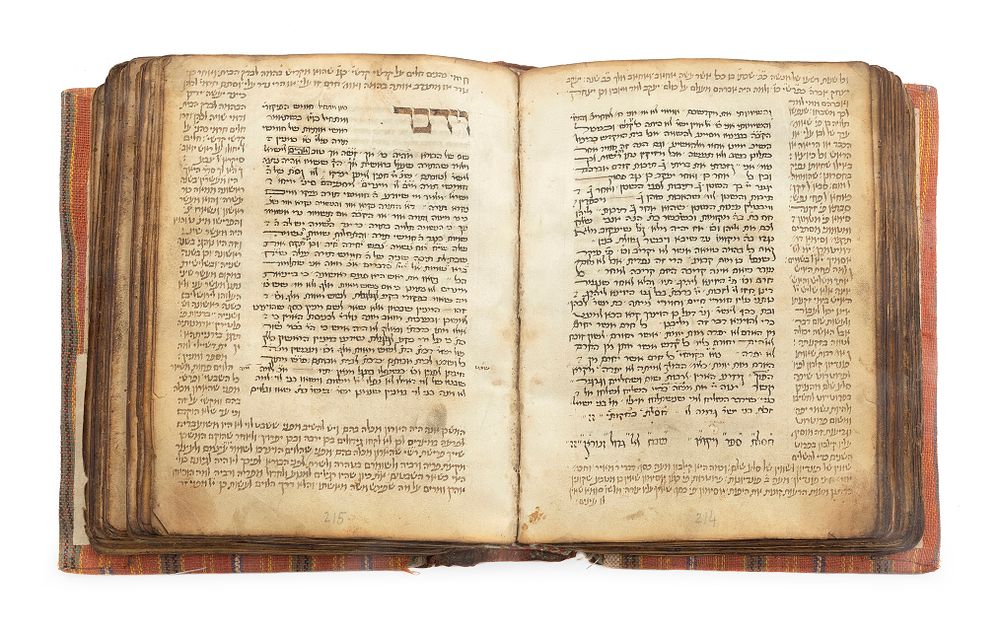
Parchment Manuscript – Paneach Raza on the Torah, with Selections on the Bible – Ashkenaz, 1356 – Sassoon Ms. 1066 - Manuscript, Paneach Raza on the Torah, with selections from the Tosafists on the Torah, Neviim and Ketuvim. [Ashkenazic lands], 1356. Ashkenazic cursive script, on parchment leaves, handwritten by one scribe. Initial words in square script. Many selections by other writers handwritten in margins (near date of writing of main text). Words in red ink in several places (in some opening words and colophon). Several diagrams and illustrations (the foremothers' tents – p. 13; the order of the gemstones on the breastplate – p. 136; the rods carried by the spies – pp. 235-236; the altar and its rings – p. 269; and more). Decorated catchwords. Main scribe's colophon at conclusion of Paneach Raza, at end of Book of Devarim (p. 327): ”I, David son of R. Meir HaKohen, have finished Paneach Raza, which contains some explanations of Lekach Tov, Sechel Tov, Bechor Shor and Tanchuma, and other comments, explanations, homilies and interpretations. I concluded it on 26th Tevet, Tuesday, 5116 [1356]…”. The scribe decorated the name ”David” in several places, alluding to his name (as on pp. 31, 49, and more). A poem follows the colophon, with the scribe's name, David, in acrostic. The present volume contains an early copying of Paneach Raza on the Torah (see below for more information on this commentary). This is the earliest copy of the work known to us. A rhyming line concludes each of the first four Books of the Torah. After copying Paneach Raza (concluding with the colophon), the scribe continued with a selection of midrashim and commentaries on the Neviim and Ketuvim, as a sort of sequel to Paneach Raza. This section follows the sequence: Yehoshua, Shoftim, Shmuel, Melachim, Yirmiyahu, Yeshayahu, Tehillim, Mishlei, Iyov, Daniel, Shir HaShirim, Ruth and Eichah. Many leaves of the section on the Torah, and several leaves in the section on Neviim and Ketuvim, contain many lengthy marginal additions, in the eclectic style characteristic of Paneach Raza. These additions comprise novellae and allusions from midrashim and commentaries of the Tosafists and other scholars. See below for a more detailed description. Paneach Raza is a collection of commentaries by the Tosafists on the Torah. Unlike other works of this genre, the identity of the author of Paneach Raza is known: R. Yitzchak son of R. Yehudah HaLevi, a Tosafist active in France in the second half of the 13th century, who edited and selected the contents of Paneach Raza. In his introduction (which is not preserved in the present manuscript), he names several Torah scholars and commentators whose works form the basis for his commentary, including R. Yitzchak, R. Yaakov of Orleans, the Bechor Shor, R. Yehudah HeChassid, R. Elazar and others. As his description indicates, the work is based on the Tosafists' commentaries on the Torah, but also on the allusive gematria literature of Chassidei Ashkenaz – R. Yehudah HeChassid, author of Sefer Chassidim, and R. Elazar of Worms, the Rokeach (for more information on Paneach Raza, its contents and its place among the Tosafists' Torah commentaries, see at length: Ephraim Kanarfogel, The Intellectual History and Rabbinic Culture of Medieval Ashkenaz, Detroit: Wayne State University Press, 2013, index). Beyond the sources mentioned in his introduction, this work cites commentary and allusions by many other sages, including Rashbam, Rabbeinu Tam, Ri HaZaken, Rivam, Rivash, R. Yom Tov of Joigny, R. Yechiel of Paris, R. Meir (Maharam) of Rothenburg and others. The present manuscript also mentions such figures as ”my grandfather R. Aharon”, ”R. Eliav”, ”R. Baruch Serfontaine”, R. Yosi HaKohen”, ”R. Yitzchak Levi”, ”R. Moshe of Paris”, ”R. Matitiah son of the martyr R. Yitzchak”, ”R. Azriel”, ”the martyr of Dreux”, ”the martyr of Rome”, ”R. Ovadiah the Spaniard”, ”R. Shneur”, and others. Paneach Raza was first printed in Prague, 1607, by R. Yitzchak son of R. Shimshon HaKohen – son-in-law of the Maharal of Prague, with his notes. Some of the early manuscripts still extant contain expanded versions of the work, with significant deviation from the printed version (see: Kanarfogel, ibid., p. 180, and index of manuscripts). To the best of our knowledge, the present manuscript is the earliest dated manuscript of Paneach Raza. It features variants differing from the printed edition as well as other manuscripts, and it requires further research to determine its import (Kanarfogel appears not to have studied the present manuscript, as it is not recorded in the index of manuscripts at the end of the above book). The marginal notes to the present manuscript are also in need of a dedicated study. They contain a selection of midrashim and other works (such as Avot DeRabbi Natan, Midrash Shocher Tov, Yosifon, Sefer Razim, Sefer HaGan and other works), and novellae of Tosafists and other sages, including R. Yechiel of Paris,