Bidspirit auction | Manuscript – Milchamot Hashem (Teshuvot
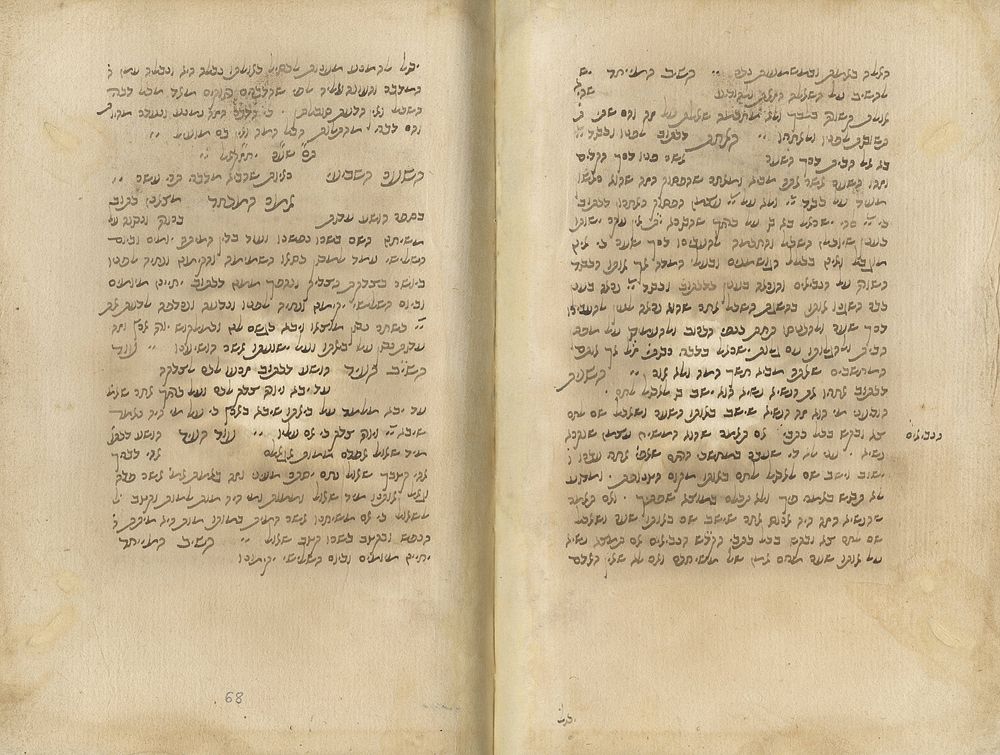
Manuscript – Milchamot Hashem (Teshuvot LaKofrim) by Rabbi Yaakov son of Reuven – Provence, 1423 - Manuscript, Sefer Milchamot, polemical work against Christianity, by R. Yaakov son of Reuven. [Provence], 1423. Spanish cursive script. The work's title, Sefer Milchamot, is written on the first page. At the top of the page is a poem, beginning Moreh Yesod Datcha (this poem has not been documented, and does not appear in other manuscripts of the work). Copyist's colophon at end of work: ”The writing of this book was concluded on 6th Elul 5183 [1423], and I, Shmuel son of R. Shmuel, known as Samiel Bonet, wrote it for Macip Abram de Trets, may G-d grant him the merit to study it constantly, he and his offspring and his offspring's offspring and all of his own, Amen Amen Selah, blessed is He Who gives strength to his servant son of his maidservant”. Milchamot Hashem, also known as Teshuvot LaKofrim, or by the name the author gives it at the end of his introduction, HaMechached VehaMeyached, is a polemical work with the purpose of defending Judaism from Christian polemics. The author, R. Yaakov son of Reuven, lived in the 12th century, probably in southern France. In his introduction, he recounts his circumstances and location: ”…For G-d had me explain great and wondrous things… in accordance with the event that I experienced while in the lowlands of Gascony as an exile, when I was sentenced to live among them. There, in the land of my residence, one Christian befriended me, an important figure in the city and one of the greatest sages of the generation, and he was a priest, expert in logic and versed in all disciplines – the inner ones only, for our Creator clouded his vision and understanding, and he was attached to his idol, his desire and his ideas, to worship his wood and stone. And while I was studying with him regularly, he asked me, 'Until when do you teeter on both sides?'… And I listened to all his questions… And I attended to understand and search after responses to his waywardness”. This work is divided into twelve sections, corresponding to Jacob's twelve sons (a reaction to a twelvefold division in Christian polemical literature, corresponding to the twelve apostles). Each section is divided into question and answer paragraphs, in a discussion between the Meyached (”unifier”) – the author, upholding the oneness of G-d, and the Mechached (”denier”) – the Christian attacking Judaism. This work elicited reactions in the Christian world, including by the Dominican scholar Nicholas of Lyra, who wrote a dedicated response to the eleventh section of Milchamot Hashem in the 13th century, and in the 14th century the famed apostate Abner of Burgos who wrote a dedicated book against this work. Milchamot Hashem is known as an influence on Jewish anti-Christian disputants, notably R. Shem Tov ibn Shaprut, who used the present work as the basis for his own Even Bochan. Milchamot Hashem was first published in full, based on several manuscripts, by Dr. Yehuda Rosenthal, Mosad HaRav Kook, Jerusalem, 1963, along with an extensive preface on the author and his work. This manuscript was however not available to the editor. On the margin of the last page, after the colophon, is an inscription by Caleb Afendopolo, documenting his purchase of the manuscript from a Spanish exile in 1494: ”Friday, 15th Av, 1494, I, Caleb Afendopolo son of R. Eliyahu son of R. Yehudah purchased this book, including the Sefer HaShir by R. Shem Tov Falaquera and Even Bochan by Shaprut and Teshuvot LaKofrim by R. Yaakov Valesi the teacher from the Spanish Exile”. This inscription indicates that the present manuscript was originally part of a larger volume, originally comprising two other works. The manuscript was divided at a later point in time. One of the divided parts is presently at the University of Columbia in New York, Ms. X 893 K 12. This manuscript comprises Even Bochan by R. Kalonymus son of Kalonymus (lacking at beginning), concluding with a colophon by the same R. Shmuel Bonet, who completed the work about a month before completing the present work, on 4th Av 1423 (Afendopolo's remark notwithstanding, the Even Bochan copied there is by R. Kalonymus son of Kalonymus, not the identically named work by R. Shem Tov ibn Shaprut, despite its relation to the present work). Caleb Afendopolo was one of the best-known Karaite scholars in 15th-16th century Byzantium, brother-in-law of Elijah Bashyazi. He was an author, poet, scholar and copyist of manuscripts. He also corresponded with rabbinite scholars, including R. Mordechai Comtino. For more information, see: Mishael Maswari Caspi, Caleb Afendopolo: Karaite Poet and Sage, Yeda-Am (1989), pp. 92-101 (Hebrew); Shimon Bernstein, The Poems for the Months of the Year by Caleb Afendopolo the Karaite, Chorev, XI, pp. 54-85 (Hebrew). Another manuscript with a colophon written by the copyist of the present manuscript is Bavaria State Library – Munich Ms. 94.