Bidspirit auction | Parchment Manuscript – ”Sassoon Pentateuch”
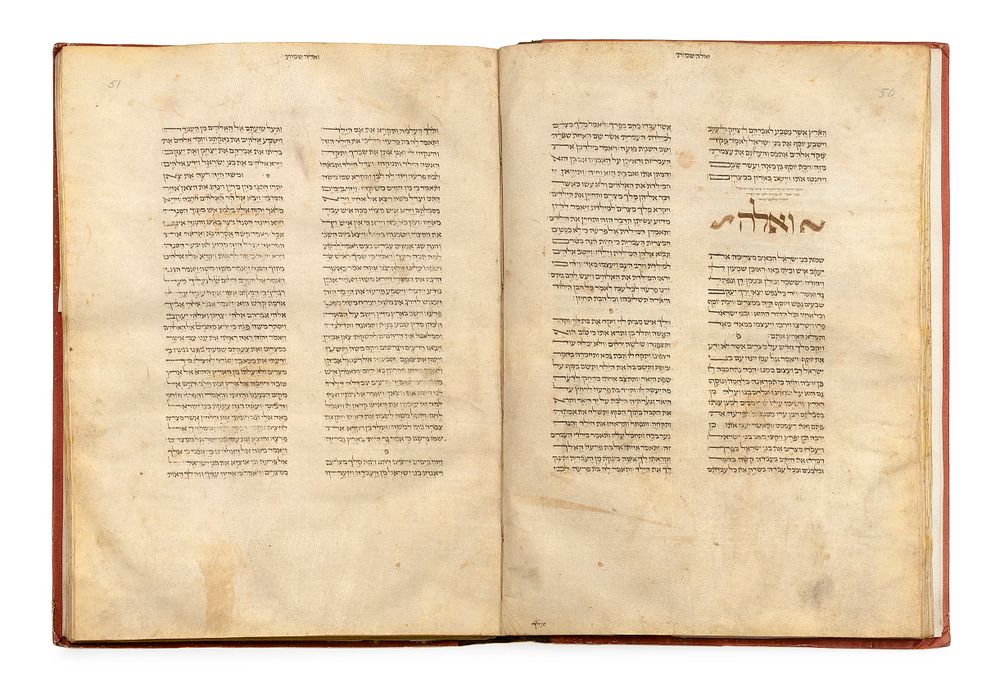
Parchment Manuscript – ”Sassoon Pentateuch” – Italy, 15th Century – Tikun for Sofer – Sassoon Ms. 958 - Parchment manuscript, Five Books of the Torah. [Italy, ca. 15th century]. Italian square script, with vocalization and cantillation. Two columns per page (31 lines per column). Enlarged initial panels, in gilt ink, at beginning of each Book of the Torah. At the beginning of Bereshit the scribe left part of the page blank for the purpose of a large decorative initial panel, but the initial panel was eventually left relatively small. This manuscript was meant to be used by sofrim scribing Torah scrolls, and it includes various instructions for the scribe (entitled ”Tikun Sefer Torah”), a detailed list of open and closed parashiot (petuchot and setumot) and other notations. The margins of some leaves include a few Masoretic notes, in minute handwriting, including such things as keri and ketiv, as well as larger and smaller letters. Several places include Tagim on the letters, and many verses have a winding letter Pei rather than the ordinary Pei, in accordance with traditional scribal practices (including certain words in Bereshit 7:11, Jacob's blessings, the Song of the Sea and elsewhere). The parashiot are marked with the letters Pei and Samech. A sampling of parashiot reveals that the paragraphing system deviates in several places from the one transmitted by the Rambam and the Aleppo Codex. The tradition represented in the present manuscript is in need of a comprehensive study. The Torah portions for yearly synagogue reading are marked in a unique fashion, resembling a final letter Nun, following an uncommon custom that has survived in few Torah scrolls (for more information, see: Jordan S. Penkower, Fragments of Six Early Torah Scrolls: Open and Closed Sections, the Layout of Ha'azinu and of the End of Deuteronomy, in: Manuscrits Hébreux et Arabes, 2014, pp. 39-61). The Song of the Sea format is written in the ariach on levenah format, conforming to the Aleppo Codex and the Rambam's method, as was received in the Italian Jewish tradition (for more information, see: Orlit Kolodni, Traditions of Writing the Song of the Sea in Medieval Italian Biblical Manuscripts, JSIJ XXIII, 2023 [Hebrew]). The lines and internal divisions, as well as the five lines before and after the Song, match the Aleppo Codex model as described by Kolodni, and it may be placed in her A1 category). The Song of Moses (Haazinu) is written in ariach on ariach and levenah on levenah format, a pattern conforming to the model of Tractate Sofrim (but not the Aleppo Codex), following the common Italian custom (see: Orlit Kolodni, The Layout of the Song of Moses (Ha'azinu) In Medieval Italian Biblical Manuscripts, Shnaton – An Annual for Biblical and Ancient Near Eastern Studies, XXVI, 2020, pp. 181-210 [Hebrew]; the six lines before and after the Song also conform to the custom recorded in Tractate Sofrim, and the present manuscript may be placed in Kolodni's A2 category). Instructions to the scribe are included in several places throughout the volume, sometimes under the title Tikun Sefer Torah (for instance, before and after the Song of the Sea and the Song of Moses and on last page, prescribing the proper format of lines). Late corrections by several writers on margins of some pages. Signature of censor ”Antonio Francesco Enriques”, dated 1687, on last page. 98 parchment leaves (196 pages). 34.5 cm. Good condition. Stains, including dark stains and dampstains. Creases, wear and fading of ink in several places, slightly affecting text. Worming to several leaves (mainly to last leaves), slightly affecting several words. Inscriptions. Bookplate of ”Yosef HaLevi”. Old binding (of Sassoon collection). Defects to binding. Provenance: David Solomon Sassoon collection, Ms. 958; Descriptive Catalogue of the Hebrew and Samaritan Manuscripts in the Sassoon Library, London, p. 609.