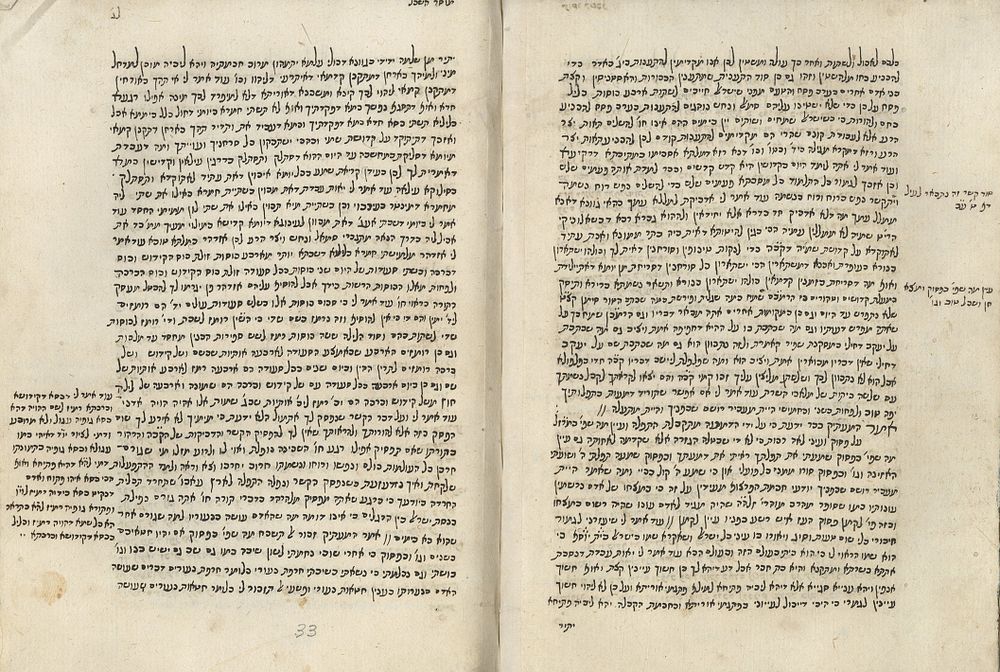
Bidspirit auction | Autograph Manuscript – Musar Haskel
Autograph Manuscript – Musar Haskel – Unpublished Work, Handwritten by Author, Rabbi Shmuel Garmison – Early Quotations (with Variations) from Maggid Meisharim by Rabbi Yosef Karo, with Elaborations and Comments – Jerusalem, 17th Century - Manuscript, Musar Haskel – ethical work based on Sefer HaMaggid (Maggid Meisharim) by R. Yosef Karo and other sources, with comments and notes, handwritten by R. Shmuel Garmison. [Jerusalem, 17th century]. Complete unpublished work, in Oriental script – the characteristic handwriting of the author, R. Shmuel Garmison, a leading Torah scholar of Jerusalem in the 1600s. The volume begins with a title page decorated in geometric patterns, resembling the decoration of other manuscript works of his, such as Responsa Mishpetei Tzedek – Benayahu Ms. E46; and Darchei Noam – Moscow-Ginzburg Ms. 443. At the center of the title page is a later inscription, in Western script, with a dedication to R. Eliyahu Chazan, Rabbi of Alexandria (see below). The manuscript begins with a notable introduction, in which R. Shmuel Garmison offers a detailed autobiographical account and describes the work's purpose. Among other details, R. Shmuel Garmison reveals that he was the one to give the name Maggid Meisharim to R. Yosef Karo's Sefer HaMaggid (Maggid Meisharim has been the work's title in print since its first edition, Lublin 1746). ”Says the young, small, smallest of the scholars, Shmuel the small of the Garmisa family: As I saw… the praiseworthy virtue of ethics… I therefore rose to collect fine ethical teachings from the Zohar and Maggid Meisharim, that is the Sefer HaMaggid by the great rabbi R. Y[osef] Ka[ro], for Maggid Meisharim is the name I gave to the book, as I wrote in its introduction… And I authored this work, small in quantity but great in quality, to carry in my breast opposite my heart, to adjure my heart 'to guard your mouth from the one dwelling in you', to distance itself from evil and anything like it. And especially ever since I decided to preach ethics publicly, and also on the Thursday of each and every week I go to the synagogue here in Jerusalem and publicly read Torah, Neviim, Ketuvim, Mishnah and ethics, 'the beginning of wisdom', I decided it would be very good and fine to collect some ethical teachings from the Zohar and Sefer HaMaggid and similar books… And I called it Musar Haskel… intending that whoever accepts the reprimands in this book will doubtlessly be enlightened and acquire prudence and reject the vanities of the world…”. [In his study on Maggid Meisharim (Yosef Bechiri, section 10, p. 405), Prof. Meir Benayahu poses a ”great mystery” born of a note Prof. Gershom Scholem attached to a copy of Maggid Meisharim in his library. Prof. Scholem writes that in 1943, he had seen a manuscript of selections from Sefer HaMaggid belonging to Simcha Asaf, the introduction of which he understood was written by the father of the publisher of the Lublin edition – Shmuel Binga. Prof. Scholem attempts, unsatisfactorily, to resolve the discrepancy between the surname in the manuscript, Garmisa, and the publisher of the Lublin edition, Binga. Benayahu writes that he was unable to discover this manuscript, expressing his hope that it would turn up and resolve the mystery. The said manuscript is the present one, and as stated above, its author and scribe is R. Shmuel Garmison, who does not describe himself as the book's publisher but rather as the one to name it Maggid Meisharim]. The present manuscript is structured as selections from Sefer HaMaggid, with comments and elaborations by R. Shmuel Garmison. R. Shmuel Garmison mainly excerpted the Maggid's ethical teachings, admonishing R. Yosef Karo and guiding him in his asceticism and repentance. For the most part, R. Shmuel Garmison omitted the homilies on the Torah portions, focusing on the ethical content, but at times he decided to include excerpts of the homilies. In tandem, throughout the manuscript he interweaves lengthy passages of commentary, explanation and elaboration of his own. He generally introduces his comments by referring to himself as ”the copyist”. In some places he offers a lengthy discussion of the Maggid's words (for example, on p. 29b). On several pages, R. Shmuel Garmison also includes marginal glosses and expansions. Thus R. Shmuel Garmison created a work focusing on the ethical aspects of Maggid Meisharim, incorporating them into his own ethical-homiletical work (on the distinction between the kabbalistic-homiletical part and the ethical part of Maggid Meisharim, see: Mordechai Pachter, Joseph Karo's ”Maggid Mesharim” as a Book of Ethics, Daat, XXI [1988], pp. 57-83 [Hebrew]). The present manuscript thus includes early quotations from Maggid Meisharim (from the generation after R. Yosef Karo; see below on R. Shmuel Garmison's part in copying the work). A sampling of differences between the present manuscript and the Ahavat Shalom edition of Sefer HaMaggid (Jerusalem 2023),