Bidspirit auction | Manuscript Volume, Ancona Jewish Community
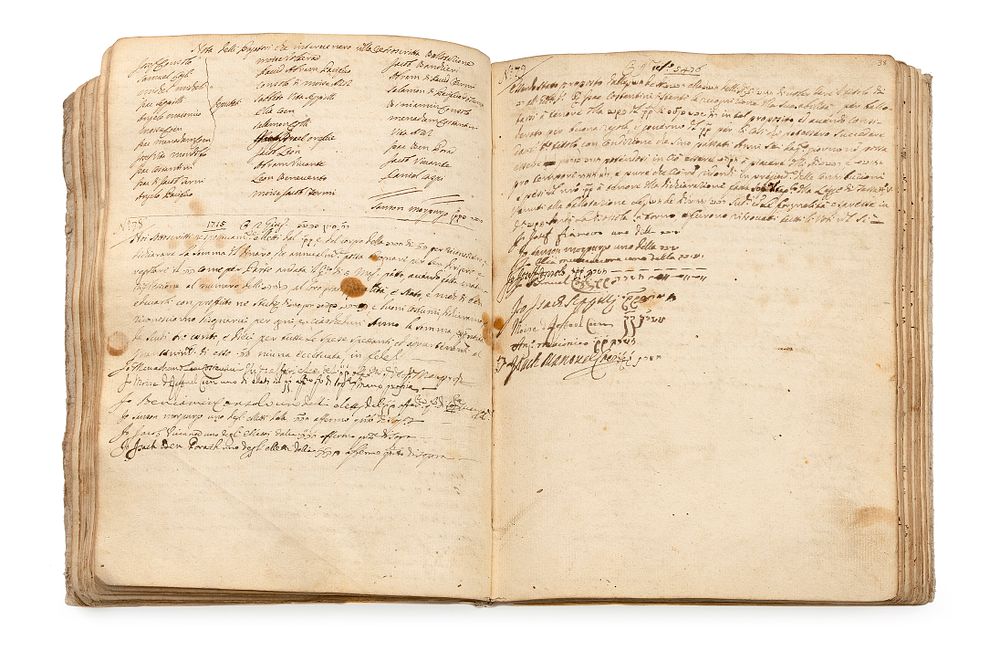
Manuscript Volume, Ancona Jewish Community Pinkas – 1692-1750 – Tens of Leaves Handwritten by Rabbi Shimshon Morpurgo, Author of Shemesh Tzedakah, and Some One Hundred of His Signatures - Manuscript, Pinkas of Jewish community of Ancona. Ancona, 1692-1750. Italian, with Hebrew terms and inscriptions and some documents in Latin. The present Pinkas or communal ledger offers a rare and extensive historical documentation of life in the Jewish ghetto of Ancona during the time ranging from the late 17th century to first half of the 18th. The leaves of this Pinkas comprise 249 paragraphs, written over the course of sixty consecutive years, including community decisions, statutes, protocols, discussions and documents. These provide an outline of the tapestry of interweaving religious, social, political and economic community institutions and their complex relation to the secular authorities. These paragraphs are signed (in Italian) by some of the leading rabbis and dayanim of Ancona across the period: R. Yosef Fiammetta, his son-in-law R. Shimshon Morpurgo, the dayan R. Avraham Alcostantini, his son the dayan R. Yitzchak Alcostantini, R. Eliyahu Mujajion, R. Yaakov Yisrael Benporat, R. Yechiel (Vidal) son of R. Yaakov HaKohen and R. Shabtai son of Mordechai Panzieri. Leaf 24 also includes the Hebrew signatures of R. Yosef Fiammetta and R. Avraham Alcostantini. The leaves of the Pinkas were written by eight of the community's official scribes, and they mention hundreds of names of community members, officials, leaders and rabbis. The early scribes are R. Shmuel Vivanti and his son R. Yaakov Vivanti, R. Menashe Panzieri, R. Binyamin Barafael and the dayan R. Yitzchak Alcostantini. From 1709, the office of community scribe was commended to R. Shimshon Morpurgo, author of Shemesh Tzedakah and Rabbi of Ancona. A significant portion of the Pinkas – about thirty whole pages (paragraphs 66-169) – are in his handwriting, with his signature at the end of each paragraph (in Latin characters). A total of some hundred autograph signatures of his appear in the Pinkas. R. Shimshon began his role as the community scribe during the rabbinical tenure of his father-in-law, R. Yosef Fiammetta, in Ancona. After his father-in-law passed away, he maintained this function in addition to his position as the city's Rabbi. The decisions and protocols paint a picture of his rising status over the years: beginning as a scribe in 1709 (paragraph 48); his hiring for another term (paragraph 69); raises in salary (paragraphs 96, 109); up to the decision to separate his double salary as scribe and rabbi (paragraph 116). His last inscription and signature are in Adar 1740 (paragraph 169). Only one month later (paragraph 170), another scribe records the bitter news of his passing. Paragraph 172 (Nisan 1740) already records the appointment of his son, R. Moshe Chaim Shabtai Morpurgo, as his successor, who continued the Pinkas records, alternating with another family member, R. Yosef Morpurgo. Some paragraphs of the Pinkas document rabbinical ordinations and Chaver titles granted to the city's Torah scholars: R. Eliyahu Mujajion in 1713 (paragraph 55), R. Yitzchak Alcostantini in 1716 (paragraph 79), R. Yechiel (Vidal) son of R. Yaakov HaKohen in 1738 (paragraph 158); and R. Moshe Chaim Shabtai Morpurgo in 1740 (paragraph 171). The text of the paragraphs incorporates many Hebrew terms and expressions. Several places also include lengthier inscriptions in Hebrew. After paragraph 42 is an inscription dated Tamuz 1709, handwritten and signed by R. Yosef Fiammetta, abrogating the statutes in the paragraph: ”As we, the undersigned, have seen the error that many of the congregation are violating the above statutes, in order to remove the stumbling block from our congregation we have decided to annul them, especially now that we have seen that most of the things we wanted to correct have been corrected on their own, and therefore we have all decided with one heart and decision to say explicitly that the above statutes are all absolutely annulled…”. This inscription is signed by R. Avraham Alcostantini. Paragraph 225 describes the arrival of the emissary of Jerusalem R. Avraham son of Asher, and the community's decision to provide the Jewish Yishuv in Eretz Israel with a yearly stipend for ten years; at the foot of the paragraph is a Hebrew inscription handwritten and signed by the emissary: ”I, the undersigned, emissary and agent of Jerusalem, approve and certify the above stipulation by my empowerment, as stipulated by the princes of Judah and Jerusalem, the officials of Constantinople, as is explicated in their Kollel certificate, and this was on 3rd Nisan, 1746, Avraham son of Asher”. Paragraph 232 outlaws games of luck and gambling in the ghetto, and at its foot is a Hebrew inscription invoking a punishment and ostracism against gamblers, handwritten by R. Yitzchak Alcostantini, R. Yechiel (Vidal) son of Yaakov HaKohen and R.