Bidspirit auction | Talmud Yerushalmi, Berachot, Zeraim, Shekalim
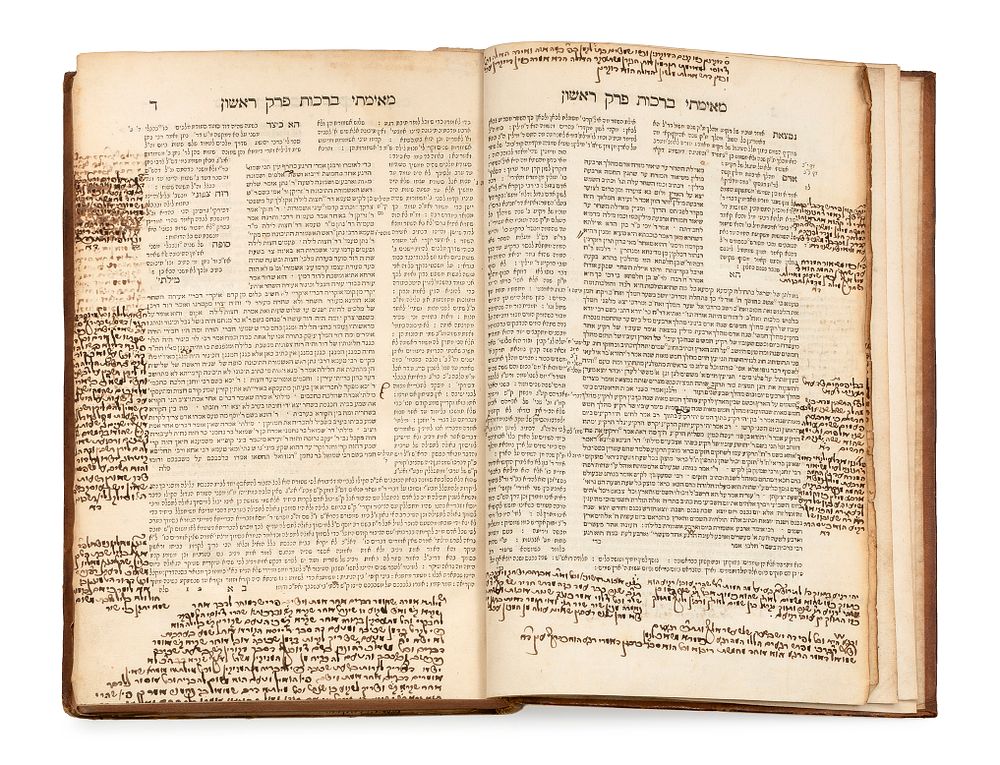
Talmud Yerushalmi, Berachot, Zeraim, Shekalim with Commentary of Rabbi Eliyahu Fulda – Amsterdam, 1710 – Copy with Glosses of Rabbi David Oppenheim (A Supporter of the Edition) - Talmud Yerushalmi, Tractate Berachot, Seder Zeraim and Tractate Shekalim, with commentary of R. Eliyahu Fulda. Amsterdam: Moshe Dias, Rosh Chodesh Elul 1710. First edition with commentary of R. Eliyahu Fulda. On the first three leaves of the tractate are lengthy handwritten glosses in Ashkenazic script, some signed: ”ד”א” [=David Oppenheim]. A comparison with the glosses of R. David Oppenheim printed by R. Eliyahu Fulda in 1712 (in the Luach HaTa'ut bound at the end of the present copy, see below) reveals that the present copy features a partially variant version of the glosses by R. David Oppenheim, chief rabbi of Prague, a prime supporter of the printing of this edition – and they may possibly be his autograph. Most of the content of the present glosses appears in the printed glosses, though with some textual variations. One gloss signed ”ד”א” was not printed at all (and several unsigned glosses were also omitted). One gloss that appears briefly in print appears here in a lengthier version. R. David Oppenheim was one of the main supporters of this edition. His approbation appears at the beginning of the volume, where he praises R. Eliyahu Fulda at length, writing among other things of his lengthy personal acquaintance with him: ”I am speaking of my personal acquaintance, for he was in my Beit Midrash for over twenty years…”. The other rabbis whose approbations appear in the book are: R. Tzvi Ashkenazi, the Chacham Tzvi, Rabbi of Amsterdam; R. Naftali Katz, Rabbi of Frankfurt, author of Semichat Chachamim, and others. In his introduction, the author mentions the supporters of the printing of the edition, in the first place R. David Oppenheim and his son: ”…Much blessing to the great, celebrated Gaon, luminary of the diaspora, Rabbi and yeshiva dean of Prague, R. David, with his son, successor of his father, the holy seed, the sharp and expert R. Yosef, who expended gold from their pocket for the printing expenses…”. In the present copy, at the end of the volume, after four pages of errata, are bound six more errata leaves, incorporating glosses of R. David Oppenheim on the commentary of R. Eliyahu Fulda. These leaves were printed by R. Eliyahu Fulda about two years after the printing of the main volume (on Rosh Chodesh Elul 1710), as stated in the colophon on the last page: ”Concluded with G-d's help, Rosh Chodesh Tamuz, [1712], Eliyah son of R. Yehudah Leib of Wisznice, residing in the countries of Fulda”. For this reason, these leaves do not appear in all copies. Several handwritten corrections (by different writers) on some leaves. R. David Oppenheim (1664-1736) was a prominent leader in his times. Outstanding Torah scholar, rabbi and yeshiva dean, kabbalist and posek, wealthy and influential in the Emperor's court. He was a disciple of R. Gershon Ashkenazi, author of Avodat HaGershuni; of R. Yaakov Katz, father of the Chacham Zvi; and of R. Binyamin Epstein, author of Nachalat Binyamin. He had a close relationship with R. Yair Chaim Bacharach, author of Chavot Yair, and exchanged halachic correspondence with him. In 1690, while still in his twenties, he was appointed rabbi of Nikolsburg (Mikulov) and Moravia. Twenty years later, he was appointed rabbi of Prague, eventually serving as chief rabbi of Bohemia. He held this position for over 25 years until his death. He authored some twenty halachic and aggadic books, including Responsa Nish'al David. Only a few of his compositions were published. Exceptionally wealthy (he inherited his wealth from his father-in-law and from his uncle, R. Shmuel Oppenheim), he held close ties with the Emperor's court and with all the top governing officials. While his books remained in manuscripts, he was very supportive of Torah scholars and assisted them in printing their books. R. David dearly loved books and privately compiled the most important Jewish library in his times, containing thousands of volumes of rare books and manuscripts spanning many eras. After his death, his library was offered for sale and was purchased by the Oxford University Bodleian Library in England. [2], 2-37; 2-22; 2-21; 2-25; 2-25; 2-34; 2-14; 2-17; 2-15; 2-14; 2-9; 2-20; [10] leaves. 30 cm. Good condition. Stains, including dark dampstains. Tears and wear to several leaves. Wear and small tears to margins of first leaves with glosses, slightly affecting text of glosses. Original leather binding, with defects. R. Eliyahu Fulda's commentary on Tractate Shekalim originally appeared in the Mahadura Kama printed in Frankfurt am Main in 1689. The author subsequently rewrote his commentary with many additions, and that is the one included here with his commentary on Tractate Berachot and Seder Zeraim, from which it was reprinted in later editions. Several variants of the present volume are known,