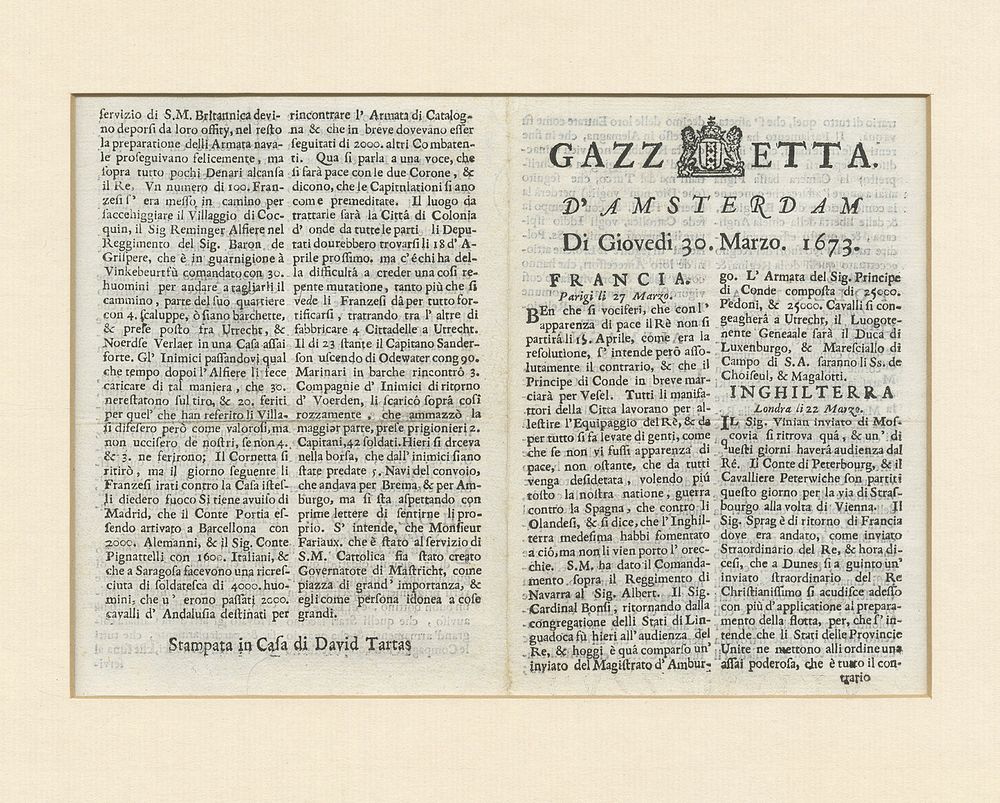
Bidspirit auction | Gazzetta D'Amsterdam – First-Ever Jewish
Gazzetta D'Amsterdam – First-Ever Jewish Newspaper – Amsterdam, March 1673 – Rare Italian Edition - Issue of the newspaper Gazzetta D'Amsterdam. Amsterdam, Thursday, 30 March 1673. Italian. On margins of last page: ”Stampata in Casa di David Tartas” (printed by David Tartas). The Gazzetta D'Amsterdam, published in Italian and Spanish, was in the view of many scholars the world's first Jewish newspaper. First published in 1672, it preceded the Yiddish Kuranten, also printed in Amsterdam (from 1686). The printer, David son of Avraham de Castro Tartas, from a Portuguese Marrano family, was one of Amsterdam's most prominent printers, publishing dozens of religious and philosophical books in Hebrew, Spanish and Portuguese, as well as newspapers. His printing work began in 1647, as a typesetter at Menasseh Ben Israel's press. Although the newspaper bears no declared sign of its Jewish character, nor does it explicitly discuss Jewish news topics, its target audience was the community of merchants and Marranos exiled from Spain and Portugal. These merchants, who resided in port cities across Europe, the Balkans, the Ottoman Empire and the New World, made use of Italian and Spanish as lingua franca for commerce and diplomacy. The newspaper's staff, based on a network of independent reporters as well as translation and adaptation of local newspapers in Dutch and French, provided its readers with vital political, military and economic information for managing their world-spanning businesses, while taking care to avoid betraying signs of Judaism that could endanger the merchants, especially the Marranos, in Catholic regimes still subject to the Inquisition. The present issue is printed in Italian. At least one other known issue is printed in Italian, dated 14 September 1673. It is unclear how long this Italian edition lasted, nor whether the newspaper changed its language for a certain time period or whether its issues were printed in both languages, Spanish and Italian. Likewise, we have no certain information on the newspaper's circulation, but it may have been sent to subscribers in various countries, like contemporaneous newspapers published in Italy and Germany, which were pioneers of printed journalism in Europe. The present issue was published in the midst of the Franco-Dutch War (1672-1678), near late 1672, which Dutch historiography remembers as the ”disaster year” (Rampjaar), when the Republic was attacked by a coalition headed by Louis XIV of France, England and certain German principalities. This issue provides a fascinating glimpse into the news of those days: A report from Paris (27 March) states that the king's preparations for war are being carried out unabated, and that the Prince of Condé was preparing to march to Utrecht at the head of an enormous army of 25,000 footmen and 25,000 horsemen; a report from London (22 March) refers to avid diplomatic activities, parliament sessions on religious affairs, and emissaries from Moscow and European courts; a report from Danzig (18 March) relays that General John Sobieski (later King of Poland) was heading an army to deal with an Ottoman invasion (his victory over the Ottomans at Vienna earned him the title of Savior of Europe); a report from Germany (28 March) cites reports of diplomatic motions on the part of the Holy Roman Empire in Vienna and involvement on the part of the Elector of Brandenburg in organizing a military coalition against King Louis XIV of France; reports from The Hague and Amsterdam (29-30 March) on Dutch military organization under the command of the Prince of Orange, alongside information on merchant and military vessels, attempts of the French to reinforce Dutch cities and diplomatic motions for peace conferences between the powers scheduled to meet in neutral Cologne in April. [4] pages (folded sheet, two columns per page). Approx. 16 cm. Good condition. Folding marks. Light creases and stains. Matted. Early issues of the Gazzetta, especially from its first years, are especially rare and virtually nonexistent in public collections. The present issue, from 1673, is one of the earliest known copies, and one of the only extant copies from this edition. Until the mid-1970s, only Spanish issues from 1675 were known. Italian issues later were discovered in a private collection in the Netherlands, and earlier Spanish copies turned up in a London archive. References: 1. Shmuel Schnitzer, ”The Gazette, First After All”, Kesher, II, November 1987, pp. 3-10 (Hebrew). This article (p. 8) mentions the present issue as a rare discovery from a private Dutch collection. 2. L. Fuks & R. G. Fuks-Mansfeld, Hebrew Typography in the Northern Netherlands 1585-1815, Leiden, 1987, p. 342. 3. Hilde Pach-Oosterbroek, Arranging Reality: The Editing Mechanisms of the World 's First Yiddish Newspaper, the Kurant (Amsterdam, 1686-1687), doctoral dissertation, University of Amsterdam, 2014, p. 83, n. 47. Provenance: 1. Collection of J. Anderson,