Bidspirit auction | Manuscript, Polemical Work Defending Judaism
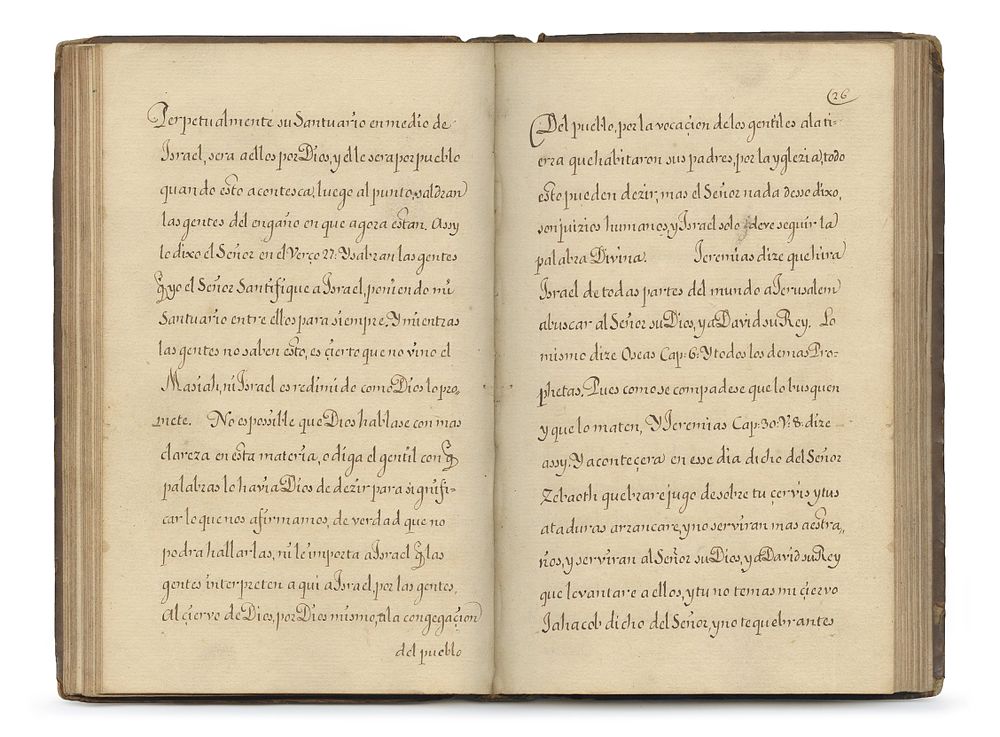
Manuscript, Polemical Work Defending Judaism by Yitzchak Orobio de Castro – Amsterdam, Early 18th Century – Copied by Calligrapher Michael Lopes Pinto - Manuscript volume, Repuesta A un tratado, que un Predicante Frances, prezento al Dor. Orobio, contra la observancia de la Divina Ley de Mosseh, al qual le respondio como sigue [Response to a tract presented to Dr. Orobio by a French preacher, against the observance of the divine law of Moses, to which he responded as follows]. [Amsterdam, ca. early 18th century]. Spanish; cursive script. Polemical work defending Judaism, by physician and philosopher Yitzchak (Balthazar) Orobio de Castro (1617-1687), a prominent figure in the Marrano Spanish-Portuguese community in Amsterdam. Orobio, born in Portugal to a Marrano family, was arrested and tortured by the Spanish Inquisition; after he was freed, he fled first to France and later to Amsterdam, where he openly returned to Judaism. He was a leader of the city's Spanish-Portuguese community, gained renown as a prominent defender of traditional Judaism against Christian theologians, and polemicized with such thinkers as Baruch Spinoza and Juan de Prado. The present work was written ca. 1670, in response to an anti-Jewish work by a Protestant French preacher (probably a Huguenot), who attempted to demonstrate the truth of Christianity from Scripture. The work is divided into two parts: in the first part, the author dismisses the concept of original sin, highlighting the principle of free will and the ability to repent and return to the Creator directly. The second part (beginning on leaf 30, under the title ”Segunda Parte”) is dedicated to the Biblical prophecy polemic, refuting familiar Christian interpretations, polemicizing against Paul's conception of circumcision in his epistles and Church Fathers' interpretations. Orobio's polemical works were not published in his lifetime for fear of provoking government and church authorities in the Netherlands, and were distributed secretly and copied in manuscript only (other copies of this work are held today in the Ets Haim library in Amsterdam, as well as the National Library of Spain in Madrid). This work was first printed by the scholar Moisés Bensabat Amzalak from the present manuscript, under the title La observancia de la Divina Ley de Mosseh, in 1925, in Coimbra, Portugal (a facsimile from this manuscript is included in Amzalak's book). At the beginning of the volume is an illustrated copper engraving by French-Dutch artist Bernard Picart, signed and dated 1712 (at the top is a blank cartouche originally meant to be filled in with printing details). On the last page is a calligraphic signature (monogram) of the copyist Michael (son of David) Lopes Pinto (ca. 1666-1743), one of the most prominent calligraphers and scribes in the Sephardic-Portuguese community in Amsterdam in the first half of the 18th century (see an identical signature in Lot 89). [1], 69 leaves. Approx. 19 cm. Good condition. Light stains and defects. Minor marginal tears to several leaves. Inscriptions on endpaper. Bookplate. Original leather binding, with gilt inscriptions on spine, slightly worn at edges. Paper sticker on binding. References: 1. Moisés Bensabat Amzalak, La observancia de la Divina Ley de Mosse, Coimbra, 1925. 2. Yosef Kaplan, From Christianity to Judaism: The Life and Work of Isaac Orobio de Castro, Jerusalem, 1982 (Hebrew). 3. H. Brugmans & A. Frank, Geschiedenis der Joden in Nederland, Amsterdam, 1940, p. 704. 4. L. Fuks & R. G. Fuks-Mansfeld, Catalogue of the Manuscripts of Ets Haim, Leiden, 1975, pp. 96-97. Provenance: Collection of Mozes Heiman Gans.