Bidspirit auction | Manuscript, Statutes of the Ashkenazic
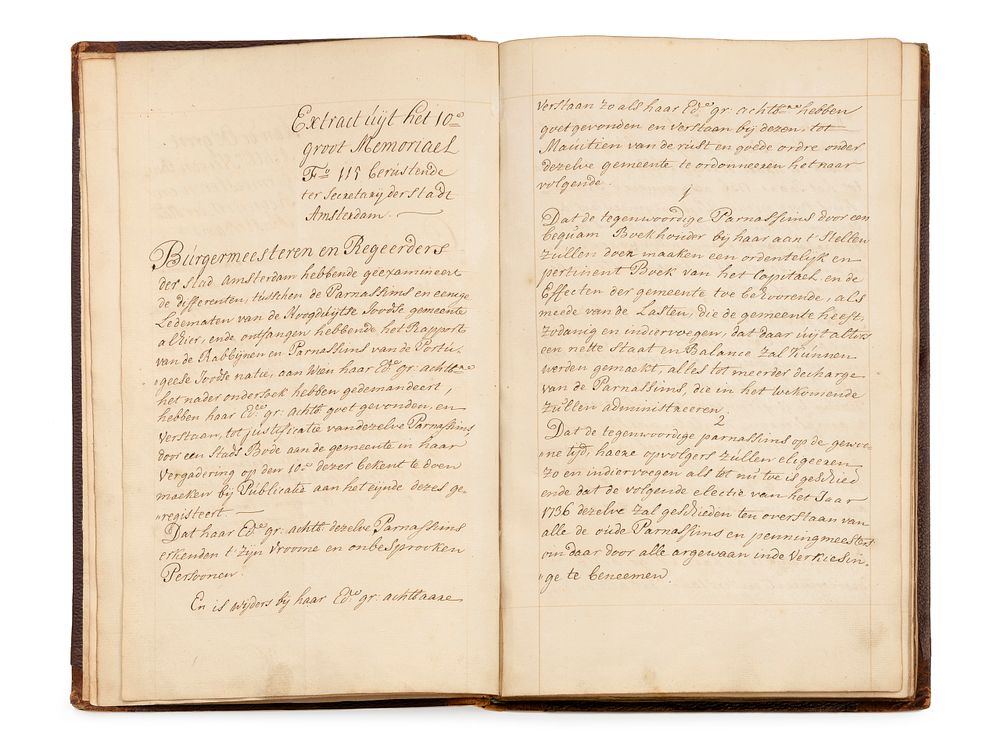
Manuscript, Statutes of the Ashkenazic Community in Amsterdam – 1735-1752 – Official Version Certified by Amsterdam City Council and Signed by City Notary - Manuscript volume, official certified version of statutes of the Ashkenazic community in Amsterdam, [1735-1752]. Dutch; cursive script. The manuscript documents the formulation, petition and formal certification of the Ashkenazic community's statutes in Amsterdam, from 1735 to 1752. This volume was evidently prepared and preserved in the community's archive, and was meant to serve as official legal evidence for the authorities, and as a basis for versions translated and printed for community members in Yiddish and Hebrew. This manuscript is of high historical import, as no other official documentation is extant that collects the entire body of statutes, petitions and certification by the authorities continuously up to 1752 (an anthology of statutes and ordinances up to 1737 only was printed in 1748). The tops of some of the leaves bear official relief stamps of the city of Amsterdam. Historical background In 1711, the first system of statutes of the Ashkenazic community in Amsterdam was printed. As a result of various disputes surrounding the process of electing community leaders, and likely also the controversy surrounding the appointment of R. Elazar Rokeach, author of Maaseh Rokeach, as Rabbi of Amsterdam in 1735, the city authorities repeatedly requested the community leaders submit an updated set of statutes for approval by the city council (as the present manuscript documents in a certification dated 10 June 1735). The volume begins with copyings of documents granting the statutes their legal force. First appears an official certification of the statutes by the mayors and city council of Amsterdam (dated 12 April 1737), followed by an announcement by the community leaders of the approval of the new statutes by majority vote in an official conference. Next is a copying of the decision from the city's ”Great Memorandum” (Groot Memoriael; dated 10 June 1735), describing the internal disagreements in the Ashkenazic community. As a result of these disagreements, and following a report received from the rabbis and community leaders of the city's Sephardic-Portuguese community, the Ashkenazic community was obliged to rewrite its statutes. The margins note that this decision was publicly announced in the Ashkenazic synagogue in Amsterdam on Friday, 10 June 1735. The main part of the present manuscript (approx. 60 leaves) comprises 102 community statutes. These cover the full range of topics relating to community life and synagogue conduct: order of prayers on weekdays, Shabbat and festivals, honors and aliyot, prayer rites and various customs, circumcisions, weddings and special occasions, visiting the sick, burial and Chevra Kadisha, and more; as well as the authority and duties of the community's officials, rabbis and leaders, election processes and their dates, supervision of community institutions, payment and management of taxes, support for the needy and widows, and the relation between the community and the local authorities (the statutes were translated and printed [in Yiddish and Hebrew] by Avraham Athias in Amsterdam, [1737]). Following these is a protocol from a gathering of community leaders certifying the statutes, with a list of the names of twenty officials present at the gathering (the name of the official ”Eizik son of R. Moshe Waag” is written in Hebrew); this is followed by an official certification of the city council, dated 11 October 1737, and the signature of the city's notary, ”A. Roermond”, dated 2 June 1744. The last twenty leaves of the volume comprise appeals and new statutes formulated by the community leaders up to 1752, which were certified by Amsterdam's authorities. These appendices reveal the social and economic challenges faced by community leaders, documenting such issues as a years-long legal battle between officials and tax evaders; a copying of a legal settlement dated 1703, securing a settlement of debts from 1650 (for the purpose of building a synagogue) by a communal monopoly on seating; a 1743 statute levying fines for immersing in a private mikveh; a series of statutes from 1747 restricting the duration and manner of celebrating weddings; sanctions placed on debtors whose heirs do not pay their debts to the community treasury; strict rules from 1751 aimed at suppressing fornication and illegitimate childbearing, including revocation of community membership and synagogue honors and hefty fines. The documents also include the names of officials who certified the statutes, and are officially confirmed with the signatures of notaries and city officials; the latest certification, at the volume's end, is dated 1 October 1752, signed by the official ”Jacobus van de Poll”. [84] leaves (+ 37 blank leaves at end of volume). 31 cm. Good condition. Light stains. Inscriptions dated 1822,