Bidspirit auction | Decorated Parchment Manuscript – Order
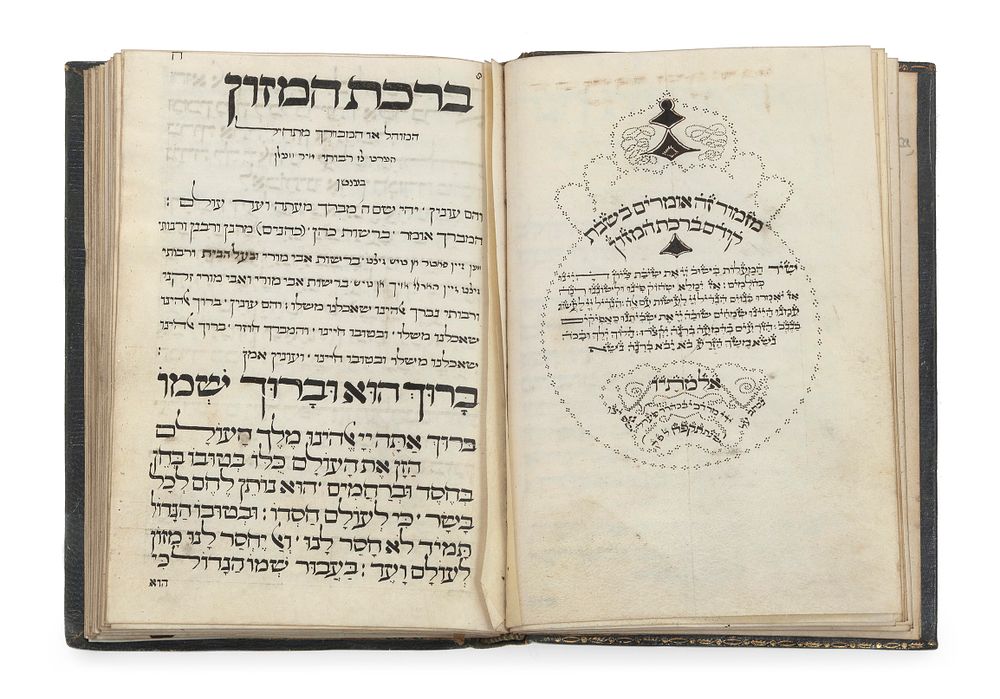
Decorated Parchment Manuscript – Order of Circumcision with Mohel Ledger – Amsterdam, 1828 - Parchment manuscript, order of circumcision with mohel ledger, belonging to the mohel R. Yissachar Perel Stokvis. [Amsterdam], 1828. Calligraphic square script, vocalized. The instructions (in Yiddish) are written in Ashkenazic semi-cursive script. Decorations in several places. The first volume begins with the order of circumcision, with verses and prayers: verses from the Song of the Sea, prayer for the mohel, verses and blessings over the circumcision and prayer following the circumcision. These are followed (p. 6b) by an order of circumcision for a convert, followed by Birkat HaMazon. Before Birkat HaMazon, Shir HaMaalot is written in a decorated frame, with the scribe's colophon: ”Written by Mordechai son of R. Perel S[tok]v[is], 1828”. The second part of the volume comprises a ledger of the mohel R. Yissachar Perel Stokvis, father of the manuscript's scribe. The present manuscript is effectively a fine copying of selected inscriptions, arranged topically (see below), from a mohel ledger that contained over 3,000 inscriptions on circumcisions the mohel performed in Amsterdam and other cities in the Netherlands, from 1794-1833. A corresponding mohel ledger, comprising all circumcision inscriptions, is presently part of the David Jeselsohn collection (Ms. 7), formerly part of the Gans collection – the source of the present ledger. The Jeselsohn manuscript comprises a record of 3,114 circumcisions performed between 1794-1833, most of them up to the year 1802. The circumcisions at the beginning of the ledger were mostly performed in Leiden, while some were performed in other communities in the Netherlands; afterwards, most circumcisions were performed in Amsterdam. The ledger begins with an illustrated title page with the mohel's details. Some of the circumcision inscriptions mention his name as well (for instance, after circumcision no. 2190, when the number of his circumcisions reached the numerical value of his name, 2190). The present ledger is a selective copying of some circumcision inscriptions between 1802-1830. It begins with an introductory page (bordered), on the inscriptions of ”the children G-d granted me to introduce to the covenant of Abraham…”. This is followed by four sets of written leaves (including blank pages), each of which contains several circumcision inscriptions within the ledger. The circumcisions are inscribed in collections, in topical order. The first collection (leaves 15-17) – circumcisions performed on Rosh Hashanah, from 1803-1827. Second collection (leaves 24-30) – circumcisions performed for adults, generally converts (but also for those who were not previously circumcised due to other circumstances), from 1803-1830. Third collection (leaves 39-40) – inscriptions of circumcisions also naming the sandak (perhaps an assistant in the circumcision), from 1804-1821. Fourth collection (leaves 49-50) – circumcisions performed on Yom Kippur, from 1805-1822. Each inscription contains its number in the present collection, as well as in the sequence of circumcisions performed by the mohel; thus, for instance, the first collection begins with the number in the collection (1), number in the sequence of the mohel's circumcisions (150), along with Hebrew date, name, location and secular date. Leaves 43-44 are dedicated to a lengthy, decorated inscription for the 3000th circumcision the mohel performed (the scribe emphasizes the words Yesh Sachar in the text, ”there is reward”, alluding to the mohel's name). This inscription appears in full and with a similar design in the Jeselsohn manuscript. The mohel's name is not written explicitly in the present manuscript (apart from the allusion in the words Yesh Sachar), but he may be identified by comparison to the above mohel ledger in the Jeselsohn collection. The details of the inscriptions in the present manuscript fully correspond to those in the Jeselsohn manuscript. The handwriting and decorations in the present manuscript are identical to the style and decorations in several leaves of the Jeselsohn manuscript, indicating that Jeselsohn's manuscript was at least partly written by the present manuscript's scribe – the aforementioned son of the mohel – Mordechai son of R. Yissachar Perel Stokvis. 1-6, 6-57 leaves (total of 50 written pages, and many blank leaves). 16 cm. Good condition. Stains. Fading of ink in several places. Gilt edges. Fine leather binding with gilt decorations. Provenance: Collection of Mozes Heiman Gans.