Bidspirit auction | Decorated and Hand-Painted Parchment Ketubah
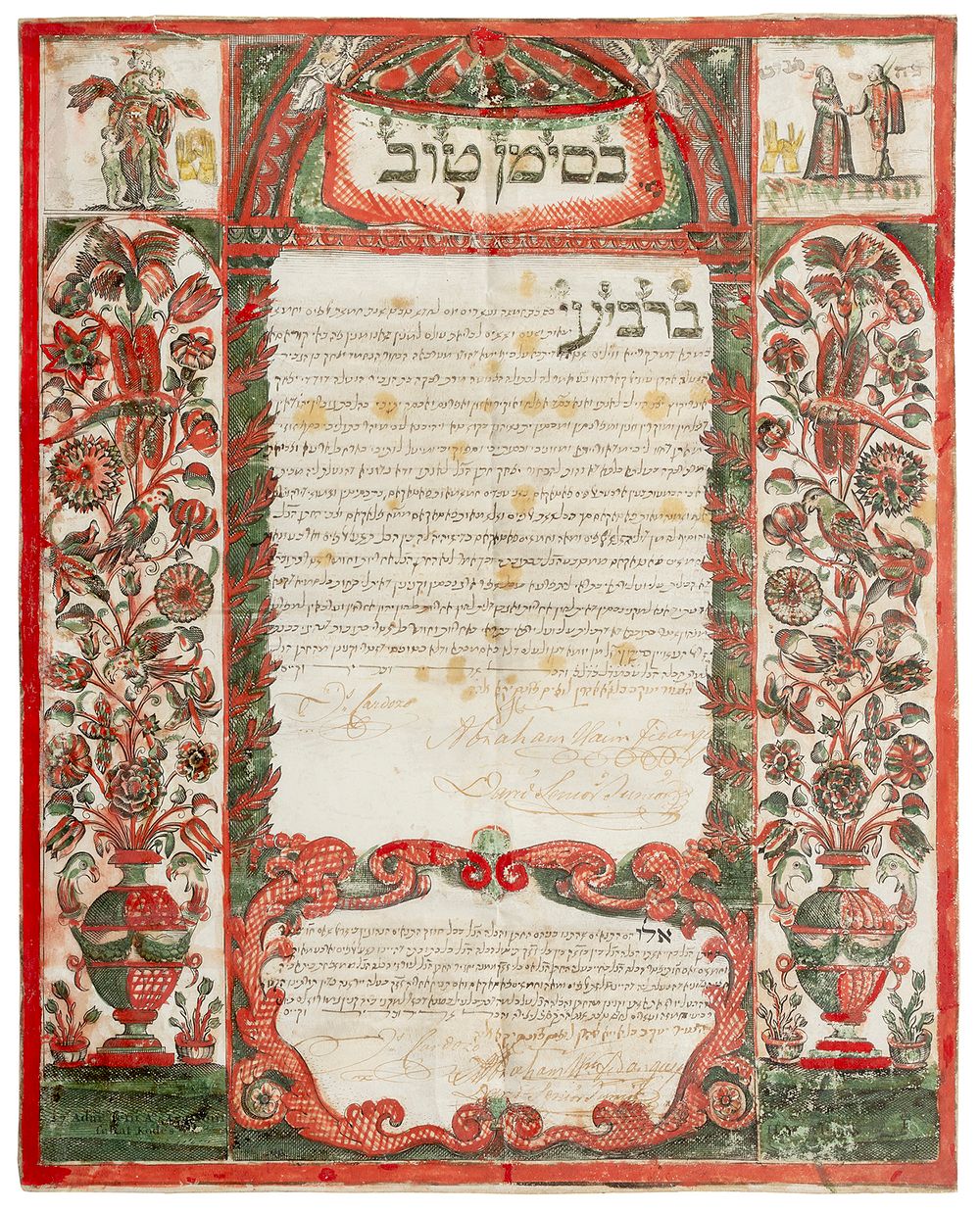
Decorated and Hand-Painted Parchment Ketubah – Willemstad, Curaçao, West Indies, 1801 – One of Only Extant Ketubot from Willemstad - Decorated parchment ketubah, for the wedding of Yitzchak son of Aharon Uziel Cardozo and Rivkah daughter of David de Yitzchak Enriquez. Willemstad, Curaçao, West Indies, 25th Tevet 5562 [30 December 1801]. Engraving, ink and paint on parchment. A rare ketubah of a couple descended from the Marranos of Spain and Portugal who immigrated to the Caribbean; one of the only extant ketubot from Willemstad and from Curaçao as a whole. The ketubah and Tenaim text are handwritten in Sephardic script. At the foot of the ketubah text are signatures of the witnesses: Yaakov son of Aharon Lopes Fonseca (signature in Hebrew) and Abraham Haim Fidanque and David Senior Junior (signatures in Latin characters), next to what appears to be the groom's signature (also signing in Latin characters). The dowry listed in the ketubah also includes ”two slaves”. This ketubah was written in a format used by the exiles from Spain and Portugal in the Netherlands (and its colonies) from the 17th to 19th centuries, decorated with an engraving inspired by ketubot produced by the artist and engraver Salom Italia in Amsterdam in the mid-17th century. It is hand-colored in bright red and green, and two allegorical illustrations printed in upper margins flank hands delivering the priestly blessing, colored yellow, along with a verse relating to the priestly blessing (Bamidbar 6:23). The bottom margins feature two printed inscriptions in Latin characters, as part of the engraving: to the left: ”27 Adar Seni A° 5453 Yom Sabat Kodes”, and to the right: ”H. Y. Aboab”, the name and date of death of the Amsterdam community's esteemed R. Yitzchak Aboab (de Fonseca, the third). The Jewish community in Curaçao was established in the 17th century by descendants of the Marranos of Portugal and Spain who reached it through Amsterdam. Most of the Jews of Curaçao lived in Willemstad, where the Mikvé Israel-Emanuel community was founded in 1651, and later established a synagogue – with an identical name – that was finally constructed in 1732. This synagogue is regarded as the earliest active synagogue in the Americas. 33X41 cm. Fair-good condition. Folding marks. Stains, some dark, over text. Fading and peeling of paint, slightly affecting decorations. Remains of glue to verso. The present ketubah formerly belonged to the collection of Mozes Heiman Gans (1917-1987), Amsterdam, from which a digitized version was made available on the NLI ketubah site, listing 990052916130205171. To the best of our knowledge, only one other ketubah from Curaçao is documented, in the Mikvé Israel-Emanuel collection in Curaçao.