Bidspirit auction | Handwritten Royal Decree – Joanna
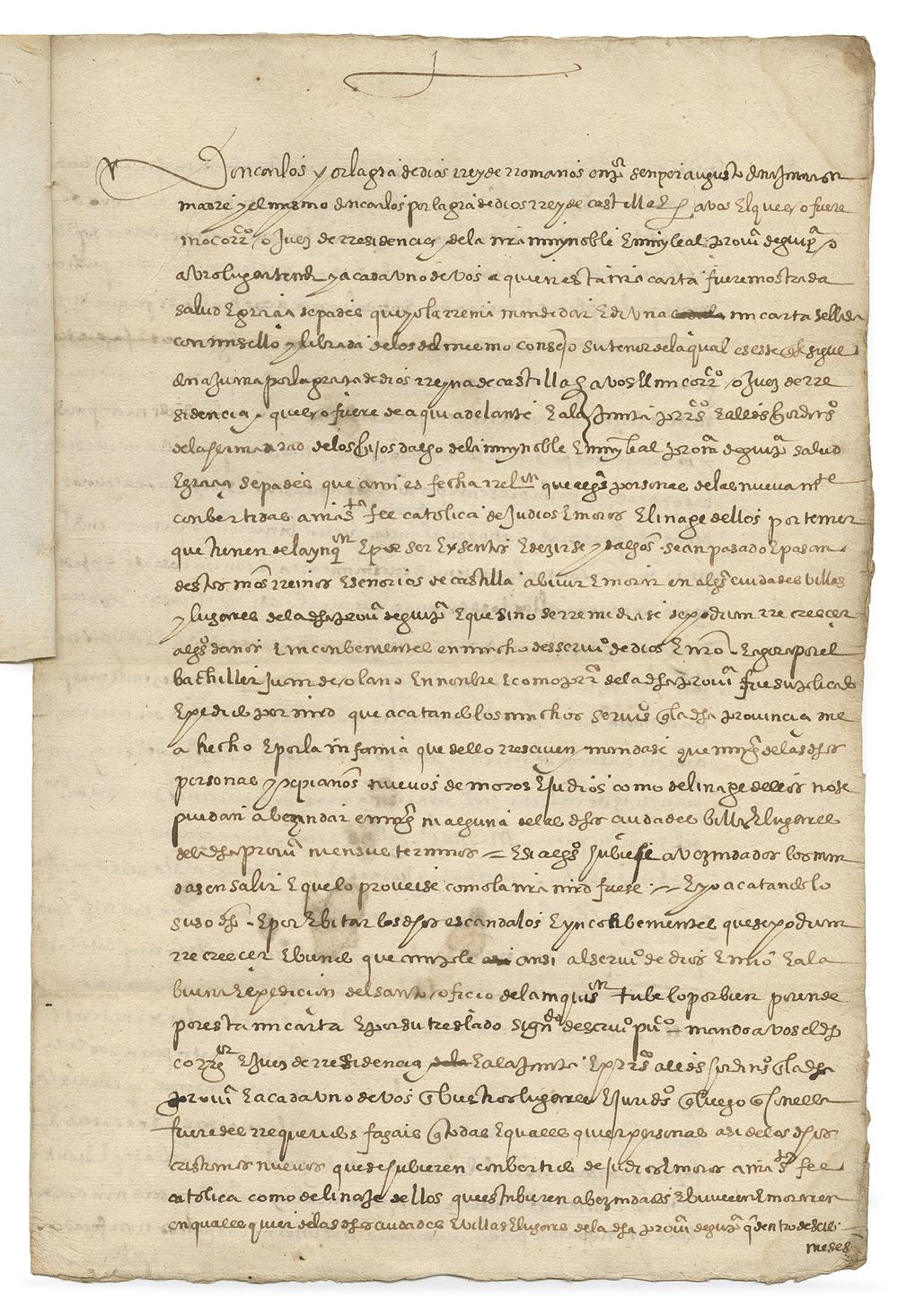
Handwritten Royal Decree – Joanna the Mad and Her Son Charles V – Spain, 1590 – Expulsion of New Christians from Gipuzkoa, Basque Country - Handwritten document, official notarized copy (traslado) made in 1590 of a royal decree issued by Queen Joanna I (”the Mad”) in Madrid on 24 December 1510, and another confirmatory decree issued by Joanna and her son Charles V in Valladolid on 12 July 1527. The decrees forbid New Christians of Jewish and Muslim origin, as well as their descendants, from settling in the Gipuzkoa province of Basque Country, and expelling those who had already settled there. San Sebastián, capital of Gipuzkoa, 7 April 1590. Old Spanish (cursive script). The document begins with the 1527 decree issued in Valladolid by Queen Joanna I and her son Charles V. This decree grants renewed legal force to the original decree of December 1510, which is copied in full within the document. In the original 1510 decree, Queen Joanna writes that it had been brought to her attention that the so-called New Christians – Jews and Muslims who had converted to Christianity and their descendants – were moving to settle in the Gipuzkoa province in order to escape the Inquisition and to achieve the noble hidalgo status granted to all the province's residents. At the request of local representatives, concerned for their ”purity of blood”, the Queen decrees that all New Christians who had already settled in the province should be expelled within six months, and forbids the descendants of Jews and Muslims to settle there in the future. The authorities are instructed to publicize the decree, to prevent the expelled from taking refuge and to confiscate the property of anyone violating the decree. In 1527, after a further appeal by the province's representatives, Joanna and Charles V reinforced the decree, ordering the local authorities to enforce it meticulously and without exception. The present copy was made in San Sebastián in April 1590, at the request of the chief representative of the Gipuzkoa province. The third page features the certification and signature of the royal public notary Joan López de Tapia, attesting that the copy fully conforms to the original. The verso of the last page features a short handwritten archival inscription, noting that this is a 1527 decree expelling New Christians of Jewish or Muslim origin from Gipuzkoa. A handwritten note sewn to the upper margins of the first page (probably later) summarizes the content of the document. The Gipuzkoa (Guipúzcoa) province was characterized by its unique sociolegal status of universal nobility (hidalguía universal), which accorded nobility to all residents of the region upon birth. With the intensification of Inquisition activities, New Christians began to immigrate to Basque Country in order to evade persecution and enjoy augmented legal rights. This immigration was sharply opposed by the locals, who sought to preserve their ”purity of blood” as Old Christians and were concerned with the degradation of their status and nobility. Furthermore, the New Christians were then stereotyped as cowardly and weak, and the Basques worried that mixed marriages would weaken their ”natural courage”, which was a vital line of military defense for the Spanish kingdom. The present orders of expulsion set the groundwork for discrimination against conversos in Basque Country. As a result, new residents were obligated to undergo careful ”genealogical investigations” as a condition of residency, and conversos and their descendants were excluded from public stations and rights of citizenship. These decrees set a legal precedent relied upon by government authorities for centuries, until the regional privileges (fueros) were abolished in 1876. [4] pages (double leaf). 30 cm. + [1] leaf (sewn on). 15 cm. Overall good condition. Stains, creases and folding marks. Light wear to margins.