Bidspirit auction | Pope Pius IV – Three
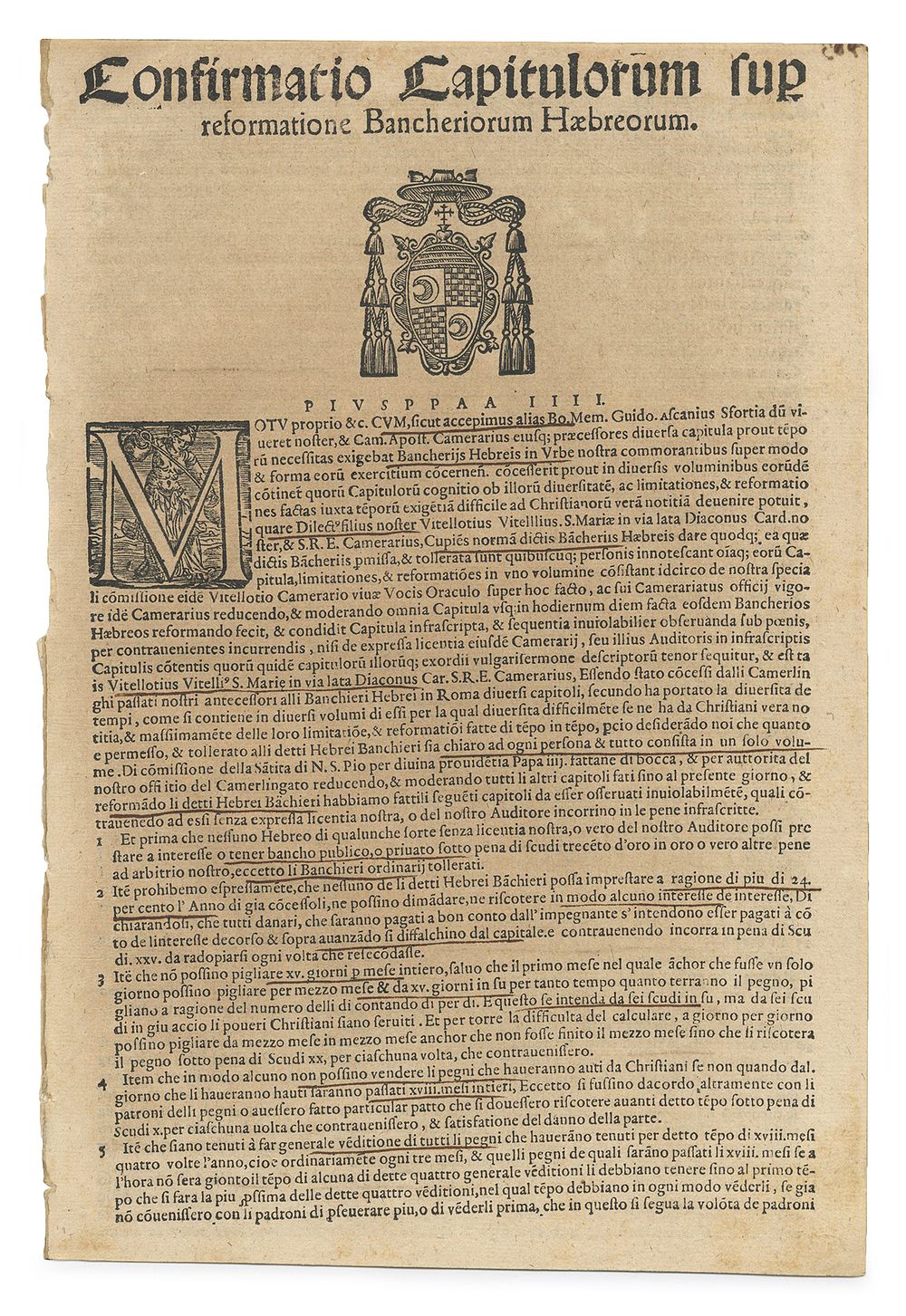
Pope Pius IV – Three Papal Documents Pertaining to the Jews – Rome, 1560-1565 - Three papal documents pertaining to the Jews of Rome: 1. Facultates, ac privilegia Archiconfraternitatis Monasterii Beatae Mariae Virginis Annuntiatae, & hospitalis Catechumenorum de Vrbe. Rome, 23 January 1560. Latin. Privilege of Pope Pius IV for the Archconfraternity of the Monastery of the Blessed Virgin Mary and the Hospital of the Catechumens of Rome. The document affirms and sets out the legal and economic status of the institution based on earlier decrees (by Popes Paul III, Julius III and Paul IV). Among other things, the document levies a special tax on the synagogues to fund the institution's activities, declaring that each Jewish community shall be permitted only one synagogue within the city, but in tandem, would be required to pay the special tax for previously active synagogues in the city that were destroyed. The document mentions apostate Jew Iacobo Giraldino, whom scholarship identifies as the first censor of Jewish books active in all the Papal States from ca. 1555 (see: A. M. Habermann, Censorship in Hebrew Books, Machanaim. CVI, 1966, pp. 52-57 [Hebrew]; and: Titolo: Tracing the Hebrew Book Collection of the Venice Ghetto, dissertation, Ca' Foscari University, Venice, 2017, p. 217). The document is dated 1560 in print at the bottom of the last page. [4] pages. 30 cm. 2. Breve S. D. N. D. Pij divina providentia Papae IIII. Super Haebreis, & eorum vivendi modo. Rome: Antonio Blado (apud Antonium Bladum impressorem cameralem), 8 August 1564. Latin. Official papal brief of Pope Pius IV, with print signature of secretary Caesar Glorierius (Cesare Glorieri). This document relieves to some extent the restrictions placed upon the Jews by the previous pope, Paul IV. These decrees were propagated after the publication of the infamous bull Cum nimis absurdum (14 July 1555), one of the consequences of which was the establishment of the Rome ghetto. Despite the leniencies, the ghettoization mandate remained in force and was moreover expanded by Pius IV to other cities. On the wrapper is the coat of arms of Pius IV (Giovanni Angelo Medici di Marignano, 1499-1565): the papal coat of arms with the Keys of Heaven and the Medici coat of arms. The original document was signed on 8 August 1561, in Pius IV's second year in office, and some of the copies note this at the bottom of the last page. The present document may be a later printing, with minor variants, dated at bottom of last page to 8 August 1564 (the text dating the document to the second year of the pope's rule – ”Pontificatus nostri anno secondo” – is unchanged in this printing). All copies known to us are dated 1564 on the title page. [4] pages, 30 cm. 3. Confirmatio Capitulorum supreformatione Bancheriorum Haebreorum. Rome, [ca. 1565]. Latin and Italian. Official act (motu proprio) of Pope Pius IV, with 36 regulations setting out the legal rights and obligations of Jewish bankers (Bancherijs Hebreis) active in Rome. The regulations were collected by Cardinal Vitellozzo Vitelli (1531-1568) following the decrees of the late Cardinal Guido Ascanio Sforza di Santa Fiora (1518-1564), which enabled Jewish bankers' activities in Rome due to extenuating circumstances, according to the document. The regulations include a prohibition against usury higher than 24% per annum (section 2), an obligation to manage accounts in Italian (section 10), a strict prohibition to receive Christian sacramental objects as collateral (section 17), permission to refrain from bank activity on the Jewish Sabbath and holidays (section 25), and more. At the top of the first page is the coat of arms of Cardinal Vitelli; the illustrated initial panel features a figure standing in a boiling vat, pouring water or wine from one jug to another, perhaps an allegorical depiction of temperance. At bottom of last page, the document is dated in print to the sixth year of Pius IV's reign, hence it was printed in 1565. [4] pages. 30 cm. Overall good condition. Light wear and defects. Minor tears and punctures to folds. Inscriptions and notations in ink (early). The three booklets were discernibly bound together at a previous point in time, but in the current collection they are separate.