Bidspirit auction | S.Y. Agnon – VeHayah HaAkob
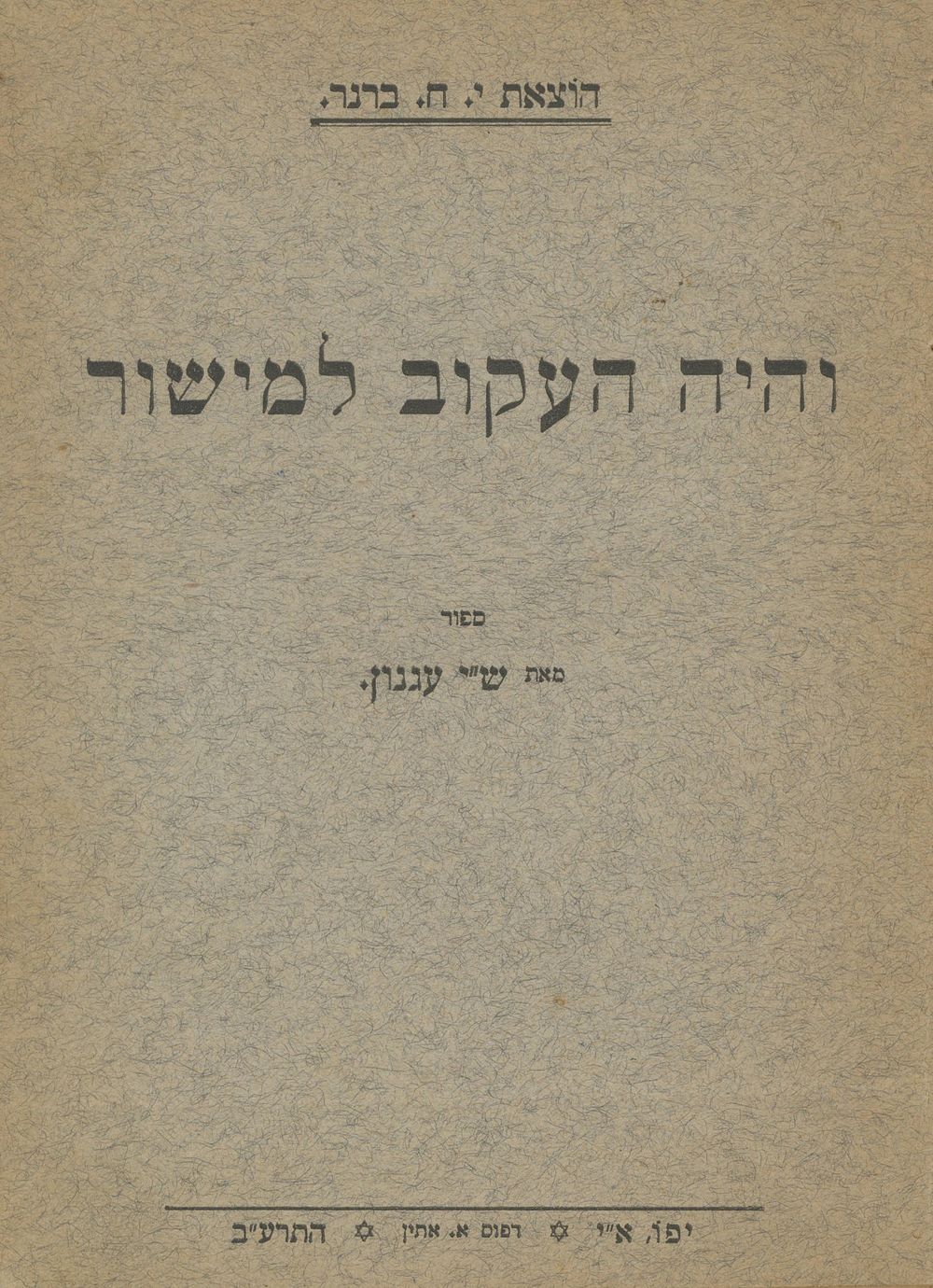
S.Y. Agnon – VeHayah HaAkob LeMishor, with Handwritten Dedication by Agnon – Published by Y.H. Brenner – Jaffa, 1912 - VeHayah HaAkob LeMishor [And the Crooked Shall Be Made Straight], by Shmuel Yosef Agnon. Jaffa: Yosef Haim Brenner, A. Itin Press, 1912. On verso of title page, dedication in Agnon 's fine square script: ”To R. Eliezer Meir Lipschütz, with respect and blessing, from me, the author”. The first book by S.Y. Agnon published in Palestine. The story was written in Neve Tzedek at the end of 1911 over the course of four days, and was first published serially in the newspaper HaPoel HaTzair. The recipient of the book, Eliezer Meir Lipschütz (or Lipschuetz; 1879-1946), rabbi and educator, was one of the leaders of the Mizrachi movement in Eretz Israel. Born in the town of Skole (Ско́ле; today in western Ukraine). In his youth he moved to nearby Lviv, where he studied under the city rabbi, R. Isaac Schmelkes, and under the Midrashic scholar Salomon Buber. Agnon first met Lipschütz while visiting Lviv, before his immigration to Eretz Israel. Lipschütz 's home was a meeting place for writers, scholars and Zionist activists, and Agnon, who became a frequent guest there, came into contact with key figures in the literary world of the time. In 1908, Agnon immigrated to Eretz Israel for the first time, bearing a letter of recommendation to Rabbi Binyamin (the writer Yehoshua Radler-Feldman), which he had received from Lipschütz (who himself immigrated to Eretz Israel about a year later). Agnon and Lipschütz maintained close and warm ties of friendship. In 1926, Lipschütz published an article on Agnon and his work in the journal HaShiloach (the article, in an expanded version, was published that same year in Berlin, by Moses Marx Press, and became the first complete book devoted to Agnon 's work). Agnon attached great importance to his friendship with Lipschütz, and regarded him as the person who convinced him to devote all his strength to the fulfillment of his literary vocation, as he later stated: ”…There was childishness in me and I occupied myself with many things. I was one of the young men of the Beit Midrash. In addition to that, a Zionist. I occupied myself with seventy-seven things… R. Eliezer Meir Lipschütz came and set me upon my foundation…” (S.Y. Agnon, ”Moreh VeChacham: Remarks Delivered on the Tenth Anniversary of the Passing of R. Eliezer Meir Lipschütz [Iyar 1955]”, ibid., pp. 197-198; Hebrew). On the Printing of VeHayah HaAkob LeMishor In an article entitled ”The Life and Death of Yosef Hayim Brenner”, Agnon writes about Brenner's efforts to fund the publication of ”VeHaya He-Akov LeMishor”: ”Finally, once he had finished printing the story, he realized he had miscalculated, and was short some four or five francs. And he had no desire to borrow again […] At the time I had finished my business in Jaffa… and had moved on to Jerusalem… I laid down my personal belongings in my room, and went to Brenner […] once we had eaten and drunk, he stood up and said ‘Let me show you around Jerusalem…' We walked for a while and spoke for a while, until he stopped and entered one of the shops next to Jaffa Gate and said, ‘Come with me.' I followed him in. He laid an item down in front of the shopkeeper and said ‘Forgive me sir, but I need to have those two bishliks back.' The shopkeeper shook his head and said ‘Some people never change' and returned his money. Why was it said ‘I need to have those two bishliks back, ' and why was it said ‘Some people never change'? Brenner would tighten his pants with a leather belt, and when the belt wore out, he eventually gave in and bought himself a pair of suspenders like your average person would do. But now that he was in need of four or five francs in order to publish a Hebrew book, he returned the suspenders to the shopkeeper, and went back to tightening his pants with that old, worn-out belt. I beg of you, who do you know who would neglect his own needs for the sake of someone else's book?” (S.Y. Agnon, ”Yosef Chaim Brenner in Life and in Death”, MeAtzmi El Atzmi, Jerusalem and Tel Aviv: Schocken, 1976, p. 132; Hebrew). [2] leaves, 3-64 pages, [1] leaf. Without back wrapper. 15.5 cm. Dry and somewhat brittle paper. Overall good condition. Stains. Minor tears. Several loose leaves (one leaf detached). Old cloth binding, worn (spine torn).