Bidspirit auction | Letter Signed by Haj Amin
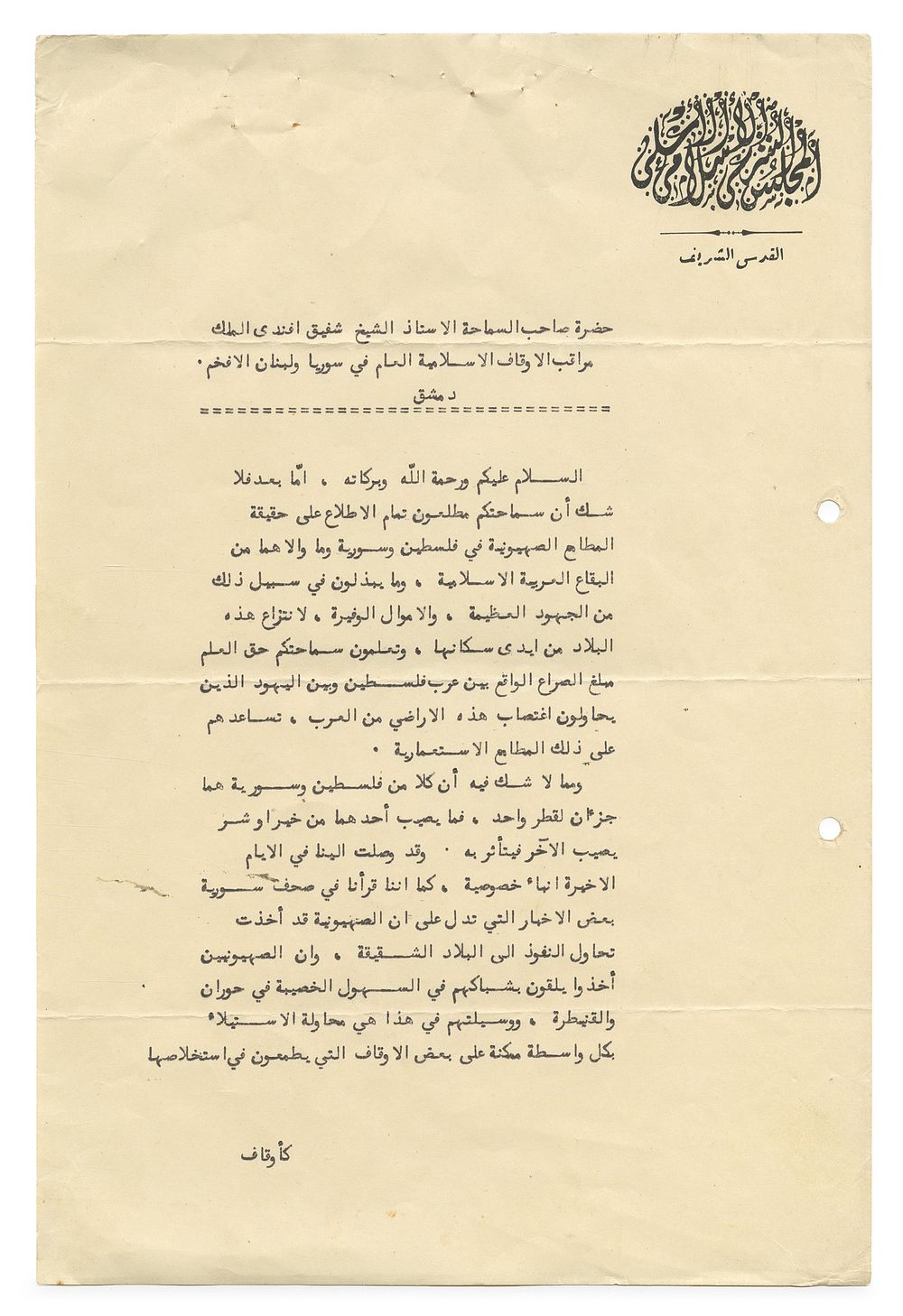
Letter Signed by Haj Amin al-Husseini – Jerusalem, 1929 - Letter of the Mufti of Jerusalem, Haj Amin al-Husseini, addressed to the General Inspector of Islamic Endowments in Syria and Lebanon, Shafiq Effendi al-Malik. Printed on official stationery, signed by Haj Amin-al-Husseini. 3rd Muharram, 1348 AH / 10 June [1]929, Jerusalem. Arabic. In the letter, Al-Husseini warns the recipient of Zionist territorial aspirations in Palestine, Syria and other regions. He underlines the tight connection between Palestine and Syria, arguing that damage to one will affect the other. The letter expresses special concern over the attempts of Zionist organizations to purchase or take over waqf lands in the Hauran and Quneitra regions. Al-Husseini implores Al-Malik to make use of his status in order to protect the Islamic waqf in Syria, in order to stay the spread of Zionist influence to that region. 2 pages. 31.5 cm. Good condition. Light stains and creases. Minute punctures to tops of leaves. Filing holes. Folding marks across width of leaves. Haj Muhammad Amin al-Husseini (1895-1974) served as the Mufti of Jerusalem during the British Mandate period, in the years 1921-1937, and as president of the Supreme Muslim Council. Al-Husseini was known as one of the most important and influential leaders of the Palestinian Arabs and the Palestinian national movement. Al-Husseini was born in Jerusalem to an eminent and well-established Palestinian-Arab family, many of whose members served in religious and political leadership roles. Al-Husseini studied in Jerusalem, Cairo and Istanbul, and with the outbreak of World War I was drafted to the Ottoman army. After his military service he returned to Jerusalem, where, among other activities, he recruited volunteers for the Arab Revolt against the Ottoman Empire (1916-1918). Al-Husseini was a member of a number of Arab organizations and clubs with nationalist leanings. As part of his activities in these organizations, he was among the chief instigators of the 1920 riots, occurring in Jerusalem during the Nabi Musa festival. As a result he gained fame among the Arab public. In the aftermath of the riots, the British authorities issued an arrest warrant for al-Husseini and Aref al-Aref (a journalist who participated in the incitement leading up to the riots), and the two fled to the Transjordan. They were sentenced in absentia to ten years of imprisonment, but in the same year were pardoned by British High Commissioner Herbert Samuel (following appeals by a number of sheikhs and dignitaries from the Transjordan). In 1921 al-Husseini was appointed Mufti of Jerusalem, and later chosen to serve as president of the Supreme Muslim Council. In these roles he acted against Jewish settlement of Palestine and in favor of Palestinian nationalism, contributing, among other things, to the 1929 Riots and the 1936-1939 Arab Revolt (al-Husseini was one of the initiators and organizers of the revolt, and the chairman of the Arab Higher Committee). In 1937, after the British outlawed the Arab Higher Committee and dissolved the Supreme Muslim Council, al-Husseini fled to Lebanon, where he stayed for about two years before moving to Iraq. In Iraq he joined the politician Rashid Ali al-Gaylani and contributed significantly to the planning and organization of the revolt led by al-Gaylani in 1941. Following the revolt, al-Gaylani established a pro-Nazi government that demanded the expulsion of the British from Iraq, but his government did not last for long, and with the collapse of the coup, al-Husseini and al-Gaylani left Iraq. Al-Husseini first traveled to Fascist Italy (where he even met Mussolini), then to Nazi Germany. Al-Gaylani also arrived in Germany. Haj Amin al-Husseini's ties with the Nazis, initiated before he had arrived in Germany, grew closer during his stay there: he had contacts with the German Foreign Ministry, with the upper echelons of the S.S. and the Gestapo, and even met with Adolf Hitler (their first meeting was in November 1941). One of al-Husseini's goals was to secure a joint German-Italian declaration recognizing the independence and unity of the Arab states, and the right of these states to act against the establishment of a national home for the Jews in Palestine. One of his major contributions to the German war effort as part of his activities in favor of the Axis Powers was the recruitment of fighters to the 13th Waffen Mountain Division of the SS (13. Waffen-Gebirgs-Division der SS) in 1943. This division, called Handschar, was established by the Germans in the region of Croatia under the rule of the pro-Nazi Ustase Party (which then included Bosnia and Herzegovina). Most of the recruits were from the Muslim population of Bosnia and Herzegovina, and the recruitment was carried out with the encouragement of al-Husseini, who was sent there especially by the German authorities. In addition,